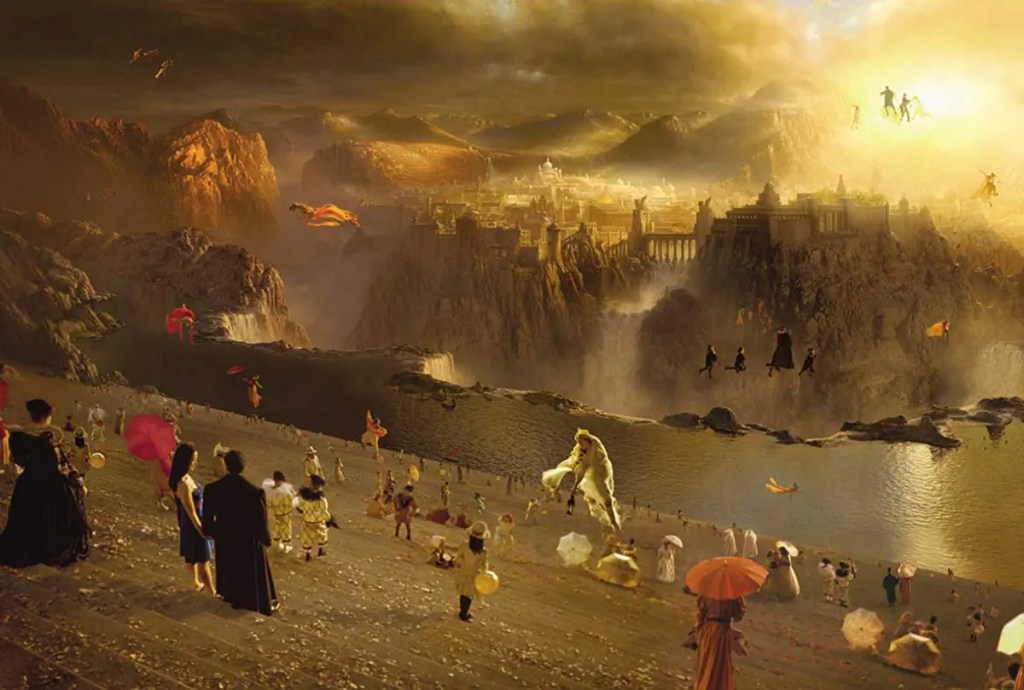
Emanuel Swedenborg and Near-Death Experiences (NDEs)
This article is the result of AI search engine reports integrated and edited with the benefit of my prior study of the subjects covered.
Post outline
- Emanuel Swedenborg and Heaven
- Modern Near-Death Experiences (NDEs)
- Swedenborg and modern NDEs
- Spiritual being influence on human consciousness
- Extraterrestrial beings in Heaven
- Resources
1. Emanuel Swedenborg and Heaven
The 18th-century scientist turned theologian Emanuel Swedenborg (1688-1772) visited heaven and hell regularly over 27 years through conscious spiritual journeys. His most famous work, Heaven and Hell (1758), contains detailed observations:
- Physical reality. Heaven is not ethereal; angels live active lives with spiritual bodies — they sleep, eat, work, play, breathe, and converse in real communities
- Organization. Heaven consists of thousands of “societies” organized by shared loves and affections. People join communities matching their interior nature. Access to heaven depends on inner nature/love, not ethnicity, nationality, or religious affiliation.
- Correspondence. Material things correspond to spiritual realities (light represents wisdom, heat represents love)
- Time and space. Exist in heaven but operate differently — measured by states of consciousness rather than mechanical time
- The intermediate state. Newly deceased enter the “world of spirits” (between heaven and hell) for preparation before joining their proper heaven or hell
- Angels. Were once human beings who lived virtuous lives on earth; they are not special creations
- Divine nature. God is love itself; He casts no one into hell. Hell emerges from union with evil/false within oneself
More specifically, according to Emanuel Swedenborg, this humanesque afterlife involves these features:
- The law of state. Swedenborg observed that space and time do not exist in heaven. Instead, distance is determined entirely by an “inner change of state”. If you feel a deep, loving connection to a soul or community, you instantly appear with them.
- The three heavens. He described heaven as three tiered kingdoms — Celestial (highest), Spiritual (middle), and Natural (lowest).
- A familiar, ordered world. To his surprise, Swedenborg saw that heaven mirrors Earth but is vastly more beautiful. Angels live in houses, gather in societies, wear clothing, and marry life-partners who share their exact spiritual frequency.
- The “Ruling Love”. After death, souls are drawn to the community that perfectly matches their true character. You cannot fake your intentions, as the light of heaven exposes a soul’s complete inner honesty. Those driven by love for others ascend naturally; those driven by absolute selfishness sink away.
2. Modern Near-Death Experiences (NDEs)
Research shows consistent patterns across cultures and eras:
Common Elements
- Inner peace and absence of pain
- Out-of-body experience: viewing of physical surroundings
- Traveling through tunnel or darkness
- Encountering deceased relatives and sometimes spiritual figures
- Life review with non-judgmental awareness
- Beautiful landscape: gardens, cities of gold, overwhelming light
- Feeling of unconditional love and acceptance
- Reluctance to return to physical body
- Transformed outlook afterward (less fear of death, more compassion)
Consistent Details
- Everyone appears middle-aged and in perfect health
- Blind-from-birth individuals report accurate visual details during NDEs
- Pattern remains consistent across age, education, geography, and cultural background
While details vary dramatically, common threads emerge: love as the fundamental quality, transformation of self, and connection with something greater than individual consciousness.
3. Swedenborg and modern NDEs
Emanuel Swedenborg’s 18th-century visions share an extraordinary, documented baseline with modern near-death experiences (NDEs). In fact, Dr. Raymond Moody, who coined the term “near-death experience” in his 1975 bestseller Life after life, explicitly dedicated a section of his book to Swedenborg, noting that the historical mystic’s accounts match modern clinical reports almost perfectly. When researchers apply the modern Greyson NDE Scale to Swedenborg’s journals, his experiences reliably cross the threshold to be classified as NDEs.
A detailed comparison between Emanuel Swedenborg’s 18th-century descriptions and modern near-death experience reports shows the striking similarities:
- Real-world appearance
Swedenborg. Heaven is tangible; angels have bodies, sleep, eat, work
Modern NDEs. Many report physical landscapes, gardens, cities - Disembodied state initially
Swedenborg. Arrive in “world of spirits” first before final destination
Modern NDEs. Out-of-body experience at start of NDE - Functional body
Both Swedenborg and NDErs report that the soul retains a functional body. Swedenborg stated that your spiritual body looks like your earthly body but is entirely free of illnesses, disabilities, or physical age limitations. - Meeting loved ones
Swedenborg. Spirits greet deceased relatives
Modern NDEs. ~80% report meeting deceased family members - Light encounters
Swedenborg. Heavenly light represents wisdom/divinity
Modern NDEs. Overwhelming beautiful light in ~70% of cases - Life review
Swedenborg. Spirits reflect on earthly life
Modern NDEs. Detailed life review common (~60%) and a hallmark of modern NDEs where individuals relive their actions. As Swedenborg wrote, everything a person has ever thought, said, or done is perfectly recorded. During this process, you do not just recall your memories; you actively feel the exact emotional impact your actions had on others. - Boundary/choice
Swedenborg. Cannot stay if not aligned with heaven’s nature
Modern NDEs. Often told “not your time” or choose to return - Post-experience transformation
Both Swedenborg and NDE survivors report profound and lasting changes in values, reduced fear of death, increased compassion, e.g. Swedenborg became a theological writer, NDE survivors often become counselors or advocates. - Cultural independence
Despite different eras, core elements of reports by Swedenborg and NDErs are similar, including the experiences of a Swedish mystic in Protestant Europe, a Buddhist monk, an American surgeon, an Iranian woman. - Not “dream-like”
Both Swedenborg and NDErs describe vivid, hyper-real experiences more concrete than dreams. Swedenborg distinguished them clearly from visions or imagination. - Reluctance to return
Swedenborg observed that spirits are reluctant to return to this world. Similarly, across NDE studies it is commonly found that spirits are reluctant to return to this realm. - Environment shaped by inner state
Swedenborg noted that heaven is shaped by inner state. Similarly, NDE reports describe life after death as loving, not punitive. - Afterlife communities
Both Swedenborg and NDErs report general feelings of “being home” with soul groups; rigidly categorized cities and angelic societies matching specific human professions.
Summary of Swedenborg and modern NDEs
Despite separation by 250+ years and vastly different contexts, Swedenborg’s accounts and modern NDEs converge on:
- Survival of consciousness after clinical death
- Preservation of identity and memory
- Encounter with loved ones who died previously
- Overwhelming sense of love/light
- Transformative aftermath reducing death anxiety
- Non-judgmental atmosphere (especially NDEs; Swedenborg emphasized moral self-selection)
For serious researchers, Swedenborg offers the most detailed single-person account ever published; modern NDEs provide larger-scale statistical patterns across cultures. Together they form complementary (not contradictory) data points about consciousness beyond ordinary waking experience.
4. Spiritual being influence on human consciousness
Based on Swedenborg’s extensive theological writings (primarily Arcana Coelestia, Heaven and Hell, and Divine Love and Wisdom), here is how he described spiritual beings’ influence on human consciousness and archetypal forms.
4.1 Spiritual influx: The core mechanism
Swedenborg’s most important concept regarding spiritual influence is “influx” — the constant flow of life, thought, and affection from the spiritual realm into human consciousness.
Continuous flow. We could not survive for a moment if the influx from God through heaven were not continuous.
Dual channels. Both heaven (angels) and hell (evil spirits) influence us constantly throughout life
Thought origin. Our thoughts do not originate within us; instead, they flow from the spiritual world — both from heaven and from hell.
Free will preservation. Humans must freely choose whether to accept good truths or reject them –forced influx would destroy freedom.
4.2 How Angels communicate with human minds
Communication method
- Telepathic. The language of thought.
- Non-verbal. Direct communication to human consciousness.
- Emotional-Affective. States of love/wisdom conveyed rather than propositional statements.
Location-based reception
- Angels near the head communicate wisdom/thought.
- Angels near the heart/chest communicate love/affects.
- Different angelic societies correspond to different cognitive/emotional faculties.
Swedenborg claimed he could consciously distinguish heavenly thoughts from his own:
- Heavenly influence. Gentle, patient, loving, hopeful, accepting
- Hellish influence. Urgent, harsh, demanding, judgmental, energy-draining
4.3 Correspondence theory as archetype system
Swedenborg’s doctrine of correspondences is essentially an archetype framework linking physical reality to spiritual meaning.
Three-level structure
- Natural/Physical. Observable material world, e.g. light, fire, water, plants
- Spiritual. Realm of angels and souls, e.g. wisdom, love, purification, growth
- Divine. Source in God’s nature, e.g. Divine truth, Divine love, Divine order
Key archetypal correspondences
- Light means Divine wisdom/truth; of God’s intellectual nature
- Heat/Fire means Divine love/charity; of God’s affective nature
- Water means Truth, cleansing error; of Spiritual purification
- Food means Knowledge, nourishing mind; of Learning and understanding
- Sun means God as source; of Divine love and wisdom combined
- Human form means God’s image; of Perfect embodiment of love/wisdom
4.4 Heaven as “Grand Man” (Divine Anthropos)
One of Swedenborg’s most striking archetypal claims:
Heaven’s collective form
- The entire heaven reflects a single Divine Man (Maximus Homo)
- Each angelic society corresponds to a specific organ/province of this spiritual body
- Every human being mirrors this structure microcosmically
Implication for human consciousness
- Our minds are structured according to heavenly architecture
- The human body is designed to receive spiritual influx from heaven’s “Grand Man”
- Perfect human = perfect correspondence with Divine structure
4.5 Historical evolution of human spiritual reception
Swedenborg proposed a developmental model of human spiritual consciousness:
Ancient humanity
- Direct perception. Instantly recognized good/evil through instinctive correspondence
- Intuitive knowledge. Thought flowed directly from God without conscious mediation
- Capacity lost gradually as humanity became more self-centered
Modern humanity
- Mediated reception. Must choose through reason and free will
- Voluntary faith. Cannot simply receive spiritual truths instinctively
- Individual responsibility. Each person must actively open to spiritual influx
Future development
- Spiritual awakening through intentional practice (meditation, charity, prayer)
- Gradual return to perceptual consciousness while maintaining freedom
4.6 Influence on later psychology: Jung and archetypes
Swedenborg’s correspondence theory directly influenced 20th-century depth psychology:
- Robert Hindmarsh (1822) described Swedenborg’s correspondences as “archetypes of human-divine consciousness”
- Carl Jung built on Swedenborg’s “correspondentia fabulosa” for dream interpretation and symbolism
- Transpersonal Psychology: Swedenborg cited as precursor to consciousness studies beyond ego
- Collective Unconscious parallels Swedenborg’s universal spiritual structures in all minds
4.7 Practical effects on daily consciousness
Swedenborg provided practical guidance for recognizing spiritual influence:
- Heavenly influence: Gentle, patient, loving; focus on others’ welfare, long-term good; hopeful, peaceful, accepting; forgiving, constructive; energized, compassionate.
- Hellish influence: Urgent, harsh, demanding; self-interest, immediate gratification; judgmental, frustrated, draining; accusatory, destructive; exhausted, bitter.
4.8 Limitations and constraints on spiritual influence
Every thought we have has a spiritual source — either heavenly or hellish — but we alone determine which becomes our own through voluntary consent. The human mind is fundamentally a vessel opened or closed to spiritual reality. Specifically:
- Spiritual beings cannot force thoughts/actions — human choice always final
- Only angels with similar affections can strongly influence a person
- Spiritual reformation takes years, not instant transformation
- Natural brain structures filter and translate spiritual influx
- People unconsciously attract heaven/hell based on dominant loves
Summary of Correspondence as archetype system
- Consciousness is permeable to spiritual influence from both positive and negative sources
- Archetypes exist as correspondences linking physical and spiritual realities
- The human mind mirrors heaven’s structure (Grand Man concept)
- Free will requires non-coercive influx — spiritual beings guide but cannot override choice
- Daily life is spiritual work — every thought can be traced to its origin and chosen
5. Extraterrestrial beings in Heaven
Swedenborg devoted an entire 1758 work to this topic titled “The earths in our solar system which are called planets and the earths in the starry heaven, and their inhabitants; Also the spirits and angels there” (often shortened to “Other planets” or “Earths in the universe”).
Swedenborg stated definitively:
- They have declared that there are earths inhabited by men, not only in this solar system, but also out of it in the starry heaven, to an immense number.
- The universe could not have been created for just one race on one planet. Divine purpose requires countless inhabited worlds throughout the cosmos.
Swedenborg claimed to have conversed with spirits from six planetary bodies plus extrasolar planets. Concerning the beings [Anunnaki] from Mars, they are “some of the best from all worlds in our solar system,” highly spiritual, and among the most advanced morally.
5.1 How these beings relate to heaven
Separate heavenly societies
Each planet has its own heaven and hell. There are different areas of heaven and hell for people from the different inhabited planets. Planets don’t share a common heaven — each world generates its own angelic communities based on their collective spiritual development.
Spirits remain near their own earth
The spirits of every earth are near their own earth, because they are of its inhabitants, and of a similar genius; and they are meant to be of service to them.
Same spiritual structure, different cultures
- All inhabitants eventually become angels after death (just like humans)
- Heaven’s structure (Grand Man) applies universally
- Cultural expressions of spirituality vary by planetary environment
- No single religion dominates — different worship forms exist
Characteristics of extraterrestrial beings
Humanoid, physical bodies (like Earth humans); on average “better and kinder than those on Earth”; worship the Divine; generally simpler, less focus on scientific pursuits; fewer corrupt priests, more direct relationship with Divine; more spiritually aware; less materialistic.
Comparison: Earth vs Extraterrestrial spirits
- Materialism
Earth spirits. High (obsessed with wealth, status, power)
Extraterrestrial spirits. Low (focused on spiritual wisdom) - Religious complexity
Earth spirits. Complex dogmas, denominations
Extraterrestrial spirits. Simpler, more direct worship - Spiritual advancement
Earth spirits. Mixed (many delayed by ego)
Extraterrestrial spirits. Generally more advanced - Scientific pursuits
Earth spirits. Emphasized
Extraterrestrial spirits. Rarely valued - Connection to Divine
Earth spirits. Mediated through scripture/clergy
Extraterrestrial spirits. Often direct, intuitive
Summary of extraterrestrial beings
- God creates life everywhere — not just Earth
- Divine love extends to all inhabited worlds
- Earth is not the cosmic center of spiritual significance
- Each planet corresponds to different spiritual qualities (Correspondences)
- Each planet contributes to universal spiritual humanity (Grand Man)
- Spiritual flow operates across multiple worlds (Influx)
- Death leads to planetary-specific afterlife heaven/hell communities
6. Resources
- Project Gutenberg: Books by Emanuel Swedenborg
- Internet Archive: Emanuel Swedenborg
- LibriVox: Works by Emanuel Swedenborg
- Swedenborg Foundation

It ends well in a new beginning.


Leave a comment