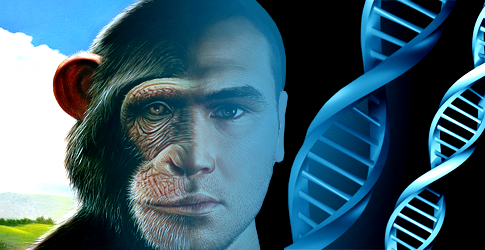
A lie — Humans did not evolve from monkeys.
Post outline
- Human and chimpanzee differences
1.1 Human chromosome 2
1.2 Human similarity to marine mammals - Genetically engineered hybrids
- References
Geologist Dr Casey Luskin (2015)1 reviewed the scientific literature and showed that (a) there are no fossils documenting a transition from ape-like Australopithecus to human-like Homo and (b) this gap is real and not due to a poor fossil record. Darwinian evolution cannot explain the appearance of Homo Sapiens (humans).
Consistent with the fossil record, Andrew Johnson (2019) in Acknowledged: A perspective on UFOs, Aliens and Crop Circles (as of p. 246)2 presents biological evidence that rules out the possibility of humans resulting from evolution and instead supports ET creation / introduction of humans (together with other animal and plant species) when the environment could support them.
1. Human and chimpanzee differences
1.1 Human chromosome 2
Although chimpanzees are supposedly our closest living relatives, we have 46 chromosomes (23 pairs) and they have 48 chromosomes, like all the other primates. We do not know when the fusion occurred3 but geneticists, including a 2022 study by Barbara Poszewiecka and colleagues (in Hawks, 20234) estimated that the head-to-head fusion of two ancestral primate chromosomes to form human chromosome 2 (HSA2) occurred between 400,000 and 1.5 million years ago (centered around 0.9 million years ago).
Many scientists suggest that the fusion occurred in the common ancestors of Neandertal, Denisovan, and African ancestral humans during the course of evolution.4 However, as was indicated above in relation to the evidence evaluated by Dr Luskin, humans did not result from evolution.
Moreover, evidence presented by Dr Witold Ferens (2024)5 indicates that the human genome is flawed and inconsistent with natural processes. Instead, the defective genome suggests a rather poor design by an intelligent being. He lists examples of glaring problems with the form and function of a human body, including:
- The optical nerve has no supply of nutrients other than what is floating in the eyeball fluid. Malnutrition of the optical nerve is responsible for many age-related problems with vision.
- The spine is not well adapted to vertical posture. It is unable to absorb shock well — the intervertebral disks provide inadequate cushion and are susceptible to slippage and damage by load bearing.
- The immune system is flawed. There are allergic responses to common substances — humans can die by ingesting peanuts or being stung by a bee, and asthma can occur in response to harmless chemicals or flower pollen.
- The prostate gland straddles the urinary duct and enlarges with age, thus squeezing the urethra and causing urination difficulty for older men.
- Our jaws are too small to accommodate all our teeth, resulting in crowded, crooked, and misshapen teeth; and eruption of our wisdom teeth is delayed until adulthood.
- The ciliated cells of our inner ear are damaged by noise and do not regenerate, resulting in deafness with age and noise exposure.
Dr Ferens’ full list of examples is in the appendix.
Consistent with the evidence of us not being closely related to chimpanzees, chimpanzees are about ten times stronger than humans for a given body weight.2
1.2 Human similarity to marine mammals
Humans have characteristics found in marine mammals but not in any primates. For example, humans have:
- A layer of fat (subcutaneous fat) like walruses, seals and dolphins, and can become very obese.
- Naked skin, like a hippopotamus or an elephant.
- Most of their hair in the opposite places to that of a chimpanzee.
- Locomotion on two feet — as shown by apes when wading through water, this is required when wading in deep water.
- Control of their breathing (e.g. for speech) like diving animals and birds. In contrast, chimpanzees cannot control their breathing to that extent and always keep their heads above water when swimming or wading in deep water.
- Millions of large sebaceous glands that exude oil over the head, face and torso. The only known function of sebum in other animals is to waterproof the skin or fur. In contrast, chimpanzees’ sebaceous glands persist only as a rudimentary structure (they are vestigial).
- DNA that is very close to dolphin DNA.
- Kidneys that are similar to those of marine mammals.2
2. Genetically engineered hybrids
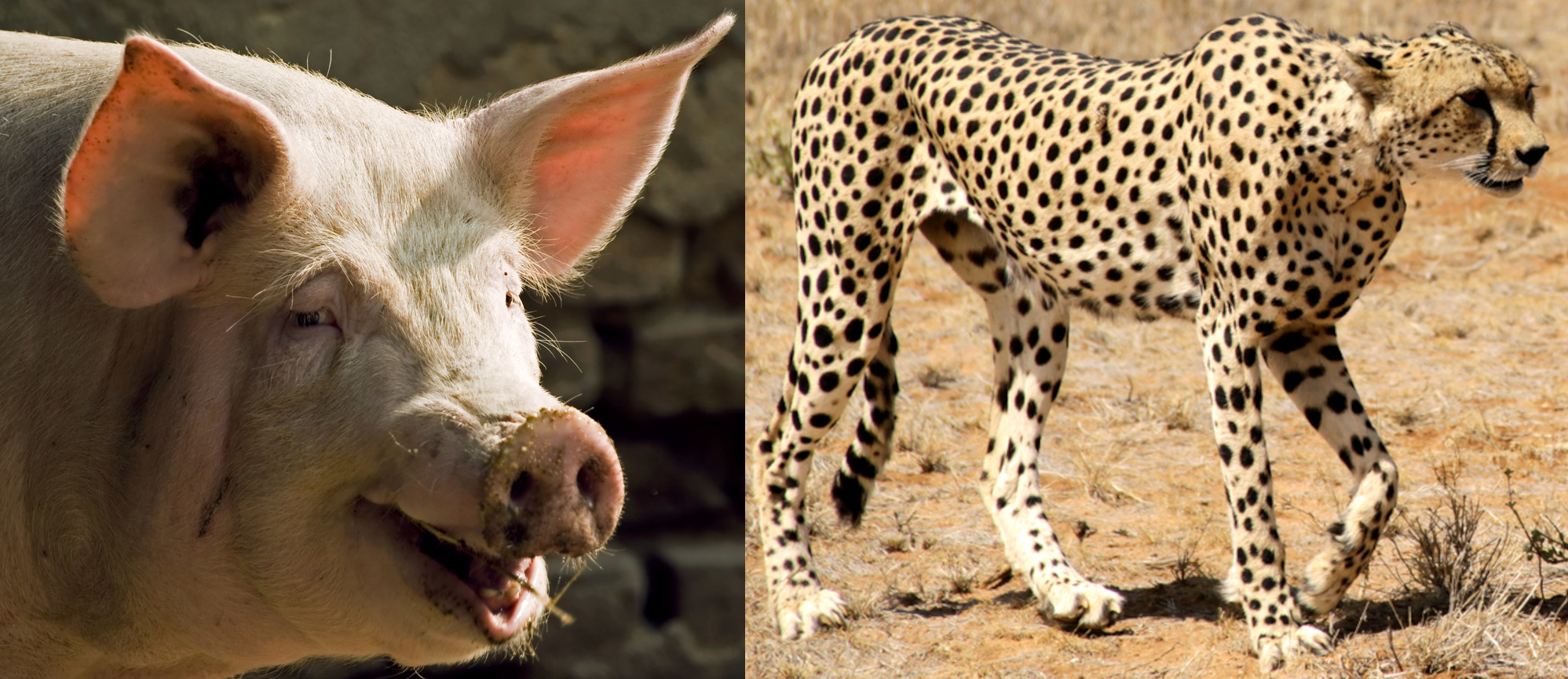
Domesticated pigs and other animals, together with plants, were developed in the upper reaches of the Euphrates river about 10,000 years ago, i.e. soon after the last glacial retreat started about 11,650 years ago. It seems likely that the ETs genetically engineered many animals. In particular:
- Cheetahs (a hunting animal for humans) have the head of a cat, the paws and body of a dog, susceptibility to both dog and cat diseases, and are all virtual clones of one another.
- Pigs and humans (but not chimpanzees) share about 80 characteristics.
- Humans are similar to hybrid mammals in their relatively low fertility, abnormal sperm that is not of one uniform type, and a high percentage of dysfunctional spermatozoa.2
3. References
- Luskin, C. (2015). Abrupt appearance of species in the fossil record does not support Darwinian evolution, Evolution News, 29 Jan 2015.
- Johnson, Andrew (2019). Acknowledged: A perspective on UFOs, Aliens and Crop Circles.
- Foley, P. (2019). Is there a scientific basis to the idea that human chromosome 2 was engineered by ET Aliens? Quora.
- Hawks, John (2023). When did human chromosome 2 fuse? John Hawks, 31 Aug 2023.
- Ferens, Witold (2024). Is there evidence that the human genome was designed by an intelligent being? Quora.
Appendix
Examples of human body form and function problems, by Witold Ferens, Ph.D. (2024) in Is there evidence that the human genome was designed by an intelligent being? Quora.
There are glaring problems with the form and function of a human body. If the human body is to be an example of a design, the designer was careless, thoughtless, sloppy, and rather stupid than smart.
Some examples:
- Inability to make vitamin C. Humans, along with guinea pigs, some apes, some birds, some insects and some fishes, and fructivore bats belong to this curious group that lost the ability to convert sugar to vitamin C. We have genes for all 5 enzymes required for the process, but with a mutation in the last one we cannot complete it. Why would a designer think it is good for people to be at risk of scurvy? Vitamin C is a crucial component necessary to keep connective tissue in good shape, as well as the immune system, and a lot of us are probably deficient in this vital component.
- Optical nerve connecting the eye with the brain. This is one of the hardest working nerves in the body — but it has no supply of nutrients other than what is floating in the eyeball fluid. Malnutrition of the optical nerve is responsible for multiple problems with vision that develop with age.
- Spine. It is somewhat adapted to vertical posture, but not very well. Unable to absorb shocks well, with intervertebral disks acting as an inadequate cushion, susceptible to slippage and damage by load bearing.
- Human birth canal. It is somewhat flattened to satisfy the requirements of bipedal posture, and makes birth a difficult and risky process for most women. Chimpanzee females are smaller than human females, and the chimp babies are just as big as human ones – but a chimp female gives birth in less than one hour, with no problems, no help, no difficulties. One can argue that a designer made birth difficult for women (as acknowledged in the bible) as a punishment for the original sin, but that makes a designer rather cruel than intelligent.
- Speaking of women – why would designer make them smaller and weaker on average than males? If women were equal to men in size and strength, 80% of violent crime would not exist, as most violent crimes are committed by man against women (with a lot of underreporting, by the way).
- Immune system. What is the purpose of allergic responses to common substances? What sense does it make that one can die by ingesting peanuts, or being stung by a bee? What is the point of asthma, when airflow is restricted by contraction of bronchioles, in response to a harmless chemical or flower pollen?
- Prostate gland. It is a hard working gland that enlarges with age — and the designer thought it proper to have this gland straddle the urinary duct, so a growing gland squeezes the urethra. Is it such a brilliant idea to make urination difficult for older men?
- Jaws and teeth. Our jaws are too small to accommodate all our teeth, so they get crowded, crooked, misshapen — and our wisdom teeth do not erupt until we are in 20s. We would have fewer dental problems if we had fewer teeth or bigger jaws. Where is the intelligence here?
- Hearing. The ciliated cells of the inner ear get damaged by noise — and do not regenerate. Once they are gone, they are gone. How is getting deaf with age or exposure showing a good design?
Closer to the truth


Leave a Reply