
The wheat genome is extraordinarily complex and five times the size of the human genome.
1. Genetic engineering
1.1 Plants
From Alternative history of agriculture (video):
- Sudden and independent emergence. An agricultural revolution occurred about 10,000 – 12,000 years ago (Middle Stone Age). Suddenly, from just eight limited and independent geographic areas, all varieties of cultivated plants appeared. This was followed by the development of the first settled societies. Since that time, humans have not added a single major plant to this suite of important plants.
- Genetic modification. Analysis of the domesticated plants shows that they resulted from highly sophisticated genetic modification. In particular, the wheat genome is extraordinarily complex — it is compiled from three different plant genomes packed into one, resulting in a genome that is five times the size of the human genome. The genome of bread wheat shows significant losses of wild wheat genes and the addition of classes of genes involved in energy harvesting, metabolism, growth and productivity. There are no transitional links from wild wheat to domesticated wheat and the genetic differences between wild wheat and bread wheat are so crucial that they do not cross-breed. Similarly, modern studies of high-altitude plants shows that in ancient times scientifically advanced beings would have analysed the chemical compositions of many poisonous high-altitude plants and used genetic modification techniques to render these otherwise nutritious vegetables harmless and edible.
- Legends and stories. In all the ancient legends and stories of places where agriculture first occurred, the people stated that gods gave them agriculture, tools, and taught techniques such as water irrigation and drainage channels.
1.2 Humans and other animals
Evidence of this is presented in The human body.
2. Engineering
2.1 Small objects
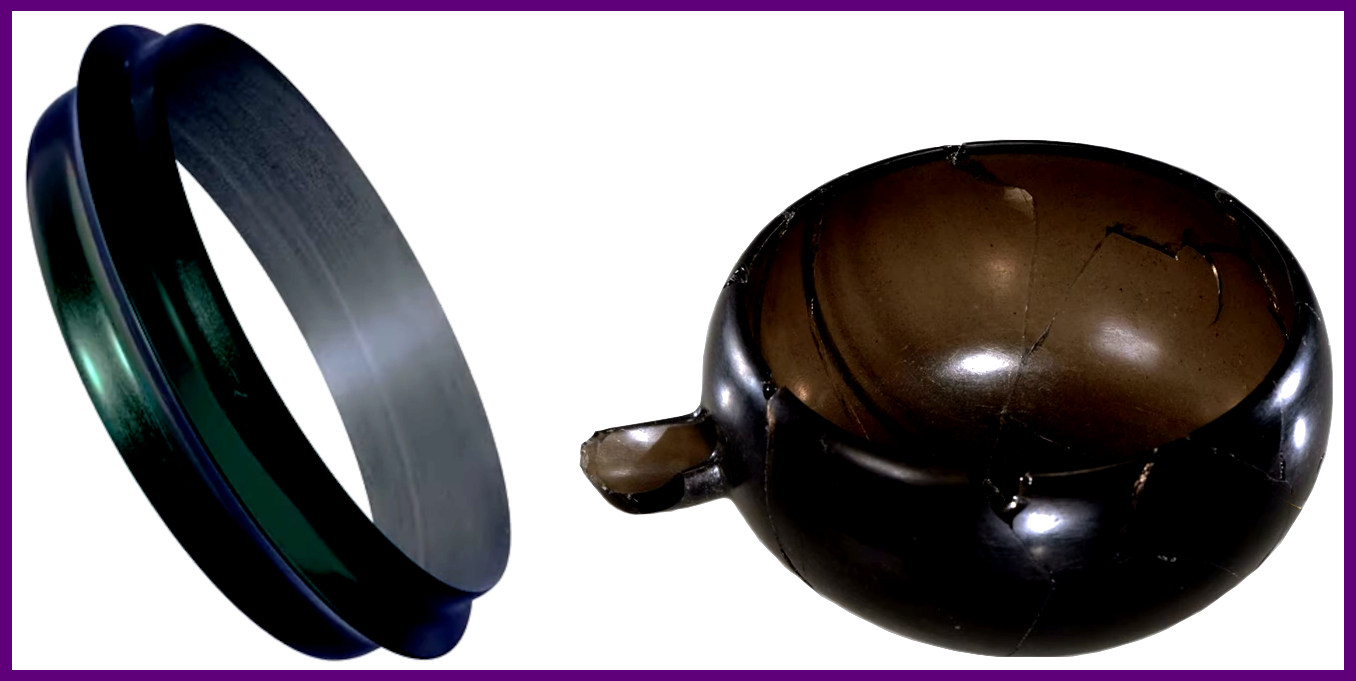
An obsidian bracelet and an obsidian bowl, both made 9,500 years ago using beyond-human technology.
From This obsidian bracelet is 9500yo and it was made with machine tools (video):
The bracelet shown above was found in ancient Anatolia (Turkey). It was made 9,500 years ago using advanced technology to cut, grind, and polish obsidian (volcanic glass that is harder than steel) into a precisely symmetrical bracelet with a surface finish that is worthy of today’s telescope lenses. Tribological analysis was used by researchers from the laboratory of tribology in Lyon and the National Centre for Scientific Research in Paris to determine how the bracelet was made. It is impossible for the technologically primitive humans of that time (stone tools) to have made that bracelet. Only beings of a technologically highly advanced civilization with tools such as lathes could have made it. The study of this bracelet was published in the Journal of Archaeological Science in 2011.
The bracelet is related to a group of ancient artefacts found in that area showing high technical input in manufacture and traces of machine tools on them. This includes some sixty other polished obsidian artefacts and ten beads made from cornelian (even harder than obsidian) and an obsidian disc. The disc is one of the best examples of ancient lathe work and it also shows multiple drilling. Similarly, about 9,500 years ago the Anunnaki made an obsidian bowl (shown above) with extremely precise radial symmetry, constant width, and surface quality, indicating advanced mechanical technologies. This item was found in Tepe Gawra, Iraq.
The manufacturing quality of the obsidian bracelet is very similar to that of obsidian coils of that era found in Peru, i.e. they too were made by artisans of a technologically highly advanced civilization. It is notable that the Paracas Peninsula (where the Paracas long-head non-humans lived up to 3,000 years ago — discussion in Long-heads of America) is in Peru. The age of the obsidian coils suggests that such humanoids (identified as Nephilim and Nephilim x human hybrids by an authority cited in that article), or their pure ET humanoid ancestors (Anunnaki), were in Peru at least 9,500 years ago.
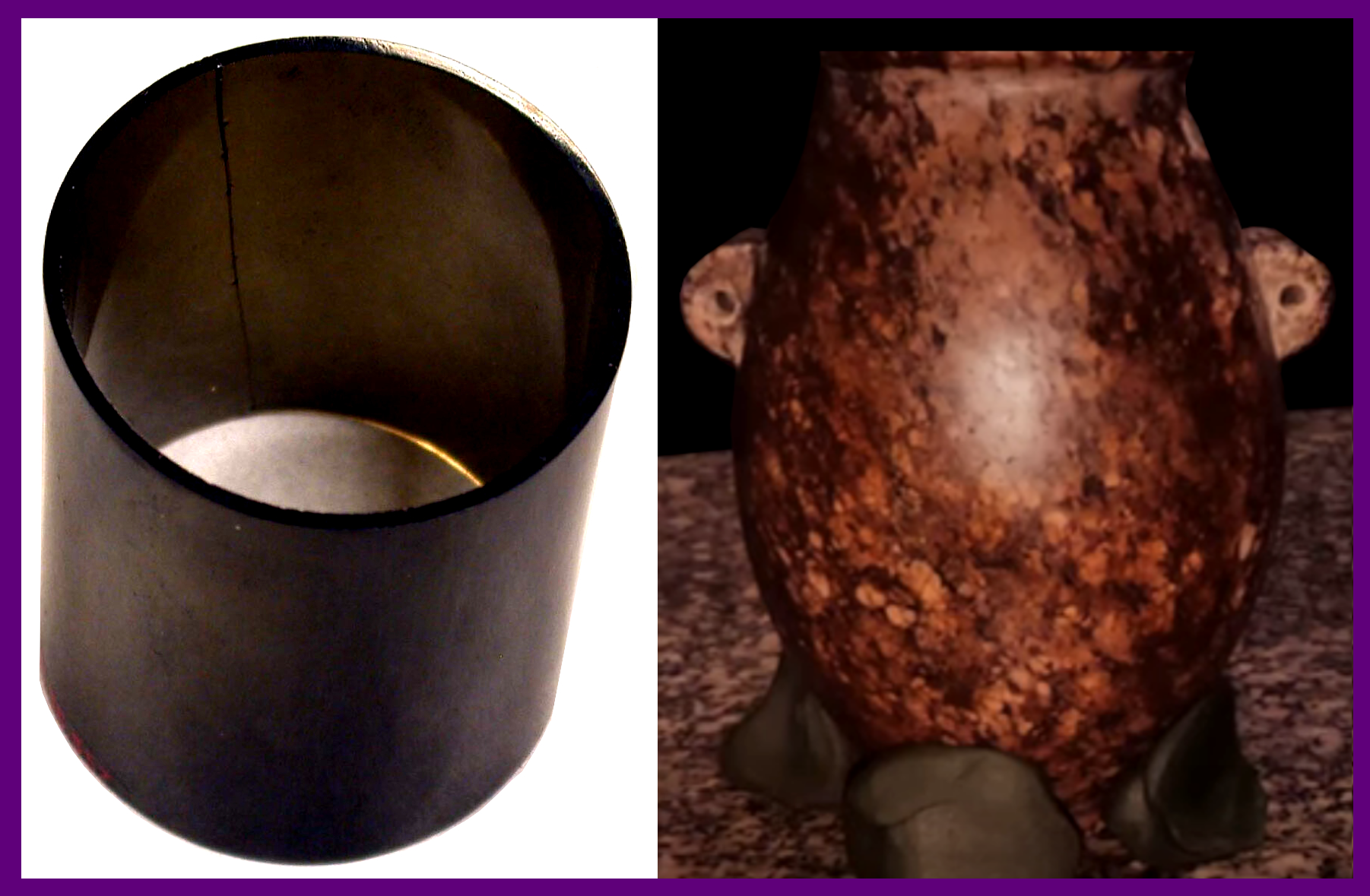
L An obsidian cylinder from Mexico dated to 1400-1600 CE, and R a granite vessel from ancient Egypt dated to before 3000 BCE.
The cylinder
From Why this ancient obsidian cylinder might not be an adornment (video):
The rare obsidian cylinder and other obsidian items are in a collection that were part of the grave goods in one of the male burials in the ancient temple precinct called Tlatelolco. The items are impossibly perfect for the pre-Columbian times in which they were made. The rotational symmetry of the obsidian cylinder is so precise that it looks as if it was manufactured using molten glass. The perfect symmetry suggests that rotational tools similar to lathes would have been used. The flange thickness of the obsidian spool is remarkably uniform and varies by only a few hundredths of a millimeter – 0.025mm. That is the level of modern machine tools precision standards. Such cocentricity is outstanding precision engineering even by today’s standards. Similar accuracy in contemporary grinding and lapping requires lath or similar precision tools, such as is used today to cut glass in the production of high-end optical lenses.
The sophisticated equipment required to manufacture such items was not available to pre-Columbian lapidaries of Mexico.
As the extremely high quality and technological complexity of these artifacts was far beyond the capabilities of pre-Columbian lapidaries, the objects must have been made by another civilization — a technically advanced civilization such as that of the ET humanoids on Earth.
The vase
From Ancient Egyptian precision granite vessel (video):
This artifact (shown above) is a granite vessel from ancient Egypt, estimated to be over 5,000 years old. It predates the first Pharaoh dynasty. The vessel is meticulously crafted from a single block of red granite. A high precision laser scan of the object indicates that it was constructed with a precision comparable to that of modern manufacturing, externally, internally, and in the relationship between its inner and outer parts. The level of precision is to one tenth the thickness of an average human hair. High precision was maintained in challenging areas, such as around the lug handle, where cutting would hinder rotation against the tool.
This vessel was manufactured to such high precision using one of the hardest materials known, granite, at a time when the potter’s wheel was unknown in ancient Egypt and the wheel itself was only on the cusp of invention.
Further, in-depth analysis revealed that the math and geometric properties of this ancient artifact indicate computer-like design processes. In particular, the vase is impressively straight, it deviates from basic geometric shapes like cones or ellipsoids, it lacks vertical symmetry, and many features correspond to a specific geometric construction of unit circles known as the flower of life or sacred geometry.
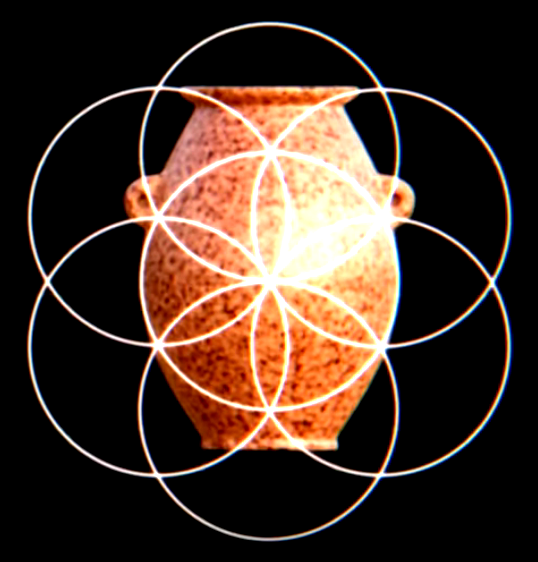
The vase and the flower of life
The analysis revealed that multiple grids of the sacred geometry pattern were utilized and that the design intricately ascends and descends from various sizes of these flower of life grids, employing elegant geometric construction details. The designers also precisely incorporated the golden ratio at a microscopic scale in one of the toughest materials to work with. The vase’s design was methodically interconnected with complex rules, not random. The makers had a profound understanding of algebra and geometry, indicating that the artifact was not just made but meticulously deigned and manufactured. All proportions of the object are tightly interwoven.
The vase shape and structure seem to be the outcomes of computation, with complexity that could be summed up in a single mathematical formula. The object looks more like a representation of mathematical concepts and calculations than a traditional vase.
As with the other small engineered objects referred to above, this granite vessel must have been designed and manufactured with beyond-human technology.
2.2 Large objects
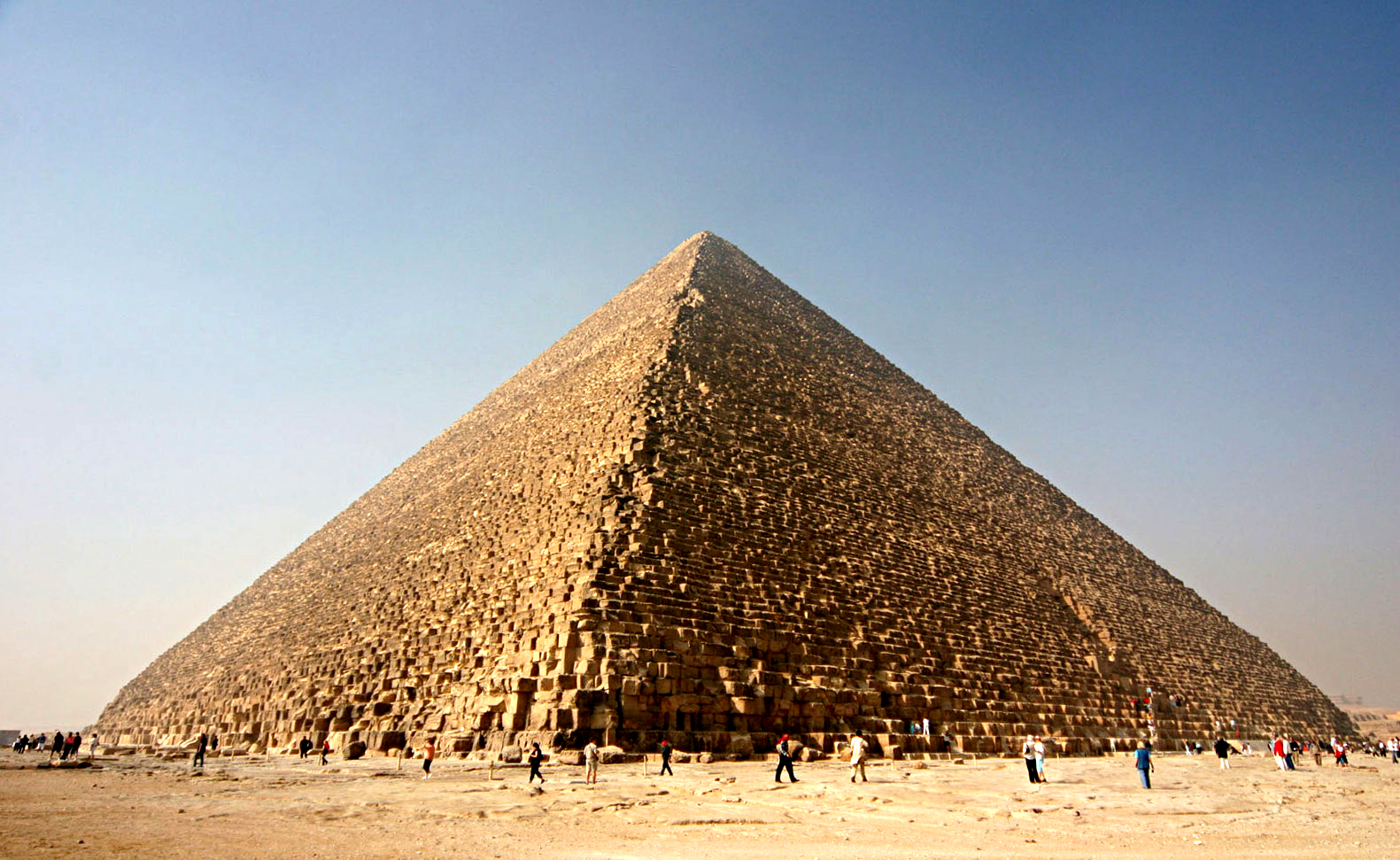
The great pyramid of Giza
From Why Pyramids are omitted in the Bible? (video):
The great pyramid of Giza (aka the pyramid for Egyptian Pharaoh Khufu) was constructed over 20 years and completed about 4,580 years ago.
Although humans of that time were technologically primitive, the great pyramid of Giza features examples of extreme engineering, aspects of which are beyond 21st century technology:
- Anomalous out of place traces of machine tools on the granite material, e.g. spiral grooves left by tubular drills that could cut through 2.54 mm granite per rotation (that is far beyond the capabilities of modern power tools).
- Alignment of the 200m base, and alignment of megalithic blocks inside the inclined corridors, with a degree of precision that humans were only capable of since laser levelling recently became available.
Similarly, in the video Stone softening, precision cutting, transportation of megaliths, experts present evidence of highly advanced technology in relation to these locations:
Qenko (construction as of about ?14,000 years ago during a period that ended with the start of the Inca Empire about 800 years ago), an archaeological site in the Sacred Valley of Peru located in the Cusco Region.
Tiwanaku (construction as of about 1,900 years ago), western Bolivia.
Puma Punku (construction as of about 1,500 years ago), part of the above-mentioned Tiwanaku site, western Bolivia.
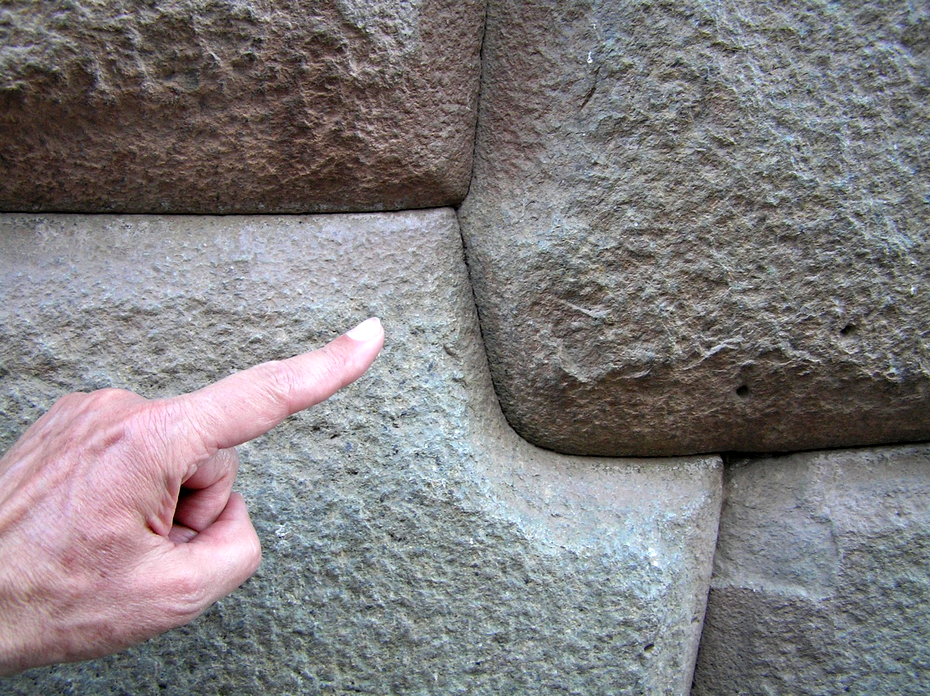
Precision fitting of massive blocks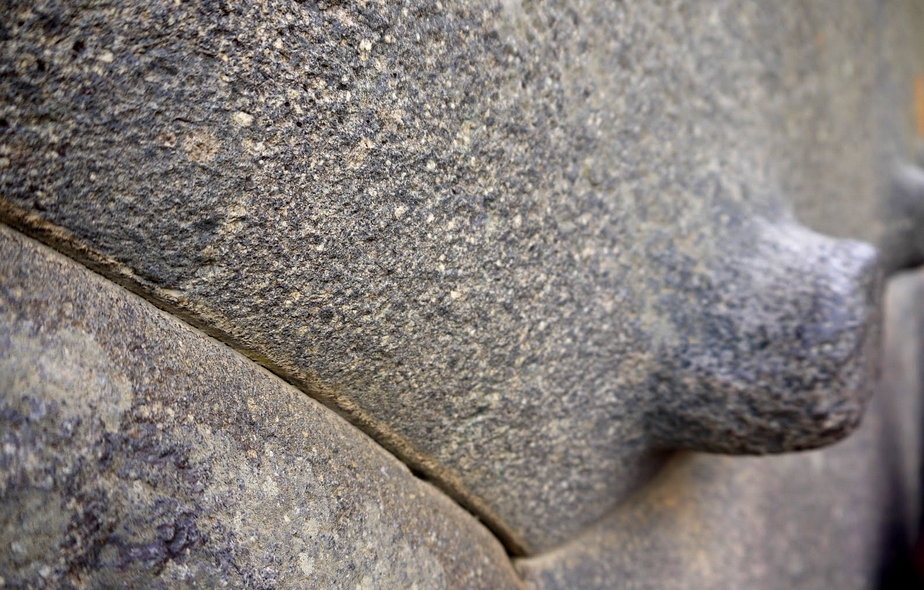
Precision fitting of massive blocks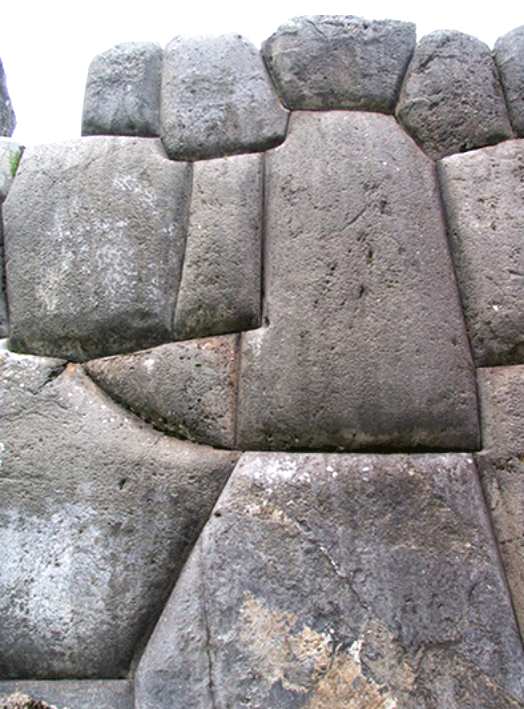
Precision fitting of massive blocks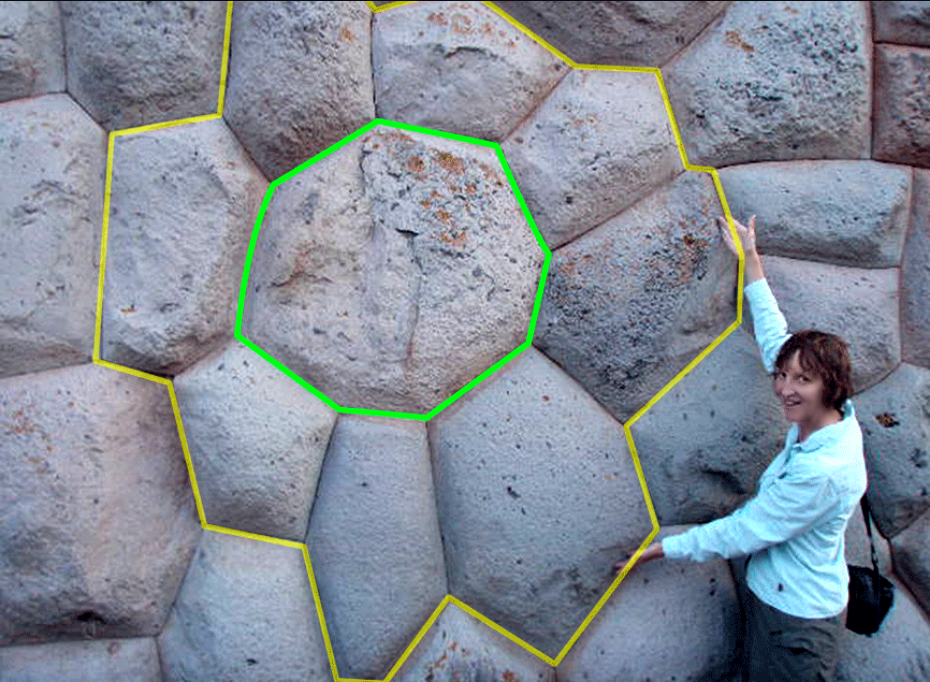
Precision fitting of massive blocks and Flower of Life
Sacsayhuamán is a citadel on the northern outskirts of the city of Cusco, Peru. According to Wikipedia, the complex was built by the Incas about 600 hundred years ago. However, according to an expert in the video Alternative history of agriculture, such structures were built by ‘the gods’ long before the Inca empire.
The above image of the citadel suggests the Flower of Life, a sacred symbol known to philosophers, architects, and artists around the world since ancient times and which represents the interconnectedness of life (What ancient secrets lie within the Flower of Life?).
Nan Madol(construction as of about 800 years ago), island of Pohnpei, Federated States of Micronesia, western Pacific Ocean.
In the video Stone softening, precision cutting, transportation of megaliths, experts explain that highly advanced technology at these sites includes:
- Precise cutting, transportation, and exact placement of huge chunks of mountain.
- Tool marks on ancient megaliths suggest that work was done on the material while it was in a plastic state. This includes tool marks in rock that resemble the mark left by a red-hot tip on plastic.
- Limestone that looks as if it melted and solidified like a puddle.
- Pictograms formed by white crystal inclusions within the stone’s structure. It looks as if somehow, this ancient writing involved moving quartz crystals to form the pictures.
Humans cannot yet do these things but physicists are beginning to understand how this could have been achieved. Their explanation involves the use of so-called Exotic Vacuum Objects (EVOs). In theory, this would allow precise cutting, transportation, and softening of stone of any weight:
- Concerning the cutting, such a tool would be similar to the laser but much more effective and require less energy. It would be able to cut through any hard rock like butter. Cutting through large chunks of mountain would be a trivial matter.
- By precise control and manipulation of magnetic fields, even the heaviest objects can be effortlessly levitated and transported. Depending on the situation and required application of this technology, an anti-gravity craft (“flying saucer”) may or may not be necessary. The levitation of massive stones is recorded in legends. In Micronesian legends, Nan Madol was built by twin sorcerers who possessed the power to levitate the massive stones, and a legend in the Tiwanaku region of Peru describes the megalithic blocks rising above the ground in a miraculous manner and “flying” to their desired location.
- Depending on the level of energy supplied to EVOs within the stone, it can be softened to mould the structures. It can even be liquefied without breaking its structure. As this technology doesn’t heat the stone, it stays cold and can therefore be manipulated by hand or very simple tools.
- This technology would rely on the energy of natural phenomena (Stone softening, precision cutting, transportation of megaliths).
3. Healthcare in ancient Egypt
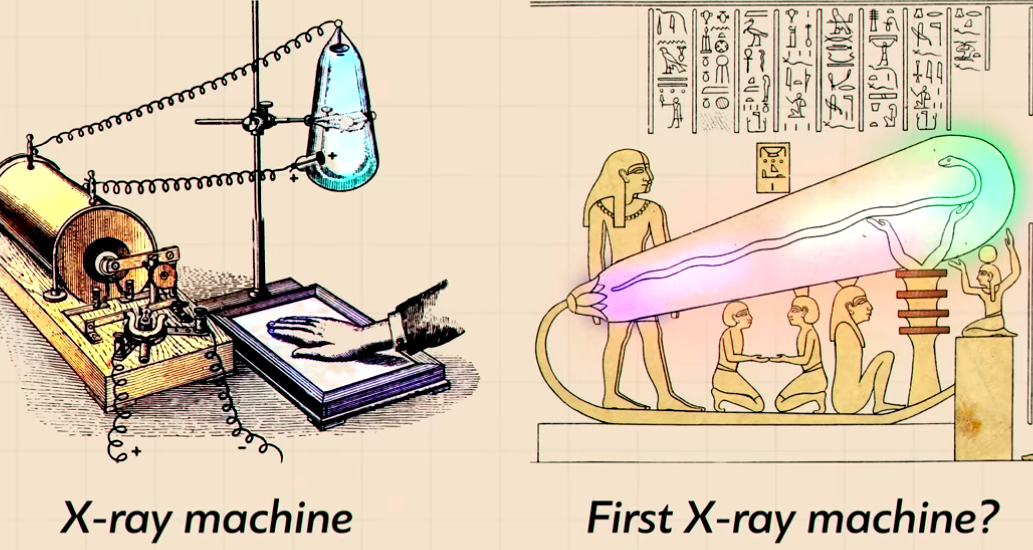
Illustration of a panel that seems to show an X-ray machine in ancient Egypt
Concerning possible evidence of advanced healthcare in ancient Egypt, as is stated in the video What is actually depicted in the secret crypts of the Hathor Temple? in relation to the Hathor Temple (constructed from about 4,000 years ago until about 3,600 years ago), relevant artefacts wouldn’t survive invasion by other people. They would be destroyed and valuable materials such as copper, glass and crystal would be stolen. Even the panels that recorded aspects of healthcare at the Hathor Temple have been largely stolen. Nonetheless, according to the video, of the remaining panels (including the image illustrated above) researchers have been able to deduce the following:
- Healthcare technology used at the Temple was so advanced as to be completely beyond the knowledge of regular humans of that era (about 4,000 years ago).
- The panels record the use of electromagnetism and plasma in healthcare.
- Included in the panels are images of what resembles a frequency transformer with five coils, an electron tube, an electrical battery (a voltaic pile) to continuously provide electric current to a circuit, electrical wires, and insulators.
- This device must have been made by someone experienced in the engineering of high-frequency impulse currents, i.e. a specialist in electromagnetism.
- If images of this device and the first X-ray machine of 1895 are overlapped, there is an almost perfect match. The match is not just in appearance, but most importantly, in the structure of these objects.
- Possible uses of such a device include the stimulation of Plasma (previously called Radiant matter) from crystals or minerals. Consistent with this explanation, ancient legends refer to a high-priest’s breastplate with crystals that communicated the god’s message by glowing.

Family from afar

