Tag: spirituality

  • Aryan ET sacred architecture

    Aryan ET sacred architecture

    A picture worth a thousand words

    Background information

    • In The Anunnaki: Basic information it is shown that the Anunnaki are Aryan. This is consistent with the finding that a Great White God [Enki] of antiquity came from heaven to America to civilize humans (Aryan ET civilization of humans).
    • Further, it can be deduced that these Aryan beings [Anunnaki] have a base on Mars (Anunnaki are from The Winter Sky).
    • In Aryan ET religion reverence for nature is built into the sacred architecture itself.
    • In his Life after death research Emanuel Swedenborg (1688-1772) found that beings [Anunnaki] from Mars have a high level of spiritual awareness and worship the Divine in a direct, simple and intuitive relationship.

    Considering the above, we can expect to see a high level of spirituality in the sacred architecture on Mars.

    Post outline

    1. The Reuleaux pyramid
    2. The D&M pyramid
    3. Matching formations on Mars and Earth
      3.1 The layout of structures in Cydonia and Avebury
      3.2 The Tholus and Silbury Hill
    4. Other constructions
    5. Conclusion
    6. References


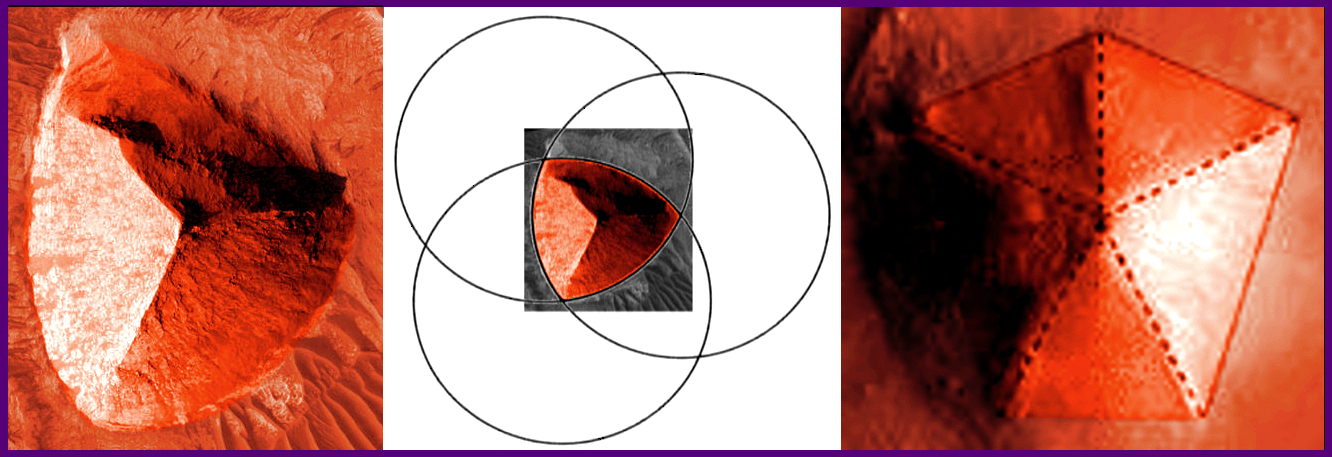
    A Reuleaux pyramid (L, C) and the D&M pyramid on Mars. Image credit: Haas et al.1

    As examples of ET pyramid symbolism, we can consider the Reuleaux and D&M pyramids.

    1. The Reuleaux pyramid

    This Reuleaux pyramid is in the Candor Chasma region of Mars.1 As the illustration shows, the ETs incorporated three circles in the design of its base to create the most powerful symbol of the Divine — a Triunity (also called Trinity) of Triunities in the three lines of the Y-shaped cross, the three faces, and the three circles.

    2. The D&M pyramid

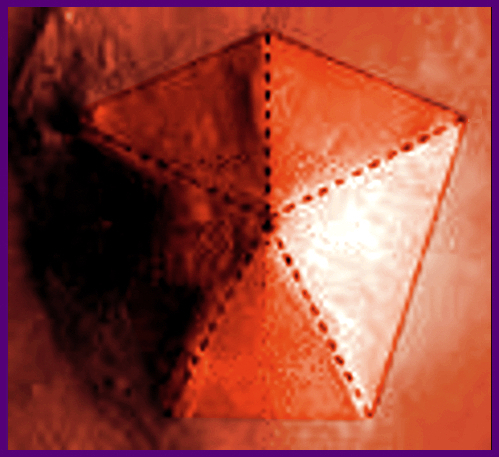
    This five-sided pyramid is in the Cydonia region. At its apex there are two 90 degree angles and three 60 degree angles.1

    Symbolism of the D&M pyramid

    • Odd numbers and their geometric forms (e.g. three, five, triangle or pentagon) indicate dynamism. In contrast, even numbers and their forms (e.g. four, six, eight, square, hexagon, octagon) indicate stability, firmness, definition.2
    • The number five corresponds to the five Elements (four material Elements + spirit or quintessence).2
    • The number five denotes love, health and humanity.2
    • The number five is analogous with the human figure (four extremities + head).2
    • The pyramid looks like a stick man with legs apart and raised arms.

    This pentagon (5 sides) pyramid symbolizes a dynamic (interactive, aware / active) relationship with our Creator (all pyramids are about material world – heaven communication) in all things (the five Elements) for the purposes of love, health and humanity.

    3. Matching formations on Mars and Earth

    3.1 The layout of structures in Cydonia and Avebury


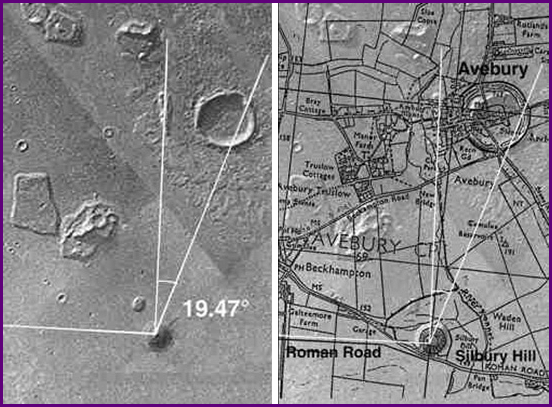
    The layout of structures on Mars (Cydonia) and Earth (Avebury, England). Image credit: S. Onstott.3

    It is suggested that after the numbers three (triangle) and four (square), the next most important numbers are seven (their sum) and twelve (their multiplication).2

    Seven is shown graphically by joining the triangle and the square. The triangle is either superimposed upon or inscribed within the square. The significance of this number is shown by examples such as the seven colours of a rainbow, days of the week, notes of the diatonic musical scale, seas, planets, directions of space, deadly sins.

    Further to the above image, the number seven also occurs in the beautiful correspondence between structures made by human/oids on Mars (Cydonia) and Earth (Avebury, England). These structures have the same shapes (circles, mounds, triangles), the same spatial relationships, and the same angles (19.47 degrees). This coincidence cannot have occurred by chance. It indicates that human/oids on Mars and Earth were involved with one another. Further, the ratio of the Cydonia : Avebury formation sizes is 7:1. Engineer and educator Andrew Johnson4 of CheckTheEvidence5 discusses this subject in detail.

    3.2 The Tholus and Silbury Hill


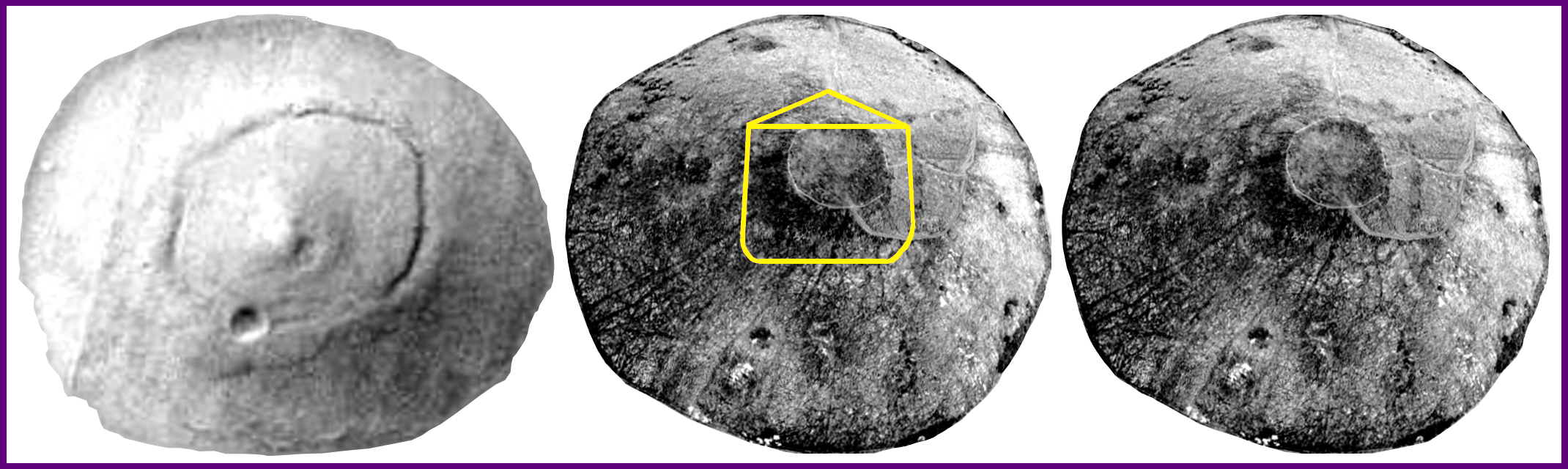
    Tholus (L) and Silbury Hill. Tholus image credit: A. Johnson4

    The large mound that is part of the formation in Cydonia is called the Tholus. It is similar to Silbury Hill, which is part of the corresponding formation in England. On top of the Tholus are the outlines of a triangle joined to a square, similar to the diagram on top of Silbury Hill.

    Note: (a) The triangle bases of the Tholus and Silbury Hill are implied; (b) There are other images of Silbury Hill online that show aspects of the square and triangle more clearly than this photo does; and (c) Silbury Hill is a prehistoric human/oid-made mound that was completed 4,300 years ago, its shape has deteriorated, we need to look carefully to see the triangle + square diagram.

    The meaning of the Tholus and Silbury Hill diagrams is equivalent to that of the quadrangular pyramid as the pyramid also combines the square (base) and triangle (triangular sides). Specifically, the diagrams on the Tholus and Silbury Hill represent (a) the number 7 in their combinations of the triangle (no. 3, spirit) and square (no. 4, material world), (b) communication between the material world and heaven (this meaning is reinforced by the contact between the triangle apex and the circular mound), (c) Oneness (the diagrams occur within circular mounds), and (d) Universal Oneness in view of the correspondence between the Cydonia and Avebury formations. Universal Oneness would be further emphasized by the likely correspondence between these formations and similar formations built by the ETs on other planets in our universe.

    4. Other constructions

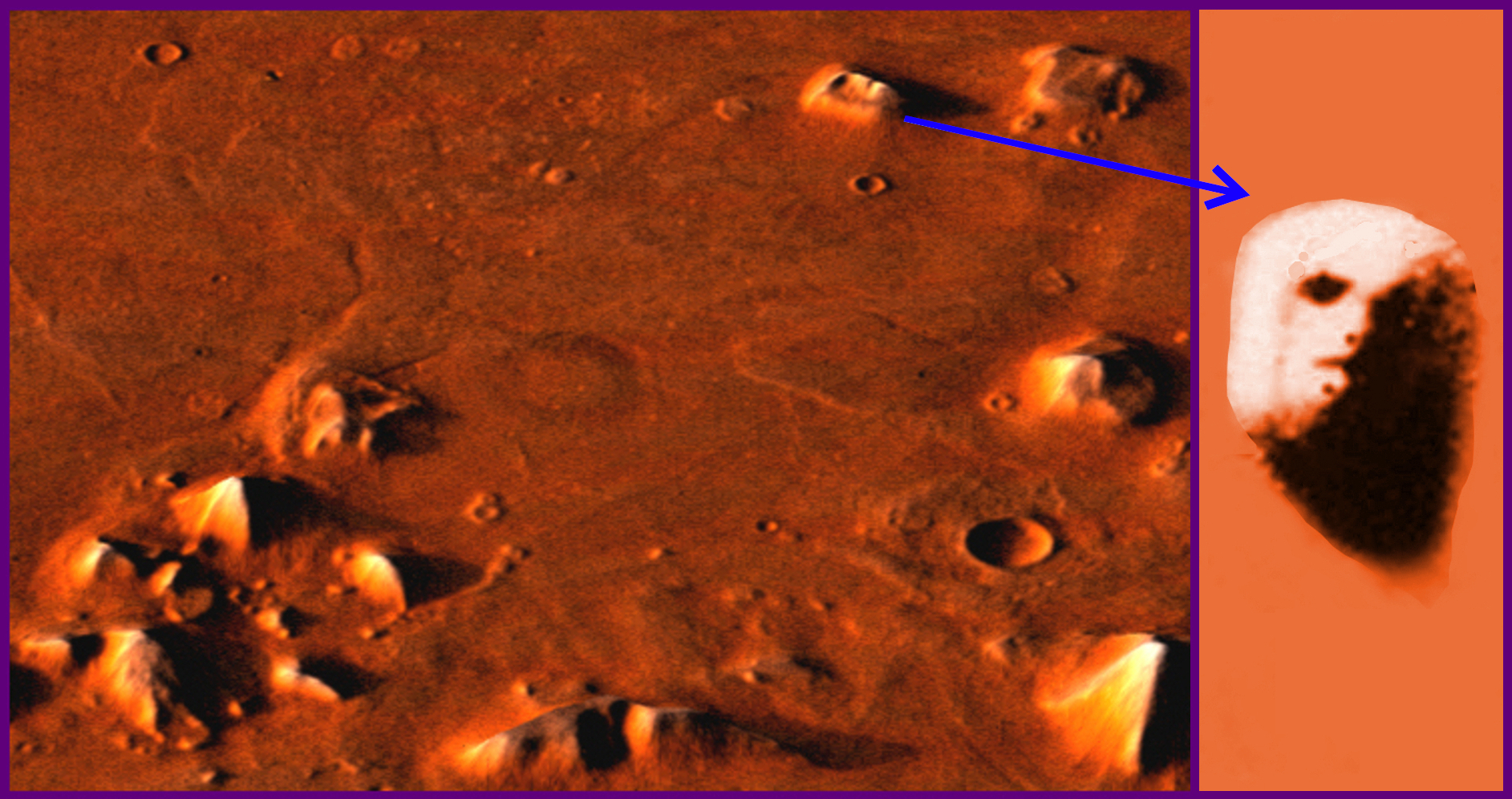
    These images from NASA, taken by Viking 1 Orbiter in 1976, show the face sculpture in the Cydonia region of Mars. The face sculpture is a kilometer wide, and the largest central pyramid is almost ten times larger than the famous pyramid of Cheops in Egypt.6

    In natural religion there is a recurring concept of a sky god or sky father, which can be traced to the sky god An (Sumerian) and Anu (Akkadian) of the Anunnaki.7 Other names for the sky god include Horus (Egyptian), Zeus (Hellenic), Týr (Germanic) and Wr-alda (Frisian religion, discussed in The Oera Linda Book). It can be deduced from information cited in Anunnaki are from The Winter Sky that the face sculpture on Mars represents the Anunnaki sky god An / Anu.

    5. Conclusion

    • As might have been expected, the sacred architecture featured above evidences a high level of Anunnaki spirituality.
    • The huge sculpture of their sky god An / Anu reinforces the conclusion of high Anunnaki spirituality.
    • The similarity and correspondence of ancient constructions on Mars and Earth indicate that (i) the Anunnaki who built those pyramids and other structures on Mars were involved in the construction of the corresponding structures on Earth and (ii) the level of Earth human consciousness was high during the period of Anunnaki leadership.

    6. References

    1. Haas G.J., Saunders, W.R., Miller, J.S. et al. Three-Sided Pyramidal Formation in the Western Region of Candor Chasma, J Space Explor. 2017; 6 (3): 133
    2. Cirlot, Juan E. (1962, extensively revised in 1971). A dictionary of symbols
    3. Onstott, Scott (n.d.). Sacred geometry in plain sight
    4. Johnson, Andrew (2018). Secrets in the Solar System: Gatekeepers on Earth. Andrew Johnson discusses this book with Richard Hall in this video on RichPlanet TV
    5. Johnson, Andrew. CheckTheEvidence
    6. Petrovych, V. A. & Fedorovich, S. A. (2023). Microrelief of the Martian surface
    7. Wilkin, Stanley (2019). Jesus and Bel Christianity and the Continuation of Paganism


    Family from afar

  • Aryan ET religion

    Aryan ET religion

    A picture worth a thousand words

    This article is based on AI search engine reports.

    Post outline

    1. Religion and how to worship
      1.1 Inana and Enki
      1.2 Enki and the World Order
      1.3 Adapa
      1.4 Core elements
    2. Evidence of these teachings in Mesopotamian religion
      2.1 Celestial reverence — the astral triad
      2.2 Nature reverence — water, storm, and field
      2.3 Temple architecture as cosmology
      2.4 The numerical-hierarchical classification

    The Mesopotamian cuneiform texts explicitly place priesthoods, shrines, cult chambers, and ritual propriety among the civilizing gifts transmitted from Eridu; Ea personally instructs the human Adapa in ritual conduct; and Mesopotamian religion demonstrably revered celestial bodies (Sin, Shamash, Ishtar) and natural forces (fresh water, storms, fields) as deities, institutionalized in temples, priesthoods, and calendrical observance. The astral and nature reverence are derived from Enki’s teaching — the temple schools that developed astral theology stood in the scribal tradition the texts trace to the apkallu, and the me-framework makes all worship institutions downstream of Eridu’s transmission.

    The Sumerian compositions that describe aspects of Enki’s civilizing role are translated in full in the Electronic Text Corpus of Sumerian Literature (ETCSL, Oxford) and they connect his gifts to cult, priesthood, and worship. To verify the full texts, the ETCSL pages are freely accessible and are the scholarly standard for the Sumerian material.

    1. Religion and how to worship

    1.1 Inana and Enki (ETCSL 1.3.1)

    The key composition, subtitled in scholarship “the transfer of the arts of civilization from Eridu to Uruk.” Enki guards the me — the fundamental powers and decrees that enable the functioning of society — and gives them to Inana. The catalog of what counts as “the arts of civilization” explicitly includes cult and priesthood. Per the ETCSL translation:

    “You have brought with you the office of egi-zi priestess, you have brought with you the office of nin-diĝir priestess, you have brought with you the office of išib priest, you have brought with you the office of lu-maḫ priest, you have brought with you the office of gudug priest.”

    And again in Segment J:

    “Inana, you have brought with you the office of en priest, you have brought with you the office of lagal priest, you have brought with you divinity, you have brought with you the great and good crown, you have brought with you the royal throne.”

    Later lines confirm these cultic offices were handed over deliberately: “Where are the office of egi-zi priestess, … the office of išib priest…? My master has given them to his daughter.” The fuller me-lists preserved in the wider tradition (as compiled at Wikipedia’s “Me (mythology)”) likewise include “the exalted shrine,” the “divine lady” priestly office, the ishib, lumah, and guda priestly offices, “the cult chamber,” and the “hierodule of heaven.” So the texts themselves classify worship and its institutions as among the fundamental powers transmitted from Eridu.

    1.2 Enki and the World Order (ETCSL 1.1.3)

    Depicts Enki as responsible for organizing the earth, and shows him as the source and locus of cultic practice. Lines 100–122, per the ETCSL translation:

    “The lords pay heed …… to me. I am Enki! They stand before me, praising me. The abgal priests and abrig officials who …… stand before me …… distant days. The enkum and ninkum officiants organise ……. They purify the river for me … In my Abzu, sacred songs and incantations resound for me.”

    And lines 140–161:

    “All the lords and rulers, the incantation-priests of Eridug and the linen-clad priests of Sumer, perform the purification rites of the Abzu for the great prince who has travelled in his land; for Father Enki they stand guard in the holy place, the most esteemed place.”

    The composition culminates in praise “be to Father Enki” — the portrait is of a god who doesn’t merely enable civilization but is himself served by its cultic machinery: purification priests, incantation-priests, sacred songs, officiants organizing shrines.

    1.3 Adapa

    Less extensive but relevant, because Ea (Enki’s Akkadian form) directly instructs his created servant in cultic propriety before Adapa ascends to heaven. The Rogers translation (1912, quoted at World History Encyclopedia) describes Adapa as “Blameless, of clean hands, anointed, observer of the divine statutes,” and Ea coaches him on how to conduct himself in the gods’ court. Here Ea is personally transmitting ritual and devotional norms to a human.

    What the texts show is (a) worship institutions (priesthoods, shrines, cult chambers) among the me Enki guards and transmits, and (b) Enki as a god who institutes and receives cult himself, and (c) his personal instruction of the human Adapa in ritual behavior.

    1.4 Core elements

    The Enki-Adapa strand of tradition contains these recurring religious elements:

    • Transmission of sacred powers (the me) as the basis of civilization
      In “Enki and the World Order” (ETCSL 1.1.3), Enlil assembles the me in the Ekur and gives them to Enki to guard and impart to the world, beginning with Eridu. Civilization itself is framed as a religious gift — the operating decrees of the cosmos, entrusted to a god who passes them on.
    • Cultic institutions among those gifts
      As we saw in “Inana and Enki” (ETCSL 1.3.1), the litany of what transfers from Eridu includes the en, lagar, išib, lu-maḫ, and gudug priesthoods, the egi-zi and nin-diĝir priestess offices, “the exalted shrine,” “the cult chamber,” and the “hierodule of heaven.” Teaching humans how to organize worship is thereby embedded in the civilizing act itself.
    • Instruction in ritual purity and divine statute
      In the Adapa references, Ea creates Adapa as “chief among men,” grants him “a wide ear to reveal the destiny of the land” (Rogers translation, 1912), and the tablet describes Adapa as “Blameless, of clean hands, anointed, observer of the divine statutes.” Ea then personally coaches Adapa on correct conduct before the gods in heaven — right behavior, right demeanor, right refusal. The teacher-pupil relationship between god and human in matters of ritual is explicit here.
    • Incantation and magic as sacred knowledge
      Enki is throughout the tradition the lord of asû-craft and incantations — “in my Abzu, sacred songs and incantations resound for me” (ETCSL 1.1.3, lines 100–122). The exorcistic, healing, and magical corpus of Mesopotamian religion traces its authority to Ea and his apkallu sages.

    2. Evidence of these teachings in Mesopotamian religion

    These elements are visible in the lived religion of Mesopotamia in ways that track the teachings closely:

    2.1 Celestial reverence — the astral triad

    By the second millennium BCE, Sin (moon), Shamash (sun), and Ishtar (Venus) formed an astral triad of divinities (Britannica, “Shamash”). Each celestial body was understood as a deity with moral and juridical functions: Shamash “was not only the god of justice but also governor of the whole universe,” pictured holding the staff and ring of righteousness, and the sun’s all-seeing light guaranteed oaths and law — hence Hammurabi’s stele depicts the king receiving the law from Shamash. The moon’s cycles structured the calendar, making Sin’s precedence over even Shamash in god-enumerations a reflection of the astronomical underpinning of timekeeping (factsanddetails.com). A developed astral theology grew out of the temple schools themselves — which is a significant point: the institution that systematized star-worship was the same scribal institution descended from the apkallu tradition.

    2.2 Nature reverence — water, storm, and field

    Earlier religion, per the survey at factsanddetails.com, centered on personifications of definite powers — “of the sun, of the moon, of the water, of the storms, or of the fields.” Enki’s own domain, the subterranean freshwater ocean (Abzu), was worshipped directly: his temple at Eridu was the E-abzu, and the Sumerian hymn “Enlil in the E-Kur” describes Enlil as controlling and animating nature itself (Metropolitan Museum of Art, “Mesopotamian Deities”). Storms (Adad), rivers, and the marshes all carried cultic weight.

    2.3 Temple architecture as cosmology

    Temples were built as meeting points of cosmic domains — the sanctuary described as “a great crown reaching heaven whose foundation is fastened on the abzu,” the deep waters below, connecting sky, earth, and underworld (per the Sumerian hymn tradition surveyed by the Met Museum and others). The temple of Enki at Eridu anchored the freshwater abyss; Enlil’s at Nippur was the “house of the mountain.” Reverence for nature was built into the sacred architecture itself.

    2.4 The numerical-hierarchical classification

    Beginning in the second millennium BCE, theologians assigned each major god a number: Anu 60, Enlil 50, Ea 40, Sin 30, Shamash 20, Ishtar 15, Adad 6 (Met Museum). This systematization — mapping the natural and celestial world into a coherent divine order — is precisely the intellectual activity attributed to Enki’s sage-lineage.


    The D&M pyramid on Mars

    This five-sided pyramid is in the Cydonia region of Mars. At its apex there are two 90 degree angles and three 60 degree angles (Haas G. J., Saunders, W. R., Miller, J. S. et al., 2017, Three-sided pyramidal formation in the western region of Candor Chasma, J Space Explor. 2017; 6 (3): 133).

    In universal symbolism this pentagon (5 sides) pyramid symbolizes a dynamic (interactive, aware / active) relationship with our Creator (all pyramids are about material world – heaven communication) in all things (the five Elements) for the purposes of love, health and humanity (Cirlot, Juan E., 1962, extensively revised in 1971, A dictionary of symbols).

  • Spiritual Light in Africa: The Dogon Tribe

    Spiritual Light in Africa: The Dogon Tribe

    A representation of Nommos in their white state (they are more commonly coloured green)

    Post outline

    1. Dogon cosmology
    2. The Nommo
    3. Celestial knowledge
    4. Symbolic architecture
    5. Ritual practices
    6. Major mask types
    7. Sacrifice
    8. References

    Appendix: Dogon continuation of Egyptian religion

    The enlightenment, coherence, and beauty of the Dogon religion contrasts with the ignorant, disordered, and hideous jew-invented killer religion based on the jew “Jesus” hoax known as Christianity. This is understandable as Dogon religion is a natural religion and it originated in Ancient Egypt (explanation in Appendix). Instead of relying on a static ‘holy book’, Egyptian culture was rooted in a sophisticated understanding of natural cycles, human psychology, and the integration of the spiritual world with everyday life.

    The Dogon are an ethnic group of about 300,000 people in Mali, West Africa.1 These people and their remarkable culture are the subject of this video: The Dogon – In search of The Dark Star (1979). French anthropologists Marcel Griaule and Germaine Dieterlen visited and studied the Dogon people as of 1931. Their book Le Renard Pâle (French); The Pale Fox (English translation)2 is a landmark anthropological study. Information about the Dogon presented below is from that book.

    1. Dogon cosmology

    Core cosmological elements of the highly elaborate and systematic Dogon cosmology:

    • The Supreme Creator Amma, a formless creator deity who existed before all else. Amma conceived the universe as a cosmic egg (aduno tal), intending to create perfect male-female twin births (representing cosmic balance).
    • The Cosmic Egg is quadrangular in shape (prefiguring four cardinal directions), it contains all potential existence compressed within, and it vibrates (bummo), creating primordial spirals. Inside the Egg are four pairs of twin Nommo [from Dogon word meaning “to make one drink,” plural: Nommos, Nummo], eight ancestors, eight seeds of grain, determining the future world structure. Compared to pottery, Amma fashioned the Cosmic Egg from clay/earthenware discs.
    • The Pale Fox (Ogo/Yurugu) symbolizes the Principle of Disorder. This being is single, imperfect, and born first from the cosmic egg. His nature is solitary, chaotic, and rebellious. He violated cosmic order by being born alone (should have been twins) and committed incest. This being symbolizes the anti-society, anti-law, disobedient son of the Creator. He is punished by Amma, became jackal/fox, and retreated to dark corners of Earth to live alone. The disorder represented by the Pale Fox contrasts with the ordered twin births that followed.
    • Amma (supreme creator) sacrificed Lébé, one of the perfect twin progeny, to restore cosmic balance after Ogo’s rebellion. They dismembered his body and scattered it across the universe to restore order and create life-giving elements. The Universe “drank of his body” and humans gained life principles. In the words of Griaule/Dieterlen,2 “The Nommo divided his body among men to feed them; that is why it is also said that as the universe ‘had drunk of his body,’ the Nommo also made men drink. He gave all his life principles to human beings.”

    2. The Nommo

    The Dogon claim that the Nommo originate from a world circling the Sirius star system and descended to Earth from the Sirius region for the purpose of bringing cosmic wisdom, civilization, and order. The Dogon see the Nommo as star-born ancestors connecting Dogon to the cosmos.

    In the Dogon cosmogony and religion, the Nommo are highly advanced ancestral beings, amphibious, associated with the Sirius star system, and the first living creatures created by the sky god Amma. In the Dogon astronomical tradition, the Nommo traveled to the Sirius star system, returned to Earth in a vessel of fire and lightning, and created a lake that they dove into, because as amphibious beings they require water in which to live.

    2.1 Dogon names for the Nommo

    “Masters of the Water” — they control water, rain, fertility
    “The Teachers” — they brought civilization, knowledge, language
    “The Monitors” — they watch over humanity
    “The Speakers” — they are the source of language and speech

    2.2 Nommo primary functions

    Bringers of Order — they replaced chaos with cosmic law
    Culture Bringers — they introduced speech, language,
    agriculture, weaving, metallurgy
    Water Masters — they govern rain, rivers, lakes, fertility
    Divine Ancestors — they are the progenitors of Dogon people

    2.3 Nommo physical appearance

    The Nommos are humanoid from the loins up, serpent-like below; accompanied by water serpents, crocodiles, turtles; and they appear in the form of twin beings (one male, one female).

    Concerning colour, the Nommos’ fish-like exterior is green and the hair on their head is green (associated with water, rain, fertility); their eyes shine red like embers (fire, thunder, transformative power); and when touching the ground their appearance becomes white (symbolizing Sirius B star, purity, celestial origin).

    3. Celestial knowledge

    Dogon rituals, symbolism, and cosmological knowledge include artifacts (e.g. a statue that is over 400 years old) that describe the Sirius star system. For example, the Dogon knew:

    • The star Sirius (now known as Sirius A, 8.6 light years from Earth) had a companion star that was invisible to the human eye, moved in a 50-year elliptical orbit around Sirius, was small and incredibly heavy, and rotated on its axis. The Dogon name for Sirius B (Po Tolo) comprises the word tolo (star) and po (the name of the smallest seed known to them). By this name they describe the star’s smallness. They also claim that it is “the heaviest star” (composed of a super-dense metal) and white.
    • These ancient Dogon beliefs are now astronomical facts. In 1862 the companion star of Sirius (Sirius B) was seen through a telescope, in 1970 Sirius B was first photographed, and it is now known that Sirius B orbits Sirius A over a period of 50.04 +/- 0.09 years. In 1926 Western scientists discovered that Sirius B is a white dwarf, a category of star characterized by very great density.1
    • The Dogon also believe that a third star (Emme Ya, larger and lighter than Sirius B) revolves around Sirius A and that the Nommos’ home planet orbits this third star. However to date astronomers have not identified Emme Ya.
    • In addition to their knowledge of Sirius, Dogon mythology includes ancient knowledge of (a) Saturn’s rings, (b) Jupiter’s four major moons, and (c) the planets’ orbit of the sun. The Dogon use such knowledge in their four calendars for the Sun, Moon, Sirius, and Venus.

    The only logical explanation for Dogon astronomical knowledge is the explanation given by the Dogon themselves: This knowledge was given to them by the Nommos who were sent to Earth from Sirius for the benefit of mankind.

    4. Symbolic architecture

    Dogon architecture links daily life to cosmic origins. Every village is literally a lived map of the creation story. Dogon architecture makes the cosmic creation story physically inhabitable. The architecture is not about cosmology — it is cosmology made manifest. Daily life becomes a continuous enactment of the creation narrative, with no boundary between the sacred and the mundane. Walking through the village means moving through the body of the cosmos itself:

    • The village overall layout represents a prone human body.
    • Togu na (men’s meeting house) is the head (cosmological centre) — for decision-making, teaching, rest, intellectual/spiritual authority.
    • Ginna (senior man’s house/courtyard) is the torso (lineage anchor) — for domestic life, extended family, daily meals.
    • Granaries (male and female) are the limbs (prosperity markers) — for food storage, women’s belongings, economic independence.
    • Streets/pathways are the spiral motion of cosmic egg opening — for movement through space-time interconnectedness.
    • Altars are the sacred sites where Nommo body parts fell — for ritual sacrifices, prayers to ancestors.

    There is unity of spiritual and material. ‘Everyday’ is sacred. Every detail of domestic, social, and economic life is connected to their cosmogony.

    5. Ritual practices

    Dogon ritual practices express cosmological themes through:

    • Embodied transformation — Masks make the dancer become the spiritual being.
    • Cyclical renewal — Sigui every 60 years regenerates cosmic order.
    • Ancestral passage — Dama guides souls from village to ancestor realm.
    • Celestial correspondence — Rituals follow star cycles and agricultural calendars.
    • Dual complementarity — Paired masks, twin principles, male-female balance.
    • Material symbolism — Every object (wood, grain, shells) carries cosmological meaning.
    • Hidden knowledge — Esoteric teachings transmitted through initiation.

    The ritual is not about cosmology—it performs cosmology. Each dance, each mask, each ceremony is an act of creating and maintaining the world according to the blueprint established when the cosmic egg opened and the Nommo descended.

    6. Major mask types

    • Kanaga Mask (the cross of Creation) — a cross-shaped frame with outstretched arms and two parallel bars extending from the central mask face to represent the supreme creator Amma (top bar = sky, bottom bar = earth). The cross pattern echoes the four cardinal directions from the cosmic egg’s quadrangular shape — each arm points to a direction established when the egg opened. The mask features black/white patterning of alternating light and dark zones to represent dualities: day/night, male/female, life/death, order/chaos. The Kanaga Mask is performed in Dama (funeral rites) to guide souls from village to ancestor realm.
    • Sirige Mask (the tree of ancestors) — a helmet-shaped tall multi-tiered superstructure with geometric motifs to represent the great house (ginna) and the tree of life. The staircase-like or stepped designs represent the ascension of souls through levels of existence and links the living world with ancestral/spiritual realms. The cross is used in mourning ceremonies honouring ancestors.
    • Nommo Masks (amphibious ancestral beings) — a fish-like lower body/tail and serpentine or aquatic tail design represents the amphibious Nommo, flowing hair or mane represents the Nommo’s green hair, and blue pigments and wave patterns symbolize water and denote rain, fertility, and purification. Every river, lake, and pond is a Nommo dwelling and these masks summon the beings for blessing and protection.
    • Imina Na (“Mother of masks”) — created only during Sigui (explained below) and thus appears once every 60 years. It is an extraordinarily tall (up to 3 meters) and massive wooden structure requiring multiple carriers. The mask symbolizes the scale of cosmic transformation, embodies the death of the first ancestor and world renewal. The complex motifs represent mythic language that carries the secret cosmological knowledge transmitted during Sigui. Imina Na is exclusive to the Sigui ceremony and its appearance marks the passing of one generation to the next and the transmission of secret teachings (sigui so, ritual language).

    The Sigui ceremony

    This is the Dogon’s most significant ritual. It occurs once every 60 years (a generational milestone) and lasts 6–7 years (a multi-year cycle moving village to village). The Imina Na mask (never seen outside Sigui) is created, it teaches secret language (sigui so, restricted to initiates), and it renews the world (spiritual cleansing and regeneration). It honours the first ancestor (commemorates Lébé’s death), connects villages (inter-community solidarity), and transmits knowledge (prevents loss of cosmological secrets).

    The next Sigui cycle starts in 2027 (60 years after 1967).

    7. Sacrifice

    The core purpose of sacrifice in Dogon cosmology is to maintain balance between living community, ancestors, and cosmic order. Blood represents vital life force. It is poured on village altars (Binu) as offering to divine beings. The primary recipients are Creator god Amma, ancestral spirits (Nommo), and serpent-god Lébé. Sacrifices are embedded in agrarian, funerary, and renewal rituals.

    Types of sacrifices

    Animal sacrifices

    • Chickens. Very common, for minor rituals, transgressions; quick to drain blood.
    • Goats. Common, regular altar offerings, purification rites; only healthiest animals selected.
    • Cattle. Rare, major communal ceremonies, highest-value sacrifice.
    • Mice. Specifically for the mono sect (unmarried men), in January/February.

    Selection criteria: Only the healthiest specimens are chosen, swift killing allows rapid blood drainage, blood is the main offering; meat distributed afterward.

    Plant and liquid offerings

    • Boiled millet (8 grains + 1), standard ritual formula, for eight ancestors from sky-granary; +1 = Amma.
    • Palm wine / millet beer, communal feasting, for sacramental drink after sacrifice.
    • Rice, supplemental offerings, for prosperity, abundance.
    • Water libations, purification rites, to invoke Nommo, rain blessings.

    The sacrifice is not merely offering to gods—it is actively maintaining the world according to the cosmic blueprint established when the Nommo descended and were sacrificed to create the sacred geography.

    8. References

    1. World Pilgrimage Guide, Sacred sites of the Dogon, Mali
    2. Marcel Griaule & Germaine Dieterlen (1965). Le Renard Pâle (French); The Pale Fox (English translation). Paris: Institut d’Ethnologie

    Appendix:
    Dogon continuation of Egyptian religion

    Various writers have proposed that the Dogon are descendants of Nile Valley peoples. A prominent proponent of the Dogon – Egyptian connection was Cheikh Anta Diop.1,2,3,4 He used comparative linguistics, anthropology, and historical analysis to argue for the continuity of Egyptian civilization across Africa. According to Diop, migration patterns and oral traditions indicate that culture spread westward from Egypt, and comparative mythology and linguistic parallels suggest that Dogon inherited Egyptian knowledge.

    Specific parallels between Dogon and Egyptian traditions highlighted by Diop:

    • Po Tolo (Sirius B) is central to Dogon cosmology, and Sirius is central to the Isis/Osiris cult.
    • Dogon Sirius vocabulary contained ancient Egyptian words.
    • Amphibious beings. Nommo (water deities, appearance as twins, hermaphroditic teachers) in the Dogon tradition are equivalent to Hapi (Nile inundation god) and the divine twins [Egyptian “divine twins” are primarily sibling couples representing cosmic dualities, the clearest examples being Nut and Geb (sky/earth) and Shu and Tefnut (air/moisture), while the Ogdoad represents four primordial complementary pairs that existed before creation]. Diop saw the Dogon and Egyptian deities as the same archetypal figures, adapted to different environments.
    • The similar Creator deity names of Amma (Dogon) and Amun (Egyptian) evidence linguistic continuity.

    Concerning Sirius, Dogon knew of Sirius B’s existence and 50-year orbital period. This knowledge predates modern astronomical discovery (1862). Egyptian temple texts recorded Sirius cult practices and Diop believed that this knowledge passed down from from ancient Egyptian star-cult traditions across millennia via Dogon oral tradition.

    Perhaps the most striking structural parallel between Egyptian and Dogon traditions is that of Dismemberment and Resurrection:

    Egypt. Set dismembers Osiris, scattering his body parts across Egypt; Osiris is reconstituted and resurrected by Isis; Osiris becomes eternal lord of the dead; sites of his body parts become sites of worship; temples and worship centers were built at each location where a body part landed (80+ sites); this event is tied to the Nile flood, planting, and harvest; Osiris’ resurrection symbolizes the annual renewal of the land.

    Dogon. Amma sacrifices a Nommo; his body is dismembered and scattered across the universe; the purpose is to restore cosmic balance after Ogo’s rebellion and create the source of water, fertility, and life; Binu shrines mark where body parts fell and there are sacred sites across Dogon territory; Nommo are resurrected and their cyclical death/resurrection is reenacted in ritual; this event is tied to rain, soil fertility, and planting cycles.

    The dismemberment-scattering-reassembly cycle of the Dogon is a remarkable structural echo of the cycle in Egypt. In both cases, the fragmentation of a divine body creates the geography of sacred sites and the cycle of agricultural renewal.5,6

    Appendix references

    1. Diop, Cheikh Anta(1954). Nations nègres et culture (2nd ed. 1955) Chapter 8: Le Dogon et les sources de la civilisation africaine (pp. 215-226)
    2. Diop, Cheikh Anta(1967). Antériorité des civilisations nègres
    3. Diop, Cheikh Anta(1974).The African origin of civilization: Myth or reality, (English translation), compiled sections from above works
    4. Diop, Cheikh Anta(1981). Comparative cultural analysis; Civilisation ou barbarie, Synthesized arguments
    5. Hornung, E. (2001). The secret lore of Egypt: Its impact on the West. Cornell University Press
    6. Pinch, G. (2004). Egyptian Mythology: A very short introduction. Oxford University Press


    Family from afar
  • Happy Summer Solstice

    Happy Summer Solstice

    In European paganism (Odinism, also known as Heathenry or Asatru), the summer solstice is a significant high holiday celebrating the peak of the sun’s power, fertility, and abundance. The celebration often involves feasting, singing, connecting to nature, lighting bonfires, and performing solar rites. This is a time for celebrations and rituals that invite prosperity to people, crops and animals.

    This major festival is second only to Yule (winter solstice). Historically, the summer solstice is also a time for resolving disputes and making political decisions within the community.

    A summer solstice song sung by Lisa Thiel

    Lyrics

    I am the fire that burns within your soul
    I am the Holy light that fills and makes you whole
    I am the Flame within, that never dies
    I am the sun that will ever arise

    Power of the Sun we honor you this night
    We leap across the fire to keep our spirits bright
    Power of the Sun, fire in the night
    We leave behind, that which blinds, to restore our sight

    I am the fire that clears away the old
    I am the holy light that guides you to your soul
    I am the Flame Of Love for which you yearn
    I am the sun that will always return

    Power of the Sun we honor you this night
    We leap across the fire to keep our spirits bright
    Power of the Sun, fire in the night
    We leave behind, that which blinds, to restore our sight

  • Yule Blessings

    Yule Blessings

    Blessings to you from the Earth Mother.
    Blessings to you from the Sky Father.
    Blessings to you from the Great Spirit.
    May you have a wonderful Holiday.
    The time has come for the sun to be reborn.

    What is Yule?

    • Yule is an ancient multi-day Pagan winter solstice festival dating back thousands of years (long before jews invented Christianity).
    • Yule (21 or 22 Dec in the Northern Hemisphere, 20 or 21 June in the Southern Hemisphere) is an important Pagan holiday.
    • We celebrate the longest night of the year, the shortest day, the return of the sun, and the eventual return of spring, life, and fertility.
    • Yule is a bright, light-filled feast with friends, family and loved ones.
    • It is a perfect reminder in the dark depths of winter that light and life are always present.
    • The word Yule may have Anglo-Saxon origins relating to the word wheel in reference to the sun’s cycles.
    • Christmas is a perverse corruption of Yule.

    How is Yule celebrated?

    Feasting

    • Farmers slaughter cattle and hunters provide boar and stag for feasting.
    • Wine, beer, and other spirits created in the previous six months are consumed.
    • Plenty of wheat products are eaten. This includes breads, cookies, and cakes.

    Evergreen Trees

    • Evergreen trees are valued at Yule because they represent protection, prosperity, and the continuity of life.
    • The evergreen trees remind us that although everything seems dead, life continues.
    • People hang gifts for the gods in the groves of evergreen trees and shrubs.

    Yule Log

    • The oak tree is considered the most potent force because it is a strong and solid wood that represents triumph and victory.
    • Pagans light bonfires during Yule and these are typically made of oak wood.
    • The fire is kept burning at a slow rate for 12 days and then the ashes are sprinkled in the field for good luck.

    Plants and Berries

    • Plants like mistletoe, ivy, and holly are brought indoors to assure safety to the residing woodland spirits over the harsh winter months.
    • In particular, ivy stands for healing, fidelity, and marriage, and is fashioned into crowns, wreaths, and garlands.
    • Druids greatly value the power of mistletoe and they dance around oaks that bear mistletoe.

    Symbols of Yule

    The symbols are of fertility, life, renewal, and hope. In addition to the above-mentioned symbolism:

    • Colour. The main colours are red, green, and white. The holly’s red berries mean blood of life, the mistletoe’s white berries stand for purity and necessity of wintertime, and green symbolizes continuity of life.
    • Holly.The masculine element and protection (due to the prickliness of the leaves).
    • Yule Tree. The Tree of Life. It is decorated with symbols of deities, as well as natural objects such as pine-cones, fruit, candles, and berries.
    • Wreaths. These symbolize the cyclical nature of the year and also friendship and joy.
    • Carol singing. People go from door to door singing songs. In return, they are given a small gift as a symbol of blessings for the new year.
    • Bells. Bells are rung to ring away the darkness of winter, and to welcome the sunshine of spring.

    A Pagan Yule song: Solstice Carole
    Lively Celtic music: The Laxey Reels (Laxey is in Isle of Man)

    Keep the yid out of Yule.