Recovery from the Christian catastrophe
Origin of European religions
European religions seem to be based on one story re-told since pre-Deluvian (Atlantean) times. This story was well-recorded in the ancient Egyptian religion. We can look at the Egyptian records to see the origin of European religions.1
Osiris
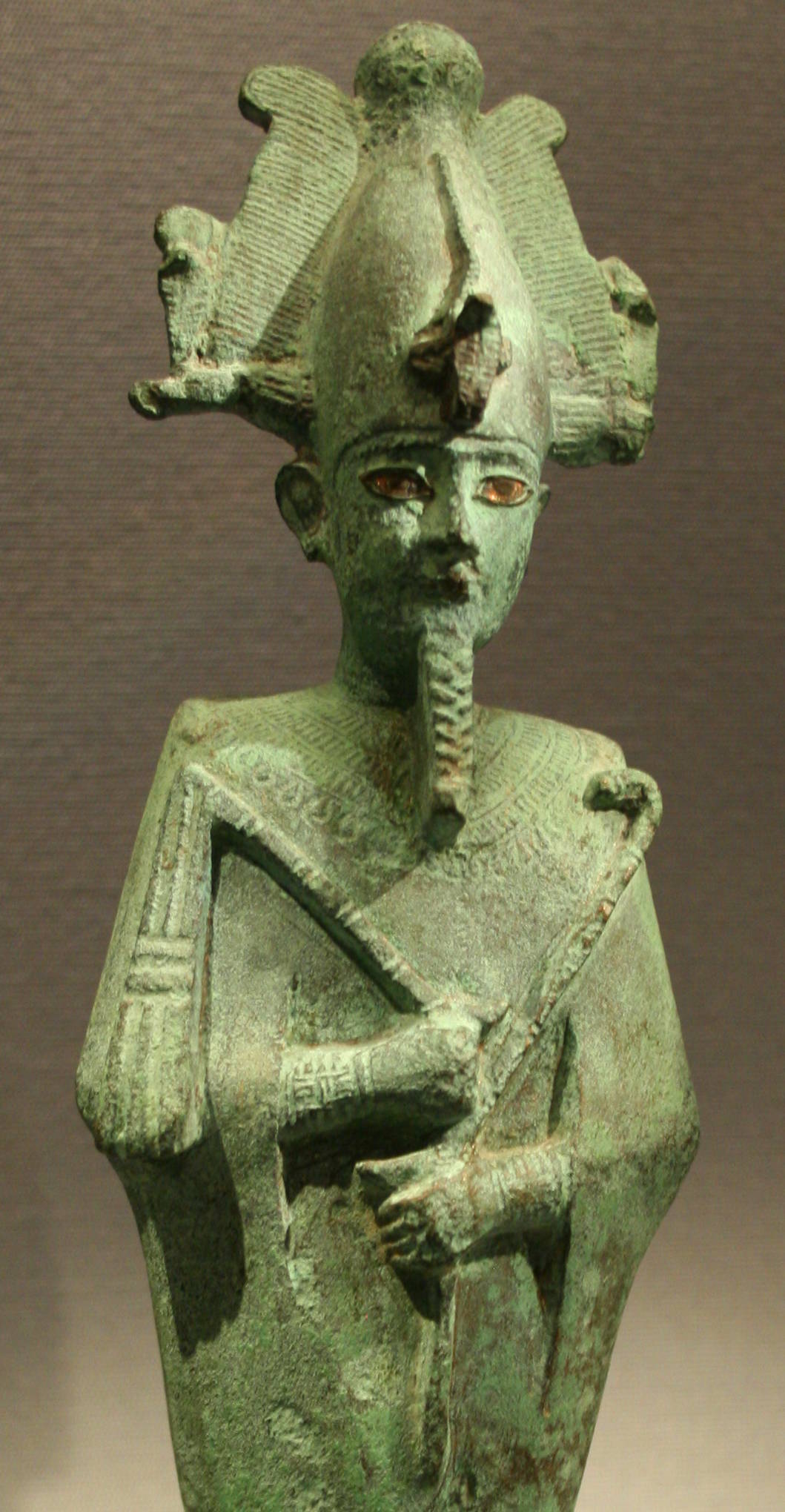
Osiris with an Atef crown made of bronze
Function and appearance
In ancient Egypt he was revered as a father-figure and god of life, fertility, agriculture, vegetation, the dead, resurrection, and the afterlife.2 He was green in colour, like the Green Man (Odin) of European pre-Christians, and he could be depicted with horns, like our Green Man.1 He symbolizes our oneness with the Earth, and as the Green Man, Odin became the god of the forest.3 Ireland has an especially deep connection to the colour green and green men.1
European names after Osiris
Among Celts the Green Man was also known as Cernunnos or Herne the Hunter, further known as the mighty hunter Nimrod and Odin. Also, add an H on the end of Osiris and we get OsIrish.1
Date connection
Osiris was killed on the 17th day of the 3rd month of the ancient calendar and the Irish St. Patrick celebration is on 17 March.1
Eye and rainbow
Osiris is also connected to the eye (iris) and rainbows (Iris the Greek goddess of the rainbow). Odin sacrificed his eye to gain wisdom, a rainbow connects our world (Midgard) to the realm (Asgard) of gods, and Bifrost is a burning rainbow bridge between Midgard and Asgard.
Crucifixions
Osiris
Osiris was shown stretched on the immense cross formed by the junction of the meridian and the equator. He was suspended in the Phrygian mysteries to a cruciform tree which was cut up and distributed as a talisman, and which became the Lignum Vitae. This represents “salvation by wood” (Thomson, 1872).4
Osiris, Horus and Prometheus
“Osiris and Horus [one of the most significant ancient Egyptian deities, served many functions] were crucified as “saviours ” and “redeemers”; the sufferings, death, and resurrection of Osiris forming the great mystery of the Egyptian religion. Prometheus [a Titan god of fire], of Greece, was with chains nailed to the rocks on Mount Caucasus, “with arms extended,” as a saviour; and the tragedy of the crucifixion was acted in Athens 500 years before the Christian era” (Hardwicke, 1899).5
Odin
“I know that I hung, on a wind-rocked tree, nine whole nights, with a spear wounded, and to Odin offered, myself to myself; on that tree, of which no one knows from what root it springs” (Odin’s Rune-song, Hávamál).6
Esus
In addition to the above-mentioned crucifixion stories (cross, tree, wood, sacrifice, crucifixion, saviour, redeemer, death, resurrection) that pre-date the Jesus crucifixion tale, there is the story of Esus (Celtic: “Lord,” or “Master”).7 From Britannica:7
“Esus was a powerful Celtic deity, one of three mentioned by the Roman poet Lucan in the 1st century AD; the other two were Taranis (“Thunderer”) and Teutates (“God of the People”). Esus’ victims, according to later commentators, were sacrificed by being ritually stabbed and hung from trees. A relief from the Cathedral of Notre-Dame in Paris portrays him as a bent woodman cutting a branch from a willow tree.”
Esus became Jesus
To clarify, Esus was a killer carpenter (a wood cutter who stabbed and hanged people from trees). Although the New Testament is quiet about this aspect of J/esus’ character, Esus became Jesus for the purposes of Christianity. Both Esus and Jesus were carpenters, both were involved in human sacrifice on wood (Jesus was allegedly sacrificed on a wooden cross) and both were involved in stabbing (Jesus was supposedly stabbed while on the cross).
The Celtic Cross
The solar saviour, crucified upon the cross of the seasons, is portrayed by the Celtic Cross, which often sits on an obelisk-like base.1
Paganism was the norm
All peoples of ancient times were pagan: the ancient Greeks, Romans, Egyptians, Babylonians and Teutons (Germanic peoples — their modern representatives include the Germans, Dutch, Flemings, Danes, Swedes, Norwegians, Icelanders, Anglo-Saxons of England and lowland Scotland, and all their descendants in the New World), Celts and Slavs. The polytheistic Hindu and Shinto faiths of India and Japan respectively, are forms of paganism that survived into modern times, as are the animist religions of sub-Saharan Africa. In a sense paganism is the only universal form of religion known to man. Odinism is but one branch of the pagan family of religions.8
Further, polytheism (the belief in many gods and goddesses) is a common feature of ancient religions. These pagan or ‘natural’ religions are in contrast to the ‘prophetic’ or ‘revealed’ religions allegedly founded much later by individuals like Confucius, Buddha, Moses, Jesus and Mohammed.8
Odin fragments in Christian society
Saint Michael
Odin was transformed into St. Michael, the warrior-angel who led the hosts of Heaven.3
Christmas
The pre-Christian festival for celebrating the coming of the sun (longer, warmer days and a new growing season) involved cutting down the Yule tree and burning the Yule log.3 The evergreen Yule tree (stripped of its meaning in the Christian “Christmas tree”) symbolized Yggdrasil and life.9 Among his many roles, Odin was a bringer of gifts, including sunshine and life. Druids honoured him by tying gilded apples to the Yule tree as a symbol of fire. As occurs at Christmas (but without the depth of meaning), in return, sacrificial harvest gifts were left in socks, boots, and clogs for Odin’s holy eight-legged steed Sleipnir (glider).3
Santa Claus (Saint Nicholas, Father Christmas)
This concept began with Odin. Until the early 1900s, Santa Claus was in the image of a fur-clad Odin / Herne with deer antlers sprouting from his head. From ancient times, horns on humans symbolized divinity and fertility. The current image of Santa Claus with his white fur-trimmed red velvet outfit was created by the Coca Cola company in the early 1900s.3
Santa Claus’ reindeer sleigh
“Sleigh” is from “Sleipnir,” the name of Odin’s eight-legged steed that could gallop at immense speed across the entire nine worlds. As Odin had to travel to the underworld at times, the eight legs of Sleipnir are also symbolized by the eight legs of funeral pallbearers carrying a coffin.3
Valhalla
Valhalla (one of Odin’s three great halls in Asgard — the realm of super-conscious awareness) was changed into a limited concept of Heaven in Christianity.3
Wednesday
This day of the week (Wotan’s day) was originally named in honour of Wotan / Odin.3
Wagner’s Der Ring des Nibelungen
Odin appears in the first three of these music dramas by Richard Wagner: Das Rheingold (Entry of the Gods into Valhalla — listen here), Die Walkuere (The ride of the Valkyries — listen here) and Götterdämmerung (Siegfried’s Funeral March — listen here).
J. R. R. Tolkien’s Lord of the Rings
Tolkien acknowledged the influence of pagan mythology in this book2 and in particular the Norse god Odin seems to have played a key role in the development of Gandalf’s character. Ways in which Odin is represented by Gandalf include:
Horses
Odin has a legendary horse, Sleipnir (eight legs, can run on the ground and through the air at great speeds). Gandalf has Shadowfax (no equal among horses in Middle-earth).10
Spear / sword / staff
Odin has a legendary spear Gungnir (also carried as his staff when wandering the earth as an old man; the spear never misses its mark when thrown11); Gandalf has a legendary sword Glamdring and the stave he carries has magical properties.10,11
Sacrifice for wisdom
Odin hangs himself, with a spear in his side, on the tree Yggdrasil for nine days in order to gain wisdom and power. Gandalf sacrifices himself defeating the Balrog, and is given back his life with increased wisdom and power after this fight.10,12
Wandering wizards
Odin and Gandalf both take the form of an old, grey beggar with a wide-brimmed hat and grey cloak when they wander the mortal world and deal with the inhabitants.13 Gandalf the grey is a version of ‘the Odinic wanderer’.14
Diminished earthly forms of themselves
In his earthly guise, Odin accrues many names, e.g. Broad-hat, Long-beard, Grey-beard, Bearer of the (Magic) Wand, Way-weary, Wayfarer, and Wanderer. Similarly, Gandalf is the name of his diminished version of his Maia state, in which he is known as Olorin.10,14
Association with birds
Both use birds as sources of information and occasionally quick transport. Odin has Huginn and Muninn, two ravens that fly over the world to bring him news.11 Similarly, Gandalf is brought tidings from the eagle, Gwaihir Windlord.10 They are even similar in thought and deed, as both use their bird companions to gather news about earthly people whom they care for and protect.
Apocalypse
The ‘end of times’ are described in Norse mythology as Ragnarok, a series of apocalyptic events that define the end of the world, where giants of frost and fire band together to fight against the gods in a final battle that destroys the planet, submerging it under water.15 Although Ragnarok is not exclusively about Odin, notable features include:
- Warnings to man. Betrayal, societal breakdown; devastating and unending winter for three years; global warfare.16
- Warnings to others. A rooster warns the giants, a second rooster warns the dead, a third rooster warns all the gods about the beginning of the end; a trumpet blast (the god Heimdal blows a thunder blast on the Gjallar-horn to awaken the nine worlds) brings selected dead people back to life.15,17
- Location. This final battle between good and evil occurs at Vigrid (equivalent to Armageddon, Revelation 16:16).15,16
- The battle. The seas are torn, the World Serpent (so large that it surrounds Earth and grasps its own tail) raises itself from the depths of the oceans to join the battle; dragons release fire that destroys all life on Earth;15 a giant wolf (Fenrir) swallows the sun and moon and causes stars to crash into Earth; mountains collapse into fragments, and the entire planet quakes in an immense bedlam of molten lava.16
- Regeneration. There will be a new Heaven and a new Earth, repopulated by a man (called Lifthrasir) and a woman (called Lif) who sheltered from the holocaust in Yggdrasil, the World Tree. The sons of the old gods remain alive, the god of purity and justice (Balder) is reincarnated, and together they create a new race of divinities, to rule a newly purified and rejuvenated universe.16,17
Odinism
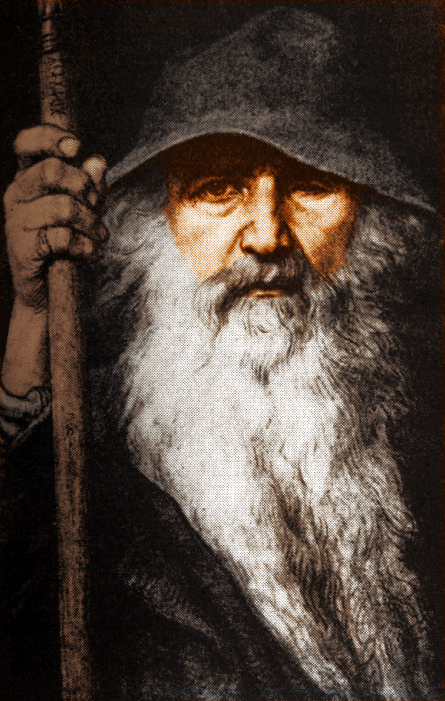
Odin in his guise as a wanderer, by Georg von Rosen (1886)
Odinism (Wotanism) is essentially a profound understanding of the laws of Nature and of our purpose in life. The Gods and other icons symbolize humankind’s struggle from egocentric limitations toward the highest evolutionary levels of super-conscious awareness.9 Odinism is the religion of our Forebears.18 It was the main religious belief over all northern Europe and part of the central regions as well as the British Isles,18 i.e. Odinism is the ancestral religion of many or most people living in what are now Norway, Sweden, Denmark, Iceland, England, Scotland, Ireland, Wales, France, Belgium, the Netherlands, Germany, Russia, Austria, northern Italy and Spain.19
Odin (Wotan) is the central figure in this religion.18 The name Odin is etymologically connected with the Latin “vadere” and means movement, or source of movement, power, a manifestation of the highest god as ‘the mover of things’.18 He is the supreme god, god of Heaven, Heaven itself; the fountain-head of wisdom and founder of poetry, writing, and culture; lord of battle and giver of the highest blessings, especially of victory; later, of magic and sorcery. His is the creative power: out of Ash and Elm he made man and woman.20 Usually Odin is shown as a distinguished old man with a wide-brimmed, floppy hat concealing his face. From his throne (Hildskialf) he can see all of the nine worlds and witness the activities of man and god.21
“Pagan” and “heathen” were Christian insults
People who prayed to Odin called themselves Odinists (or Wotanists),22 as do Odinists today. However, Christians expressed their contempt for those (Odinists) who revere gods and all their creations by calling them pagans (pagani: villagers, equivalent to the modern insult, “peasants”) and later heathens (from Old English hæðen: not Christian or Jewish).2,18 The terms “heathen” and “pagan” are synonymous and interchangeable.8
Endurance and recovery of Odinism
Where I live (Isle of Man) in the British Isles, until the early 1900s, Odin still featured prominently in Manx culture, e.g. in 1903, for Fair-days here, people still made cakes of ginger-bread moulded into the figures of Odin, his wife Frigga, their son Thor, Odin’s horse Sleipnir and a rooster (likely Goldcomb, who crows in Valhalla).20 Odinism and our true culture never completely died out here, and as is occurring in other Celtic nations, it’s now making a strong recovery.
More generally, although Odinism was almost exterminated in the fifteenth century,23 it was kept alive and passed on by actual practitioners.9 Indeed, according to Odinic Rite Australia,19 in Australian (and British and US) law, Odinism is described as “the continuation of … the organic spiritual beliefs and religion of the indigenous peoples of northern Europe as embodied in the Edda ….” [my emphasis]
As is evident from the many Odinist organizations around the world (see Resources below), the strong recovery of Odinism is widespread. It’s also interesting to consider the substantial history of some Odinist groups, e.g. The Odin Brotherhood23 claims an unbroken historical lineage from 1421.
How intelligent Odinists view the myths
The myths were not intended to be read as a history of actual events. Odinists believe in the spiritual truths expressed in myth, not the story as such.8 Similarly, although the gods and goddesses are depicted as human-like, intelligent Odinists knew the Aesir are gods, divine spirits, not humans. Our Forefathers depicted the gods as human-like because our human minds find it easier to grasp spiritual truths when they are expressed in familiar terms. Every detail of the gods’ physical attributes and behaviour recorded in the myths indicates an underlying spiritual truth.8
Other names for Odin
Apart from his German name, Wotan (Wuotan in the High German form), Odin is also called Woden.18 Among Celts, Odin was also known as Cernunnos, Herne the Hunter, the mighty hunter Nimrod, and the Green Man. In Isle of Man, Odin’s names included Grim (on account of his broad-brimmed hat or a hood), a name that occurs in two of our runic inscriptions; Gautr (Father); Ygg (Awe); Lord of the Gallows (all who died by hanging were dedicated to Odin); Hnikar (a water-god — commemorated in the Nickey fishing boat rig and the ancient place-name “Nikkeson,” a pool on the Glen Roy river). As in other places, on this Island the term “Old Nick” refers to Odin.20
Among old Germans, Odin / Wotan was known as All-Father, Lord of Hosts, Lord of the Spear, Smiter, All-Knowing, Fulfiller of Wishes, Farspoken, Shaker, Burner, Destroyer, Protector, and Gelding.3
Odinist Cosmology
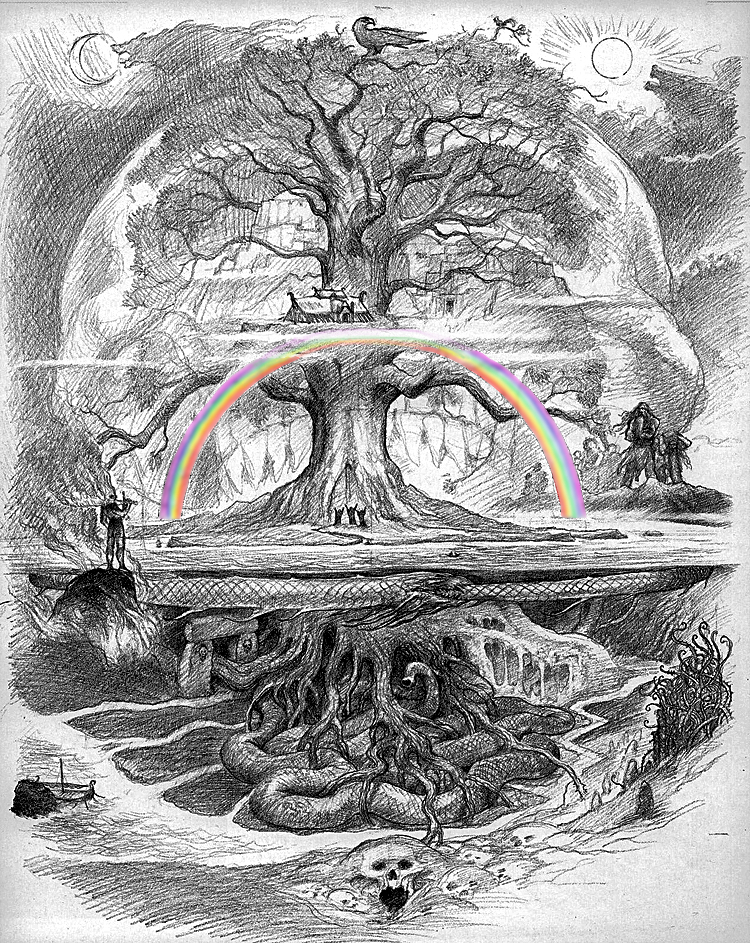
Yggdrasil, illustrated by John Howe
In Odinism there isn’t a simplistic dichotomy of ‘Heaven and Earth’. Odinist mythology explains that, just as there are many gods, there are also many ‘worlds’, i.e. many planes of existence, or dimensions of reality, interconnected, overlapping and inextricably enmeshed with one another. The myths describe these different aspects of consciousness as the Nine Worlds.8 This integrated, dynamic and evolving psycho-spiritual model represents the complexity of our being in ways that are uniquely suited to the European psyche.
This is a short version of a detailed explanation given by experienced Odinist, Jost Turner (1994):9
Yggdrasil
All existence is allegorically placed in nine worlds, protected and sustained by a great tree called Yggdrasil. Yggdrasil is key to a complete understanding of all the allegories.
At the very top of Yggdrasil sits an eagle (intuitive faculties of the super-conscious) with a hawk (all-seeing eye of intuition) perched between its eyes.
A squirrel (Ratatosk; life energy travelling up and down the spine) runs up and down Yggdrasil’s trunk carrying insults between a serpent (Nidhogg) gnawing at the root and the eagle at the top (conflict between demands of the senses and aspirations to higher awareness).
The Nine Worlds
Yggdrasil is the axis of nine worlds. These worlds are on three levels, symbolizing three basic levels of consciousness.
The three levels of consciousness
- The worlds of (i) Asgard (for our principal gods, the twelve Aesir), (ii) Vanaheim (for the Vanir, another and perhaps older family of gods), and (iii) Alfheim (for the Light Elves, a god-like race of elves). Within Asgard is a realm (Valhalla) of joyous life after death for those who were self-disciplined and overcame subconscious barriers to reach early stages of super-conscious awareness.
- The worlds of (i) Midgard (for mortals), (ii) Nidavellir (for the dwarfs), (iii) Svartalfheim (for the dark elves), and (iv) Jotunheim (for the giants).
- The worlds of (i) Niflheim (a dark and cold realm for the dead), and (ii) Muspellheim (world of fire).
The first level is linked to the second level by a flaming rainbow bridge of shimmering light (Bifrost).
Roots into the levels of consciousness
Yggdrasil has three great roots. Each root is sunk into one of the three levels of consciousness:
- Under this root is the Well of Urd, by which sit three goddesses of destiny.
- Under this root is the Well of Mimir, which is a great source of wisdom.
- Under this root is the Spring of Hvergelmir, the source of many rivers, and where Nidhogg (the above-mentioned serpent) and other serpents tear apart corpses and gnaw at the root.
Odinist Values
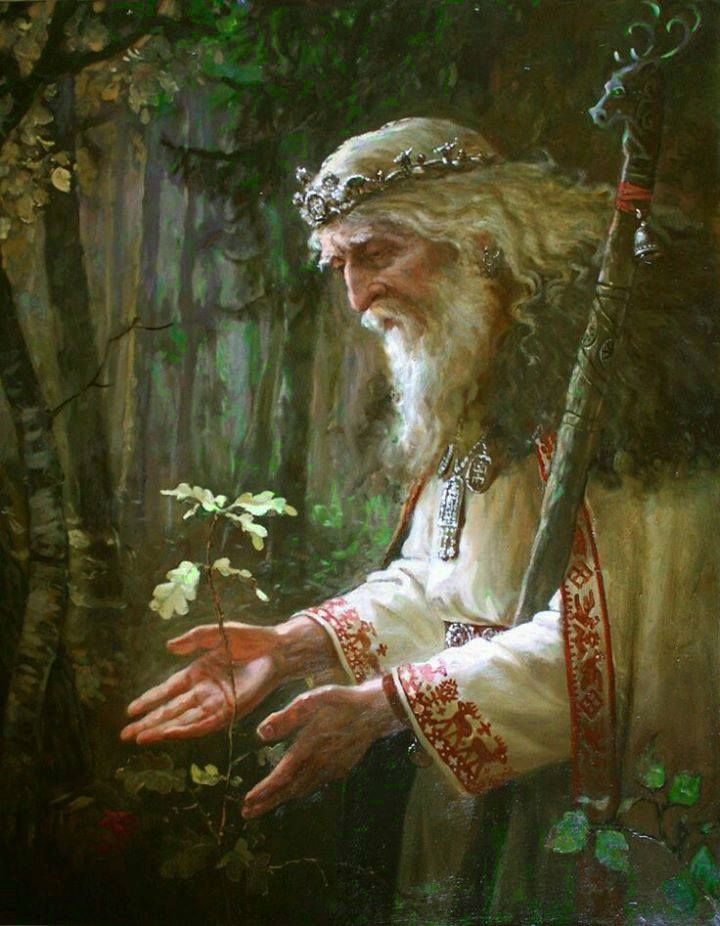
Druid with an oak tree
Nature
Like aware people today, Odinists experienced the natural world as a living thing, toward which the natural attitude is respect and reverence.18 In Odinism, Nature is Divine, man is part of Nature, and there is a natural communion between man and Nature.18 Odinists saw all creatures as expressions of God and all human races as playing valuable roles within a Divine process.24,25
Odinists continue to acknowledge Nature as a true manifestation of the spiritual. They see consciousness as an intrinsic property of creation, from the level of atoms through to creatures with complex nervous systems like ours. This does not mean that simpler systems have human-like thoughts or feelings, only that everything in the universe has the capacity for consciousness in some form, however faint. This ancient knowledge is consistent with what modern scientists know as the primacy of consciousness. Odinists see all animals, plants, mountains, rocks, seas, rivers, islands, Earth and the cosmos as a whole, as spiritually endowed and alive to some degree.8
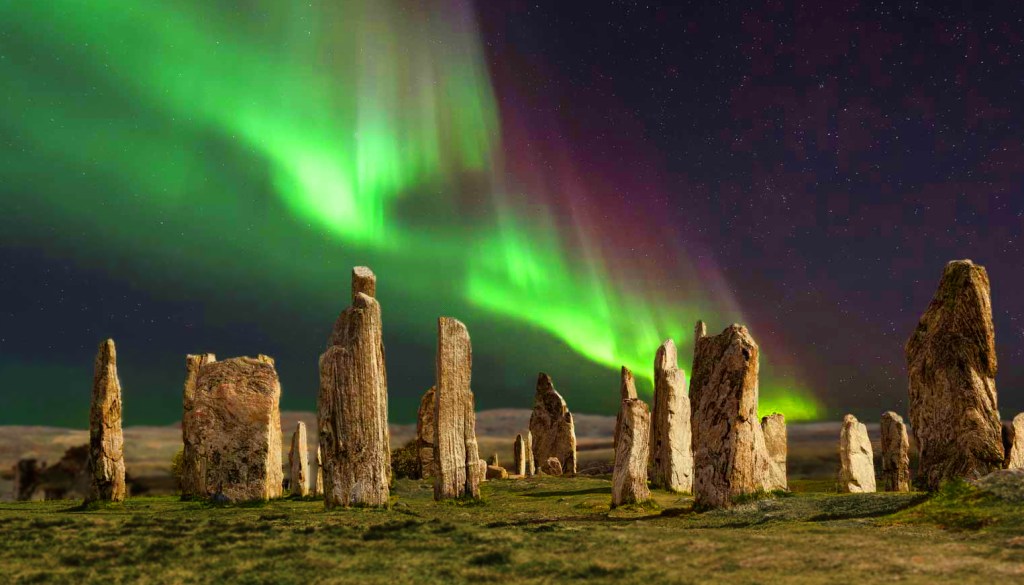
Concerning rocks in particular, in many lands shapeless stones have been adored. Among several ancient nations the idea of Divinity was symbolized by a rough stone. Circles of upright stones have been found in Japan, China, India, the Pacific Isles, Persia, Arabia, Palestine, Barbary, North and South America and in every country of Europe, including the British Isles.26
The Druids
The name “Druid” comes from the Indo-European word ‘dru’, meaning oak.27 Druids were priests of the Celts. They saw all life as sacred and worthy of protection. Druids venerated the earth and plants, especially trees. The oak symbolized tradition, wisdom, longevity28 and the omnipotent God.27 Their ceremonies were held in oak-groves27 and the oak tree was absolutely sacred to the Druids.28 Chopping down a great oak was punishable by death. Other sacred wood was the yew, hawthorn and more especially the rowan tree. A Druid’s staff was usually made from wood of the yew tree, a tree believed to be the guardian of the mysteries.28
Spirituality
As is already evident from the above, Odinists and Celts in particular were deeply spiritual.28 Although Odinism is a most spiritual religion, Odinists do not despise material aspects of human nature and the world. However, Odinists recognise that humans are primarily spiritual beings — we are instances of an imperishable and eternal Self.8
Odinism includes concepts of:
- A soul
- Life after physical death
- A relationship between level of awareness during life in this world and level of continued consciousness
- A realm of highest joy reserved for those who overcame ego-consciousness and reached states of super-consciousness
- Continued evolution of consciousness after physical death
- Esteem for the dead, including all our ancestors8,9,22,28
Creativity
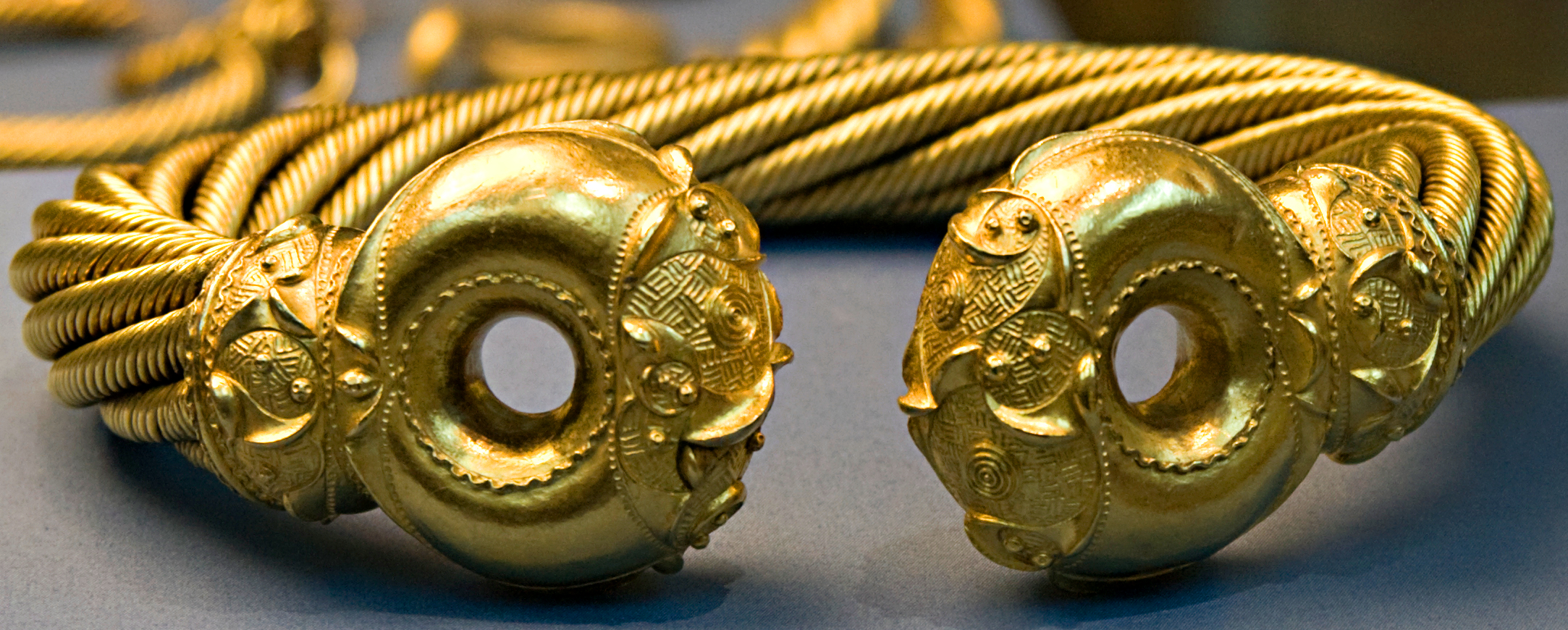
A Celtic torc in the British museum
Modern man associates civilization with buildings but Celts did not value these things. Instead, their values and genius are expressed in original and high quality fine art, jewellery, weaving, music and eloquence. Celts made exquisite abstract designs in metal and incised stone. Concerning music, the ancient Greek god Apollo (received his trademark harp from his brother Hermes who invented the instrument) was also a god of the Celts. This is reflected in the ancient history of the Irish harp, which is as much a symbol of the Celts as the Shamrock.28
Ethics
True Odinists embrace the cause of the Aesir.8 Therefore they:
- Act in ways that promote and respect Nature, order, life and creativity
- Shun harmful behaviour that threatens the well-being of the folk, faith and family
- Reject all forms of totalitarianism
- Accept common law for the common good
Odinist ethics are not expressed as prohibitions and commandments. They are stated as virtues (the Nine Noble Virtues29) to be practised by all Odinists: Courage, Truth, Honour, Fidelity, Discipline, Hospitality, Industriousness, Self-reliance and Perseverance.8,29
Sacrifices
Sacrifice was the most widespread form of communal worship practised by pagans in ancient times. A gift was offered to the gods in order to earn their favour and rewards.8 Intelligent pagans knew that the sacrifice is symbolic and that — as with all gifts — it’s the thought that counts. Sacrifice to the gods demonstrated devotion by the worshipper.8 In modern times Odinists do not practise animal sacrifices but they continue to apply the underlying theological principles. The form of sacrifice practised by modern Odinists is the libation of mead, accounts of which have been recorded in the literature. It was known in ancient times as the Cup of Remembrance.8
Theologically the pagan sacrifice is a ‘sacrament’ (Christianity borrowed this term from paganism), i.e. it is a symbol which effects what it symbolises and symbolises what it effects.8
Religious festivals observed
Odinists worship the gods in feasting and merry-making. The calendar used by Odinists in Britain today is based on festivals most widely celebrated by our ancestors, especially those which survived as part of our people’s folklore. There are six major feast days: The solstices and equinoxes, Sigurd’s Day (23 Apr) and Heroes’ Day or Einheriar (11 Nov).8
Other religious rites
Pledge of Faith. This initiation rite is a solemn and formal public declaration that occurs after an Odinist reaches the age of majority. The priest proffers the oath-ring, which the aspirant grasps while repeating the pledge.8
Handfasting or Wedding ceremony. The couple make solemn vows together while holding the altar oath-ring in their hands, and finger-rings are exchanged to serve as a reminder of this act. Then the Thor’s Hammer is laid upon the bride and groom by way of blessing. Odinists hold the ties of marriage and family relationships to be sacred.8
Naming ceremony. New-born babies receive their name and in accordance with an old pagan custom (prevalent long before the introduction of Christianity) water is poured over the infant.8
Laying to Rest. This may take the form of burial or cremation.8
Thor’s hammer
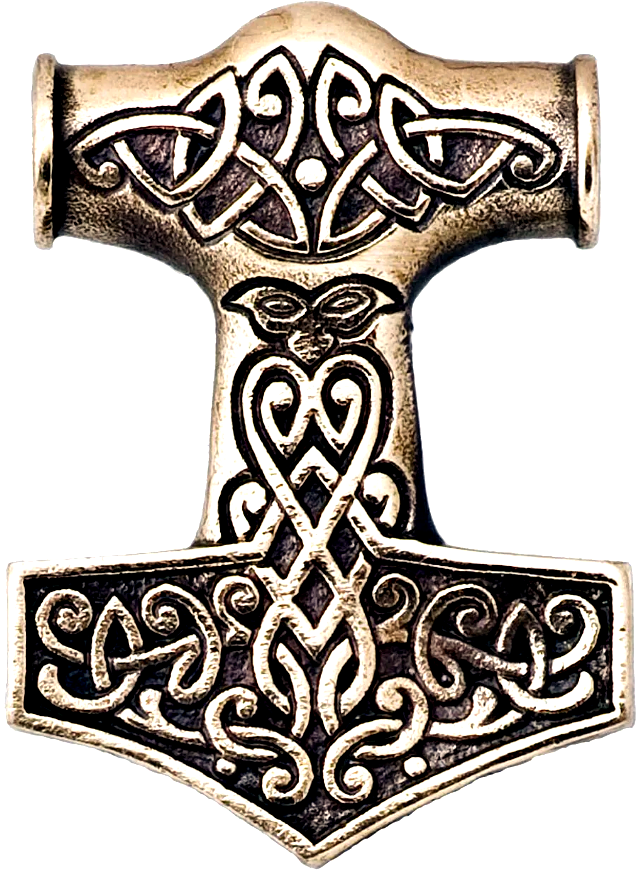
A Thor’s hammer pendant
All religions have an emblem or symbolic device. In Odinism this is the Thor’s Hammer. The Eddas call it Miollnir, i.e. the ‘Crusher’ or ‘Grinder’. From the literature it is apparent that Odinists have used this symbol in their liturgies since ancient times. It is primarily a sign of Divine reverence, commitment to work with the Aesir gods in their struggle against the forces of chaos, and protection by the gods.8
Places of worship
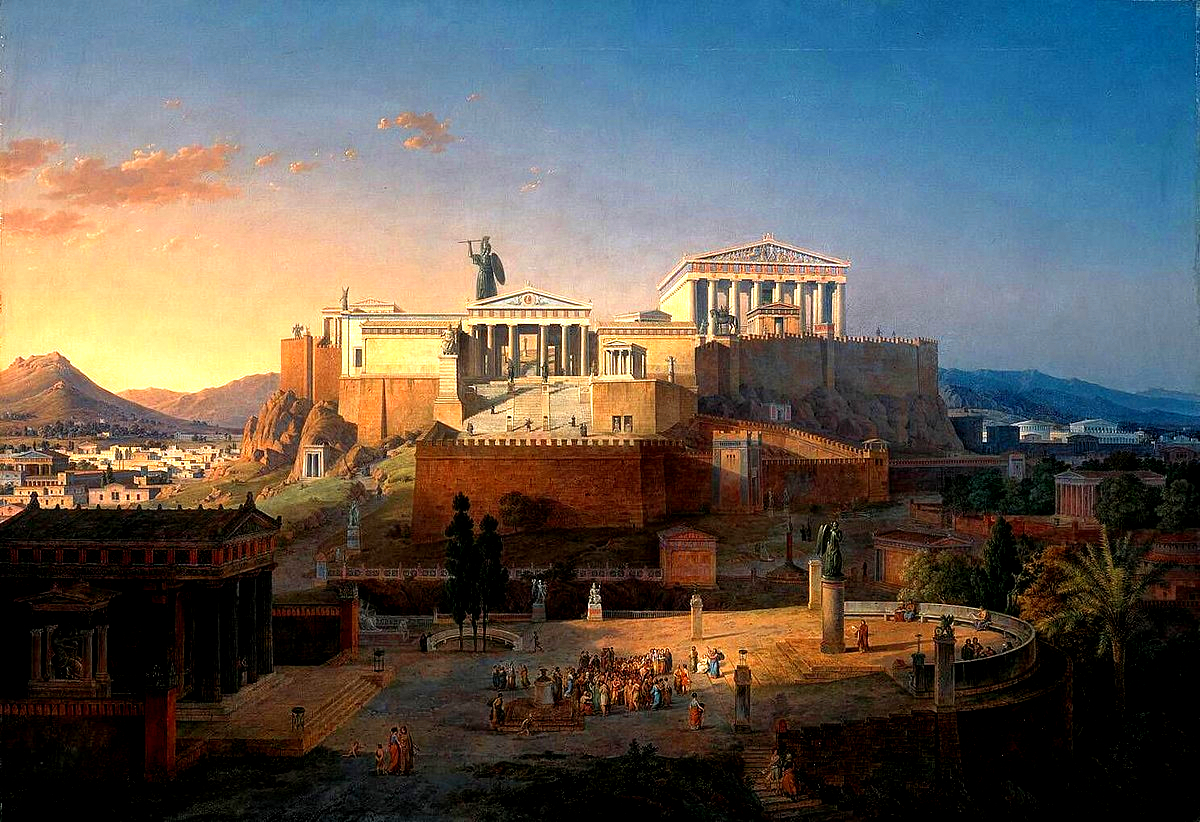
Acropolis and Areios Pagos in Athens by Leo von Klenze (1846)
Pagan temples such as the Acropolis and the Pantheon were among the grandest monuments built in Europe. Odinists also built and used countless other temples for celebrating their rituals.8 It seems that in the British Isles, Druids and others also used the Bronze-age stone circles (referred to above) as temples.26 Odinists aim to restore a network of temples in every country but in the meantime they meet in house groups called ‘Hearths’. Odinists also hold outdoor ceremonies at sites of special spiritual or historical significance or natural beauty.8
Congregation leadership
Provided they enjoy the confidence of their fellow Odinists, any adult Odinist, male or female, who has made the Pledge of Faith, may lead a congregation or perform priestly duties.8
Sacred texts
Odinists pay special attention to texts known collectively as the Eddas. They provide the most important primary sources of information on the old religion, and its theology, mythology and cosmology.8
Other primary sources
Other enlightening Odinist literature includes: The Icelandic Sagas and Snorri Sturluson’s ‘Heimskringla’; Saxo Grammaticus’s Latin work, ‘Gesta Danorum’; the medieval German ‘Song of the Nibelungs’; various Old English works, like ‘Beowulf’ and ‘The Nine Herbs Charm’; the Old High German ‘Merseburg Charms’; various other literary sources, such as the English, Norwegian and Icelandic rune poems; Tacitus’s ‘Germania’; Bede’s ‘Ecclesiastical History of the English Nation’; and the German ‘Wayland-Dietrich Saga’.8
No proselytising
Odinists aim to share knowledge of their cultural heritage with their compatriots but they do not try to convert adherents of other religions. They respect others’ rights to make their own decisions in religious matters. Further, although paganism is universal, the Odinist form of paganism is ethnospecific. Therefore Odinists would encourage people of other races to cherish their indigenous form of paganism, as pagans of all nations value being true to oneself and one’s ancestors.
Odinists deplore Christian and Muslim missionary work among less developed peoples, undermining their traditional customs and imposing alien moral and cultural standards on them.8
Our future
In Odinism, Örlög or Wyrd is the cosmic web of cause and effect that is influenced by, and influences, everyone. Örlög is not set in stone, for our choices in the moment are constantly modifying it. This differs from the concept of “fate,” because it does not imply being utterly bound by a predetermined future. Nonetheless, it means that we cannot escape the consequences of our actions. In Old Norwegian, the term ‘OR-LOG’ means something like First Law, Primal Law, Ultimate Law (The Law of God) and the ultimate purpose of Creation. The word ‘Wyrd’ is Old English and means ‘destiny’. Although ‘Wyrd’ is sometimes interpreted as ‘fate’, this is incorrect as our destiny is influenced by choices that we make now.29
Specifically, our Örlög / Wyrd depends on the extent to which we choose action that is biologically viable for our race, species and the Nature upon which all our lives depend. This applies equally to Jews. Like the ‘goyim’, most Jews are victims of deadly indoctrination by their ‘elites’. Whether they are called Khazars, Sabbateans, Frankists, Bolsheviks, Maoists, Maccabeans or Sicarii, Jews’ destiny is intertwined with that of the non-Jew and Nature.
Örlög and the Odin archetype
From Carl Jung (1936):30
- The gods are personifications of psychic forces.
- Human control ends when archetypes start to function.
- As the god of rage and battle, Odin represents the archetype of the awakened Aryan man.
- Inevitably, Odin will reveal the restless, violent, stormy side of his character.
- When this occurs, it will be like a hurricane that breaks loose while people still believe it’s fine weather.
Odinic rage in an Englishman’s poem
The Beginnings, a 1917 poem by English writer Rudyard Kipling (1865 – 1936):
It was not part of their blood,
It came to them very late,
With long arrears to make good,
When the Saxon began to hate.
They were not easily moved,
They were icy — willing to wait
Till every count should be proved,
Ere the Saxon began to hate.
Their voices were even and low.
Their eyes were level and straight.
There was neither sign nor show
When the Saxon began to hate.
It was not preached to the crowd.
It was not taught by the state.
No man spoke it aloud
When the Saxon began to hate.
It was not suddenly bred.
It will not swiftly abate.
Through the chilled years ahead,
When Time shall count from the date
That the Saxon began to hate.
References
- Hunt, Kyle (2015 ). The Egyptian Connection to Our European Religion, Renegade Tribune, 6 Aug 2015.
- Wikipedia: Osiris
- McVan, Ron, (2017). Who is Wotan? Renegade Tribune, 24 Dec 2017.
- Thomson, Arthur Dyot (1872). On Mankind: Their Origin and Destiny, p 560, Longmans, Green.
- Hardwicke, William Wright (1899). The Evolution of Man: His Religious Systems and Social Ethics, p 244, Watts & co.
- Thorpe, Benjamin (1865). The Edda Of Sæmund The Learned (Edda Sæmundar Hinns Froða), from The Old Norse Or Icelandic, London, Trübner & Co.
- Britannica (2021). Esus, Celtic deity
- Odinist Fellowship, London
- Turner, Jost (1994). The Path of Wotan
- Tolkien, John R. R. (1995). The Lord Of The Rings, Harper Collins.
- The Prose Edda, also known as the Younger Edda, Snorri’s Edda (1916), by Snorri Sturluson.
- The Poetic Edda, also known as the Elder Edda, Saemund’s Edda (1908). Edited and translated by Olve Bray.
- Pitts, J. A. (2011). The Quiet Sense of Foreboding That Is Norse Mythology, Tor.com, 26 Oct 2011.
- Drout, Michael D. C. (2006). Old Norse Literature, J.R.R. Tolkien Encyclopedia Scholarship and Critical Assessment, New York: Routledge.
- Black, John (2020). The Story of Ragnarok, The Ancient Norse Apocalypse, 25 Jun 2020, Ancient Origins: Reconstructing the story of humanity’s past.
- Patrick (2017). Twilight of the Gods: The Coming of Ragnarok, Renegade Tribune, 25 Feb 2017.
- Mackenzie, Donald A. (1912). Teutonic Myth And Legend
- Christensen, Else, in Heathenism (2017), Renegade Tribune, 15 Jun 2017.
- Odinic Rite Australia
- Kermode, P. M. C. (1904). Traces of the Norse mythology in the Isle of Man. Read before the Isle of Man Natural History and Antiquarian Society, Ramsey, 18 Dec 1903.
- Roberts, Morgan J. (1994). Norse gods and heroes, publisher Friedman Group.
- Pastenaci, Kurt (1935). The Nordic Foundations of Europe, translated from the Third Reich original Die Nordischen Grundlagen Europas by Kurt Pastenaci, which appeared in the Feb 1935 issue of Der Schulungsbrieg.
- Odin Brotherhood
- Mills, Alexander Rud (1957). The Call of Our Ancient Nordic Religion: Reflections on the Theological Content of the Sagas. Coventry, England: Northern World Pub.
- MacCulloch, J. A. (1911). The religion of the ancient Celts, Edinburgh: T. & T. Clark.
- Renegade (2020). Stone Worship of the Ancient Irish, Renegade Tribune, 20 Jun 2020.
- Kelley, Ruth Edna (1919). The book of Hallowe’en, Boston: Lothrop, Lee & Shepard.
- McVan, Ron (2011). Way of the Druid, Pub. CreateSpace Independent Publishing Platform.
- Nine noble virtues of Asatru
- Jung, Carl Gustav (1936) in The Wotan Essay, Renegade Tribune, 15 Dec 2015.
Resources
Odinist organizations online
Odin Brotherhood This is a “secret society for men and women who value knowledge, freedom, and power.”
Odin Brotherhood in Spanish
Odin Brotherhood in South America (Spanish)
Odin Brotherhood in Portuguese
Odin Brotherhood material in Afrikaans: Odhin Broederbond
North America
The Asatru Alliance
Asatru Folk Assembly
Odinia International
Rune Gild
The Troth
Britain
Odinist Fellowship
The Odinic Rite
Germany
Eldaring.de
VfGH e.V. |
Netherlands
Het Rad
Italy
Comunità Odinista
Russia
Асатру-Магические Тайны Севера
Australia
Odinic Rite Australia
For information about Odinism and links to other Odinist organizations around the world, see WikiPagan.
Publications
Creed of iron: Wotansvolk wisdom by Ron McVan (1997) with forward by David Lane.
Articles on Wotanism and Religion by David Lane.
Literature listed by the Odinist Fellowship
The Prose Edda (aka Younger Edda)
‘Edda’ by Snorri Sturluson, translated by Anthony Faulkes (Everyman).
The Poetic Edda (aka Elder Edda)
‘The Poetic Edda’ translated by Carolyne Larrington (World’s Classics)
‘Poems of the Elder Edda’ translated by Patricia Terry (University of Pennsylvania Press)
‘The Poetic Edda’ translated by Lee Hollander (University of Texas Press)
‘The Elder Edda – A Selection’ translated by Paul Taylor, W H Auden & Peter Salus (Faber & Faber)
Popularisation of the Myths
‘The Norse Myths’ by Kevin Crossley-Holland (Penguin Books)
‘Tales of the Norse Gods’ by Barbara Picard (Oxford University Press)
Icelandic Sagas
Njal’s Saga’, ‘Laxdaela Saga’, ‘King Harald’s Saga’, ‘Orkneyinga Saga’ and ‘The Vinland Sagas: The Norse Discovery of America’ all translated by Magnus Magnusson and Hermann Pálsson (Penguin Classics)
Scholarly Works on Teutonic Heathenism
‘Gods of the Ancient Northmen’ by Georges Dumézil, translated by Einar
Haugen (University of California Press)
‘Gods and Myths of Northern Europe’ by Hilda Ellis Davidson (Penguin)
‘The Lost Beliefs of Northern Europe’ by Hilda Ellis Davidson (Routledge)
‘The Lost Gods of England’ by Brian Branston (Thames & Hudson)
‘Gods of the North’ by Brian Branston (Thames & Hudson)
Scholarly Works on the Runes
‘Runes’ by Ralph Elliott (Manchester University Press)
‘An Introduction to English Runes’ by R I Page (Methuen & Co)
‘Rudiments of Runelore’ by Stephen Pollington (Anglo-Saxon Books)
History of the Period
‘Anglo-Saxon England’ by Sir Frank Stenton (Clarendon Press)
‘The Anglo-Saxons’ by David Wilson (Pelican Books)
‘The Vikings’ by Johannes Brondsted (Pelican Books)
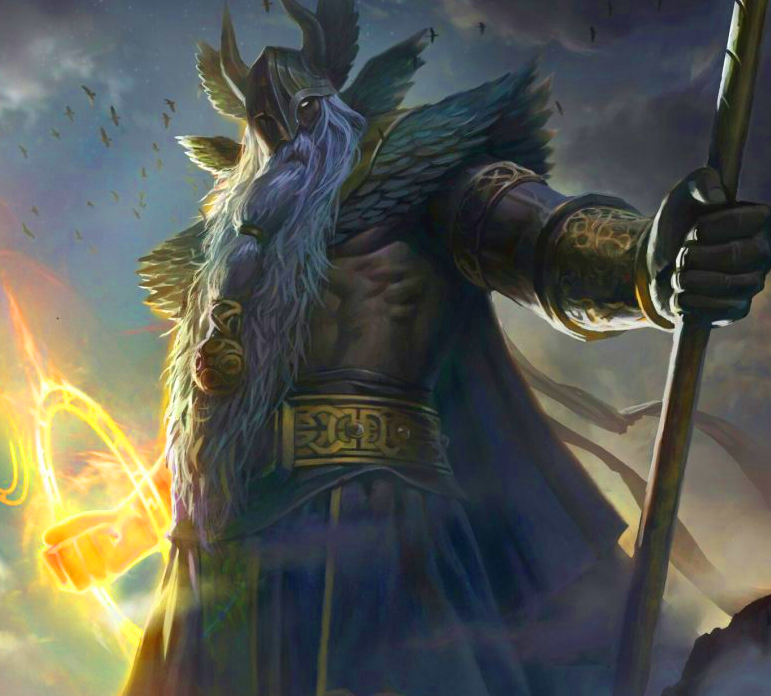
Odin as the god of rage and battle


 Toward the Light