Tag: Oera Linda Book

  • Aryan makers of man 1: Aryans

    Aryan makers of man 1: Aryans

    Aryan man

    This is the first part of a three-part article series that will cover (i) Aryans, (ii) the Aryan ETs known as Anunnaki, and (iii) the creation and civilization of humans by the Anunnaki, including the true religion of Aryans.

    Post outline

    1. The importance of education about Aryans
      1.1 Individual psychological benefits
      1.2 Inter-generational and family-level benefits
      1.3 Community and societal benefits
      1.4 Health outcomes
      1.5 Educational and economic advantages
      1.6 Heinrich Himmler and Adolf Hitler
    2. What is an Aryan?
    3. Language of the gods
    4. Outflow of Aryans
    5. Interconnectedness of Aryan populations
      5.1 Supporting evidence
      5.2 Recommended viewing
    6. References

    1. The importance of education about Aryans

    There are well-documented positive effects for people who engage with their history, ancestry, culture, and collective identity.

    1.1 Individual psychological benefits

    This includes stronger sense of identity, higher self-esteem, internal locus of control, reduced anxiety, and greater emotional resilience.1,2,3

    1.2 Inter-generational and family-level benefits

    This includes improved parent-child relationships, healthier adolescent development, and transmission of coping strategies.4

    1.3 Community and societal benefits

    This includes enhanced social cohesion, stronger interpersonal networks and access to support, improved mental health at community level, long-term community building and quality of life improvements.5,6

    1.4 Health outcomes

    This includes lower cortisol and inflammatory markers (linked to cardiovascular health) and improved healthcare access.7

    1.5 Educational and economic advantages

    This includes educational achievement, economic collaboration, and civic engagement.8

    1.6 Heinrich Himmler and Adolf Hitler

    Heinrich Himmler, chief of the SS, was a highly educated man with a strong research interest in ancient Aryan lore, Germanic traditions, and the primeval Teutonic past. In 1935 he created an elite research institute called the Ahnenerbe to investigate and document the vast history of white Aryan accomplishment as of the Paleolithic or Old Stone Age.9

    His research showed that the Aryan race has roots far beyond just Celtic, Slavic or Germanic. He found that the Aryan race shows a unity of language, ethnicity and culture extending into a much more distant antiquity. Specifically, like other investigators of this subject, Himmler’s findings indicated that the Aryan race descended from the gods as described in the Eddas and other Icelandic sagas.9

    Concerning the value of this race, in Mein Kampf (Chapter XI, Race and People) Adolf Hitler is clear:

    All that we admire in the world today, its science, its art, its technical developments and discoveries, are the products of the creative activities of a few peoples, and it may be true that their first beginnings must be attributed to one race. The maintenance of civilization is wholly dependent on such peoples. Should they perish, all that makes this earth beautiful will descend with them into the grave.

    2. What is an Aryan?
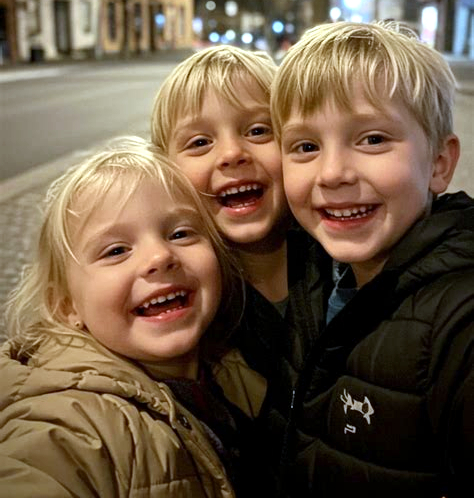

    Aryan children
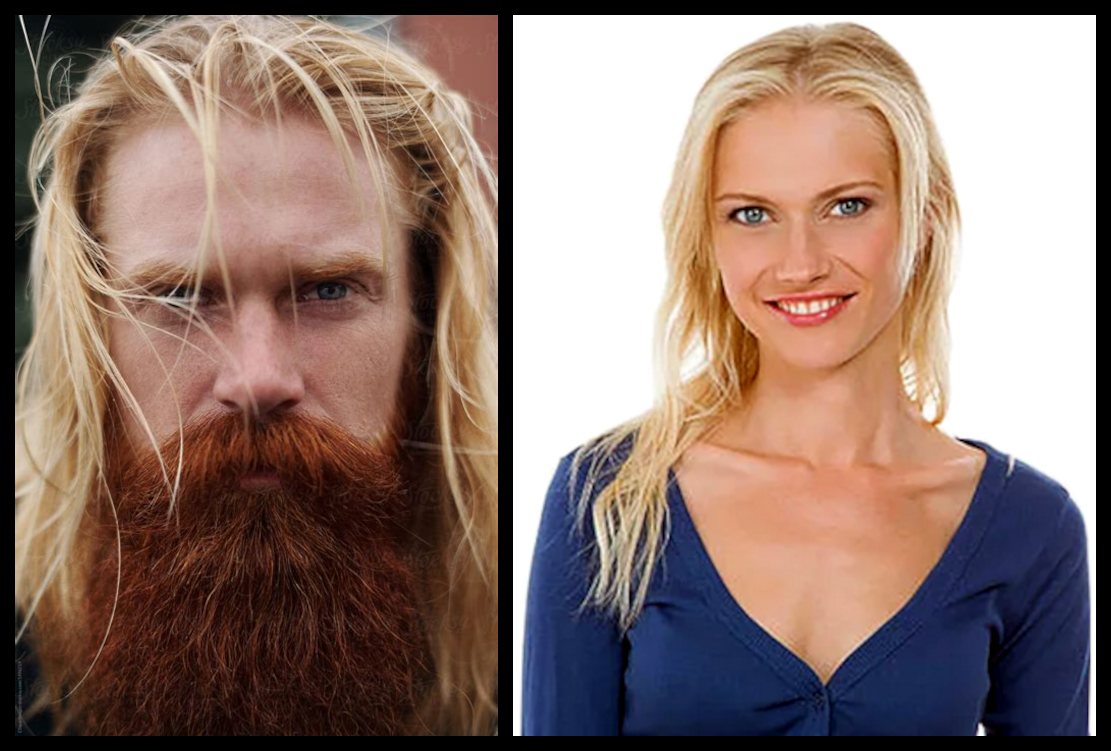

    Aryan man and woman

    After World War 2, “Aryan” was replaced by “White” in everyday use and by “Indo-European” for use by historical and linguistic specialists. However, the racial identity of White people remains Aryan. Similar to the designations of Asian, African, and Arab, we are Aryan (not “White”).10

    The name Aryans means the “Noble Ones.” The name is related to the Greek words aristos (“the best”) and arete (“excellence in virtue”).10

    Prehistoric Europe comprised three distinct populations of Aryans:

    • Western hunter-gatherers. This primordial population arrived in Europe about 45,000 years ago and developed a culture of egalitarian individualism in the northwest areas of Europe.
    • Early Farmers. The farmers arrived from Anatolia about 8,000 years ago and had the greatest genetic effect on the hunter-gatherer population in the southern areas of Europe.
    • Indo-Europeans. These Aryans migrated from the Pontic-Steppes as of about 4,500 years ago and had the greatest genetic impact on central Europe and some regions in the north, with less effect in the east and south.11

    This racially homogeneous collection of tribes called themselves the “Aryans,” all spoke the same language, and they had a common religion, legal system and social structure.10

    3. Language of the gods

    Concerning Aryans’ initially shared language, perhaps the following quote from the Oera Linda Book12 (discussed in this post) is a reference to that ancient language:

    “When Wr-alda [God] gave children to the mothers of mankind, he gave one language to every tongue and to all lips. . . . As thus our language . . . is rightly named the language of the gods, and all those by whom it is held in honour derive honour from it.” (p 69)

    Especially as the OLB always uses the word Wr-alda when referring to God, could this “language of the gods” be a reference to the language of the god-like beings known in ancient Sumer as the Anunnaki? Evidence presented by the distinguished British philologist Sir William Jones (1746 – 1794) is consistent with this view. In his Third Anniversary Discourse to the Asiatic Society (1786) Jones suggested that Sanskrit, Greek and Latin languages had a common root and that they might all be related to Gothic and the Celtic languages, as well as to Persian. He postulated a proto-language uniting Sanskrit, Iranian, Greek, Latin, Germanic and Celtic:13

    The Sanscrit language, whatever be its antiquity, is of a wonderful structure; more perfect than the Greek, more copious than the Latin, and more exquisitely refined than either, yet bearing to both of them a stronger affinity, both in the roots of verbs and the forms of grammar, than could possibly have been produced by accident; so strong indeed, that no philologer could examine them all three, without believing them to have sprung from some common source, which, perhaps, no longer exists; there is a similar reason, though not quite so forcible, for supposing that both the Gothic and the Celtic, though blended with a very different idiom, had the same origin with the Sanscrit; and the old Persian might be added to the same family.14

    Further, languages like Lithuanian and the Dutch Friesian Saxon Germanic root tongue appear to be even more similar to the lost proto-European language than Hebrew, Greek or Latin.15

    Perhaps the lost common source of these languages is indeed the language referred to in the OLB as “the language of the gods,” with the gods being the god-like ET humanoids known in ancient Sumer as the Anunnaki.

    4. Outflow of Aryans

    The great out-flowing of Aryans from their homeland in the Pontic-Steppes as of about 4,500 years ago involved:

    • The above-mentioned migration into Europe.
    • Migration across the Hindu Kush mountains and into the Indus valley, where they gave birth to the Classical Indian civilization.
    • Migration to the area now known as Iran, where they created the ancient Persian civilization.
    • Journeying further east, across the the Takla Makan desert and into Western China.10

    The Eastern Aryans intermarried with the more-numerous non-Aryan peoples whom they conquered, lost their distinctive racial identity, and eventually became extinct. The Western Aryans, who poured into Europe, conquered Greece, Italy, swept across Northwestern Europe as far as Ireland, and established the distinctive culture of the Germanic peoples.10

    The names “Ireland” and “Iran” both mean “land of the Aryans” and evidence the extent of Aryan settlement. Similarly, among the ancient Aryan civilization of the Hittites, there are documents referring to non-Hittites as “nata ara” (“non-Aryan”).10

    Excepting for the (racially related) Basques in the west and the Finno-Ugric peoples in the northeast, all the nations and peoples of Europe are descended from the Western Aryans. As the people they conquered were racially similar to them, the Western Aryans maintained their distinctive racial identity to this day after mixing with the “Old Europeans.”10

    5. Interconnectedness of Aryan populations

    From about 2,000 to 3,000 BCE especially, signs of deeply interconnected peoples began springing up everywhere, from the Tarim Basin in China to India and Persia, to Sumer, Egypt and Crete, to the Caucuses and the Steppes, with traces found as far away as North and South America, China, Japan, and Koreas.15

    Written descriptions, artistic depictions, and the most ancient remains exhumed, clearly illustrate that:15

    • These Aryans were a highly competent seafaring people who explored, mined, and settled far and wide.
    • Aryans formed the elite and ruling class of the regions that they occupied.
    • This widely distributed ruling class were close relatives or family in most cases, and they saw themselves as a race, tribe or extended family with kinship ties.
    • As this Aryan family spread across the world, they often became known by different names, with a single branch sometimes being referred to by several different names simultaneously.
    • These Aryans produced many great sages and leaders.

    In many cases, the populations living today in the once Aryan-ruled regions are poorly representative of those who lived and ruled there long ago. Also, modern border demarcations and labels for nations and cultures often bear little to no resemblance whatsoever to those in common usage long ago.15

    5.1 Supporting evidence

    A sample of the evidence showing interconnectedness of key Aryan populations in antiquity:

    Aryans –> Sumer

    When stripped of the specifics and reduced to their core elements, Sumerian stories and myths have countless parallels with the stories and myths of Northern Europeans.27 Further, evidence presented by Donald Mackenzie28 indicates that Aryans laid the foundations for the brilliant civilizations of the ancient world in southern Europe, Egypt, and the valley of the Tigris and Euphrates:

    • Much circumstantial evidence indicates that Sumerian culture originated from Central Asia, where vast areas of desert country were once lush and densely populated by advanced communities. For example, the Anau culture in southern Turkmenistan dates to 4,500 BCE, and it was preceded in the same region by Jeitun culture, which may have begun prior to 7,000 BCE.29 From these ancient centres of civilization, large migrations would have occurred in response to the gradual encroachment of wind-distributed sand and the increasing shortage of water. Evidence suggesting such early migrations from Central Asia include Copper Age artifacts: Clay votive statuettes found at Anau resemble those which were used in Sumer for religious purposes.28
    • A comprehensive study of thousands of ancient crania in London and Cambridge collections showed that Mediterranean peoples were distributed between Egypt and the Punjab. This indicates that the ancient Sumerians belonged to the same race as the pre-Dynastic inhabitants of Egypt and the Pelasgians and Iberians of Europe.28
    • The statuettes from Tello, the site of the Sumerian city of Lagash, have distinctly Mediterranean skull forms and faces.28
    • Fine and exact sculpture of the later Sumerian period shows that the ruling classes’ eyes were similar to those of the Ancient Egyptians and southern Europeans.28
    • Sumerian noses were of the Egyptian and Grecian type and not Semitic.28
    • Like the Ancient Egyptians, Sumerians habitually shaved their scalps and faces.28
    • Like the Egyptian noblemen of the Old Kingdom period, Sumerians wore short, pleated kilts, and left the upper part of their bodies quite bare.28
    • Like the other people in their racial group, Sumerians spoke a non-Semitic language.28
    • Research shows that the originators of Mesopotamian civilization shared a common racial origin with other ancient agriculturists: Proto-Egyptians, the early Cretans, and the Pelasgians in southern Europe and Asia Minor. In the view of Professor Elliot Smith, the eastern branch of this racial group that included Sumerians reaches to India and the western branch reaches to the British Isles and Ireland.28

    It is also notable that the Sumerians, whose racial home was Eridu (originally a seaport) evidently possessed knowledge of navigation and they traded on the Persian Gulf.28

    Aryans –> Egypt

    There were red-headed Egyptian Pharos with a far stronger genetic connection to North-Western Europe than to present-day Egyptians.15 The subject of fair-skinned and red-haired Egyptian Pharos is discussed in the post Long-heads of Egypt.

    Aryans –> Rome

    Concerning the Romans, the investigations of Karl Earlson16 show that there was a predominance of Aryans among the Roman ruling class. Of the 18 emperors from Augustus to Commodus, 9 had blond or red hair, 5 had grey or white hair, 3 had no recorded hair colour, and just 1 (Hadrian) was referred to as dark-haired. Of those 18 emperors, 9 had blue or grey eyes, 2 had “wine-coloured eyes,” and 7 had no recorded eye colour. Although several of the emperors were white/grey-haired old men, some of them were depicted as light-eyed. It is likely that in their youth they too would have been described as fair-haired. Of the 9 emperors with fair hair, 5 are recorded as also having light eyes, with the remaining 4 having no eye colour noted. Only Hadrian is called dark-haired, but he was described as being light-eyed. None of these early Roman emperors are referred to as having dark eyes.

    Karl Earlson’s research totally exposes the misconception that Roman emperors were brunet like the majority of Romans during that era.

    Further, Earlson’s work “augments the findings of Wilhelm Sieglin [1935], who compiled a list of 27 blond-haired Roman gods and goddesses, 10 blond Roman heroes and heroines, and 63 blond Roman historical figures, many of whom were Patricians” and “it also confirms the theories of Hans F. K. Günther [1957], who argued that the frequent use by the Patricians, of names such as Rufi, Flavi or Fulvi (indicating fair hair), and Caesulla or Ravilia (indicating light eyes), demonstrated their strongly Nordic racial affinities.”16 In addition to showing that the hair and eyes of Roman emperors were Aryan, he also found that many of the Roman emperors were tall.16

    Aryans –> China

    At the beginning of the 20th century, European explorers found mummies preserved in the Tarim desert of Xinjiang in Western China. The Tarim Basin mummies have tartan pattern clothing of the style found in modern Scotland and the early Tarim mummies were exclusively Aryan, with phenotypic features including European traits such as tall stature up to 6 1/2 feet, high cheek bones, deep-set eyes, hair colors ranging from light blond to deep brown, long nose, elongated skulls, and high cranial vaults. The earliest mummies are dated to around 4,000 years ago and the latest to around 2,000 years ago. As of about 3,000 years ago, mummies of the Tarim’s eastern regions begin to show some Mongoloid/East Asian phenotypes. A genetic analysis on the mummies in 2021 showed that they belonged to a population known as West Siberian Hunter-Gatherers, who directly descended from the Ancient North Eurasians.17

    Aryans –> New Zealand

    New Zealand polymath Edward Tregear (1846 – 1931)18 expressed his research on comparative mythology and linguistics in his book The Aryan Maori (1885) in which he stated that (a) The Māori language is in the Indo-European language family, (b) Māori are descended from Hindu Brahmins who spread south from India, and (c) Māori have Indo-Iranian origins.

    Aryans –> Philippines, Hawaii, and Japan

    Scholars such as John Batchelor (1854-1944)19 reasoned that the Aryan invasion extended to the Philippines, Hawaii, and Japan, and they identified indigenous peoples whom they believed to be descendants of early Aryan conquerors. Concerning the Ainu:

    • They are a near-extinct group native to northern Japan with some Aryan features, including “European” eyes and eye sockets, and lighter skin pigmentation relative to other Japanese people.
    • The Ainu trace ~80% of their ancestry to the Hokkaido Jōmon.
    • In 2001 a craniometric study conducted on the Hokkaido Jōmon found numerous physical similarities between Jōmon and European skulls, and the researchers suggested that the Jōmon were at least partially descended from a ‘Eurasian’ population of the Upper Paleolithic.
    • Modern genetic studies have confirmed that the Ainu do in fact share some ancestry with Aryans, specifically those in ancient North Siberia, thus indicating gene flow between Ancient North Siberians and the ancestors of Jōmon.20

    Aryans –> Pakistan

    In a DNA study published in 2014, Garrett Hellenthal and colleagues21 found that the swiftly-disappearing Kalash people still living around modern Pakistan, and who claim to be descended from the soldiers of Alexander the Great, do in fact have DNA input from modern day Germany and Austria between 990 and 210 BCE.

    Aryans –> India

    A single genetic mutation, the western Eurasian -13910 C>T mutation, that enables lactose digestion after weaning, and is common in modern European populations but far less common in others, is the identical genetic mutation that still occurs frequently in northwest India and follows a general northwest to southeast declining pattern within the country.22

    In 2018 genetic evidence presented by leading Harvard geneticist David Reich showed that a Northern European input accounts for ~0-30% of South Asian ancestry, particularly in northwestern regions and among the upper classes of India. Although Indians belonging to higher castes are genetically closer to Europeans, individuals from lower castes are genetically closer to Asians.33

    Aryans –> Persia

    There are references to Frya (a Frisian deity and central figure in the Oera Linda Book, discussed in this post) in the Avesta, the primary collection of religious literature of Zoroastrianism, an Iranian religion centred on the Avesta. The Avesta dates back to some time after the Aryan invasion in c. 1,500 BCE, which coincides with the arrival of the Aryans (Germanic people, referred to as Geertmen in the Oera Linda Book12) in India, Parkistan, and later in Persia. The Avesta was only compiled in its current format some one thousand years later.27

    Prayer numbers and references to Frya in the Khorda Avesta:31

    110 We worship the Fravashi of the holy Frya.

    119 We worship the Fravashi of the holy Frya.

    Prayer numbers and references to Fryana in the Khorda Avesta:

    81. ‘To her did Yoishta, one of the Fryanas, offer up a sacrifice with a hundred horses, a thousand oxen, ten thousand lambs on the Pedvaepa of the Rangha.

    120. We worship the Fravashi of the holy Yoishta, of the Fryana house.

    Similarly, in the Yasna Avesta,32 in Chapter 46 it is written:

    12. When among the laudable descendants and posterity of the Turanian Fryana the right ariseth, through activity of piety that blesseth substance; then shall Good Thought admit them, and Mazda Ahura give them protection at the Fulfillment.

    India – Persia

    “Almost any Sanskrit word may be changed at once into its Avestan equivalent, or vice versa, merely by applying certain phonetic laws.”34

    Sumer – Egypt – India

    Laurence Waddell23 found correlations between various Sumerian king lists, the Egyptian list of pharaohs, the Bhagavata Purana, Mahabharata, Rigveda and numerous Indus Valley civilization seals and other monuments and relics and sources. Waddell used the Indian king list to validate the Sumerian king list. He explained that the Indian king list is just the Sanskrit version of the Sumerian king list.24

    Aryans –> S. America

    Spanish Conquistador Pedro Pizarro (1571) said the following about the people of Peru: “The ruling class in the kingdom of Peru was fair-skinned with fair hair about the colour of ripe wheat. Most of the great lords and ladies looked like white Spaniards. In that country I met an Indian woman with her child, both so fair-skinned that they were hardly distinguishable from fair, white men. Their countrymen called them ‘children of the gods’.”25

    Archaeologist Pierre Honoré30 stated that the pre-Columbian Mesoamerican civilizations were built by fair-skinned people from the vicinity of Crete.

    Aryans –> Middle East and S. America

    According to Ignatius Donnelly:26

    • The Mayan alphabet is similar to the Phoenician.
    • The original Mayan people were of the White race.
    • There are many strong connections between South American empires and Egypt and Egyptian cities and pyramids, including peculiarities in their construction and their unique cultural significance.
    • Prussian polymath and scientifically-minded explorer in South America, Alexander von Humboldt (1769 – 1859) came across numerous plants that he knew were not native to the area, including a certain palm tree found in the Middle East, indicating their recent introduction.26

    Aryans –> Easter Island

    When Mrs Scorseby Routledge (one of the first scholars to visit Easter Island) and others visited Easter Island in 1913, they saw that among the population there were tall, red-haired, white-skinned people with European features. These white people had ears stretched down to their shoulders with discs or chocks in their earlobes, and some of these Whites wore white feather headdresses.35 In 1964/5 a photograph was taken of such an Aryan-looking man (Nicolas Pakomio) on Easter Island. The photo is featured in the post Long-heads of America.

    Japan –> S. America

    The largest ever genetic study of native South Americans, published in PLOS Genetics in 2013, concluded that no more than 6,000 years ago there was contact between Ecuador and East Asia, while the Jōmon culture was flourishing in Japan. The study suggests that the contact could have been trans-oceanic or a late-stage coastal migration that did not leave genetic imprints in North America. This contact could explain the similarity between the pottery of the Valdivia culture of Ecuador and the Jōmon culture, the earliest major culture of prehistoric Japan.36

    Southern Africa: Great Zimbabwe

    This subject is discussed in the post Who built Great Zimbabwe?

    5.2 Recommended viewing

    More information on this subject is available in these videos:

    Skeletons in the Cupboard. This documentary created by Peter Marsh and Gabi Plumm is available in three episodes on YouTube:

    Episode 1 Episode 2 Episode 3

    The documentary presents unequivocal evidence of tall, fair-skinned people with reddish hair who arrived in the general area of New Zealand in ancient times. This distinctive population was peaceful and benevolent, offering gifts of culture, civilization, technology, and new concepts of philosophy and spirituality. The presentation also discusses the many cultural and genetic links between historical peoples in Peru, Egypt, the Middle East, and the Pacific, including Easter Island and New Zealand.

    Asha Logos: Oera Linda. This highly informed and professional discussion of the Oera Linda is presented in three parts:

    Part 1 Part 2 Part 3

    From the Asha Logos videos we learn:

    • The Frisians of the Oera Linda Book (OLB) [discussed in this post] seem to have been a seed people, with shared spiritual beliefs, acting as the central pillar at the head of a confederacy of kindred peoples, whose branches stretched out in all directions over time, and whose members played key roles in nearly every pivotal event in history. [Part 1]
    • Numerous historians from the ancient to the modern, spoke of the broader Germanic people group as something of a seed population, a wandering tribe from which branches constantly sprang. [Part 2]
    • In particular, in seems that Persia and India were an epicentre for much history, and branches of fair-skinned seafaring people extended far and wide, with the migrations often spurred by natural disasters or major wars or conflicts. [Part 3]
    • The branch that seems to have extended into South America and subsequently into the region of New Zealand and Easter Island, seems to have separated from the larger Aryan family at a very early date, likely around 1,500 BCE. [Part 3]
    • The Aryan invaders seem to have represented an aristocratic ruling class, equivalent to the knightly caste in feudal Europe, with membership of elite cavalry regiments signaling distinction and good breeding throughout much of Europe until just a century or two ago. [Part 3]
    • There certainly seems to have existed a seagoing empire with virtual limitless reach, as is clearly evidenced by similar megalithic structures found in key positions around the world, and constructed in similar manners. [Part 3]
    • It is possible that the sea kings of the OLB were of the cultural lineage and perhaps even genetic descendants of the sea kings of a more distant age. [Part 3]
    • It is not clear how unified the Aryan confederacy (in north and south America, Greece, the Middle East, India, Iran, New Zealand, Easter Island, and virtually everything in-between) was at any point after the cataclysmic deluge of 2193 BCE (the date given in the OLB for the great flood that submerged Atlantis). [Part 3]
    • However, evidence seems to indicate that these Aryans represented something of a royal lineage with several branches, and they only began to embrace this perspective of unity when their world began to crumble after the cataclysmic deluge and necessity demanded such unity. [Part 3]

    6. References

    1. Elias, A., & Brown, A. D. (2022). The role of inter-generational family stories in mental health and wellbeing, Frontiers in Psychology, 13, 927795.
    2. Haydon, C. G., Hill, B. J., Ward, P. J., & Eggett, D. L. (2023). Identity development and its relationship to family history knowledge among late adolescents, Genealogy, 7(1), 13.
    3. Lunt, B. M., Summers, K. R., & Wood, D. A. (2023). Improving psychological well-being of young adults by conducting family history research at a religious university , J of Genealogy and Family History, 6(1), 66–73.
    4. Moore, A. (2024). It can be life-changing: How exploring ancestry helps mental health, BBC Future, 29 Aug 2024.
    5. Yang, C.-H., Sun, Y., Lin, P.-H., & Lin, R. (2024). Exploring the impact of cultural identity on the revitalization benefits of rural communities, Social Sciences (MDPI), 14(6): 377.
    6. Fowler Davis, S., & Davies, M. (2025). Understanding the effects of social cohesion on social wellbeing: A scoping review, Int J of Public Health, 70, 1607414.
    7. Gallou, E. (2022). Heritage and pathways to wellbeing: From personal to social benefits, between experience, identity and capability shaping, Wellbeing, Space and Society, 3, 100084.
    8. Sullivan, A. (2001). Cultural capital and educational attainment, Sociology, 35(4), 893–912.
    9. Chouinard, Patrick (2017). The Ahnenerbe discovered ancient Aryans, Renegade Tribune, 20 Jun 2017.
    10. Harting, James (2015). “Aryan” is the correct and proper name of our race, National Vanguard, 26 July, 2015.
    11. Duchesne, Ricardo (2020). The Indigenous Europeans Consisted of Three Distinct White Population Movements, The Occidental Observer, 28 Jun 2020.
    12. The Oera Linda Book, English translation by William R. Sandbach, 1876.
    13. Patil, Narendranath B. (2003). The variegated plumage: Encounters with Indian philosophy: A commemoration volume in honour of Pandit Jankinath Kaul “Kamal,” Motilal Banarsidass Publications. p. 249.
    14. Jones, Sir William (1824). Discourses delivered before the Asiatic Society and miscellaneous papers, on the religion, poetry, literature, etc., of the nations of India, printed for C. S. Arnold, p.28.
    15. Asha Logos. Oera Linda Part 1
    16. Earlson, Karl. Pigmentation of the Early Roman Emperors, Racial History Research Website.
    17. Thuletide (2021). Tocharian update: CCP study on Xinjiang Tarim Basin mummies is full of lies, unproven claims, and disinformation. Thuletide, 29 Oct 2021.
    18. Tregear, Edward, (1885). The Aryan Maori, Wellington: G. Didsbury.
    19. Batchelor, John (1901). The Ainu and their folklore, London: Religious Tract Society.
    20. Thuletide (2021). Why do some Japanese Ainu look European? Mystery (almost) solved?, Thuletide, 16 Sep 2021.
    21. Hellenthal, Garrett; Busby, George B. J.; Band, Gavin; Wilson, James F.; Capelli, Cristian; Falush, Daniel; & Myers, Simon (2014). A Genetic Atlas of Human Admixture History, Science, 14 Feb 2014, Vol 343, 6172, 747-751.
    22. Romero, Irene Gallego; Mallick, Chandana Basu; Liebert, Anke; Crivellaro, Federica et al. (2011). Herders of Indian and European Cattle Share Their Predominant Allele for Lactase Persistence, Molecular Biology and Evolution, 29(1):249-60.
    23. Waddell, Laurence Austine (1930). Egyptian civilization: Its Sumerian origin and real chronology, London: Luzac & Co.
    24. Uno (2024). Ancient Civilization Makers, 28 Jul 2024.
    25. Chapman, A. B. (?date). Aryanity: Forbidden history of the Aryan race.
    26. Donnelly, Ignatius (1882). Atlantis: The antediluvian world, New York: Harper & Bros.
    27. Asha Logos. Oera Linda Part 3
    28. Mackenzie, Donald A. (1915). Myths of Babylonia and Assyria.
    29. Wikipedia: Anau, Turkmenistan
    30. Honoré, Pierre (1962). In quest of the white god: The mysterious heritage of South American civilization, Futura Publications.
    31. Avesta: Khorda Avesta (Book of Common Prayer). Translation by James Darmesteter (From Sacred Books of the East, American Edition, 1898).
    32. Avesta: Yasna: Sacred liturgy and gathas/hymns of Zarathushtra. Translation by L. H. Mills (from Sacred Books of the East, American Edition, 1898).
    33. Thuletide (2022). The genetic history of South Asia (India, Pakistan, etc).
    34. Jackson, A. V. Williams (1892). An Avesta grammar in comparison with Sanskrit, p 55. Stuttgart: Kohlhammer.
    35. Farra, Leonard (2015). Easter Island Revealed.
    36. Roewer, Lutz; Nothnagel, Michael; Gusmão, Leonor; et al. (2013). Continent-wide decoupling of Y-chromosomal genetic variation from language and geography in native South Americans, PLOS.
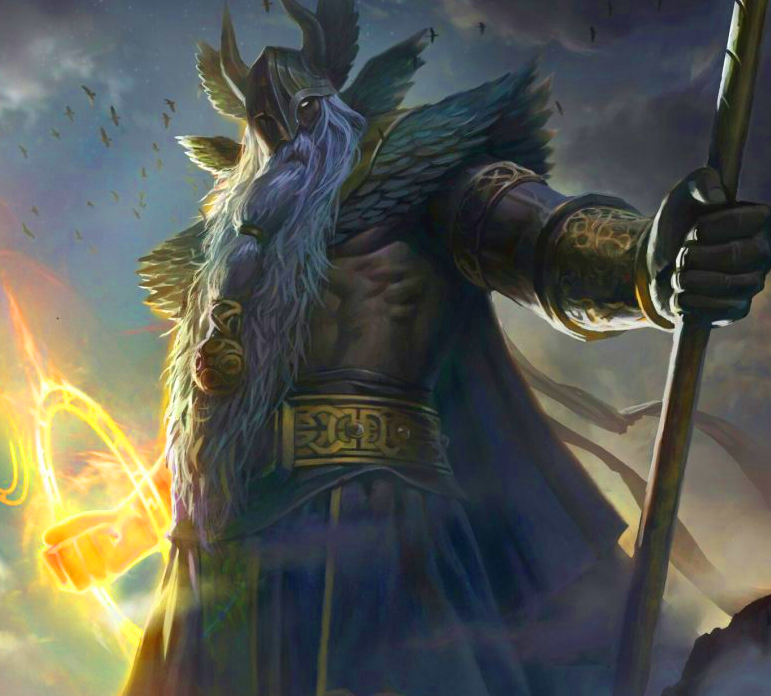


    Odin as the god of rage and battle

    From Dr Carl Gustav Jung, 1936, in The Wotan Essay:

    • As the god of rage and battle, Odin represents the archetype of the awakened Aryan man.
    • Inevitably, Odin will reveal the restless, violent, stormy side of his character.
    • When this occurs, it will be like a hurricane that breaks loose while people still believe it’s fine weather.
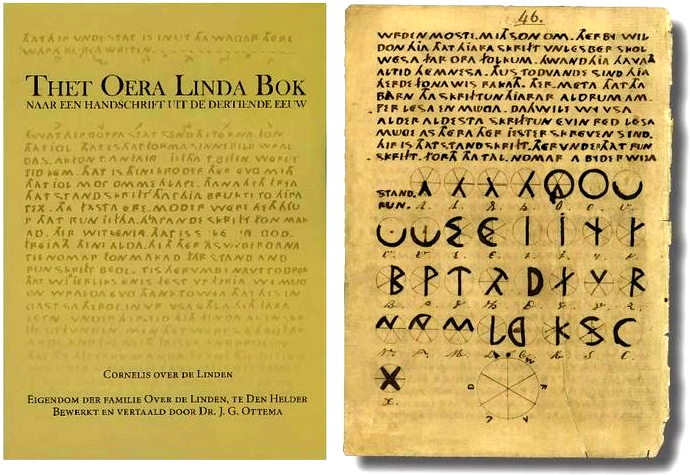
  • The Oera Linda Book: Explosive power for Aryans

    The Oera Linda Book: Explosive power for Aryans

    Post outline

    1. Introduction
    2. Context
      2.1 Climate
      2.2 Religion
      2.3 Yin and yang
    3. Concepts in the OLB
      3.1 Sky god and Earth mother
      3.2 Ethnocentrism
      3.3 Respectful treatment of other groups
      3.4 Freedom
      3.5 Contempt for arrogance
      3.6 Language
      3.7 Other
    4. The destruction of Atlantis
    5. Jessos
    6. References
    7. Appendices

    1. Introduction

    The Oera Linda Book (OLB)1 resonates with the Aryan psyche like no other. This ancient text offers a blueprint for our spiritual, religious, and political recovery. The OLB is extremely dangerous to the liars, thieves, and murderers presently in control of our societal levers. For example, they have attacked the authenticity of the OLB in Wikipedia (‘jewpedia’).2

    It is easy to see why Heinrich Himmler (a German National Socialist politician) was greatly impressed by the OLB and consequently, together with Herman Wirth and Richard Walther Darré, on 4 May 1934, he founded Ahnenerbe (Ancestral Heritage), an organization comprising academics and scientists from a broad range of academic disciplines to investigate the prehistoric roots of the Aryan race.3 More recently, in 1999, Russian political philosopher Alexander Dugin highlighted what any perceptive reader of the OLB can see: the book can easily be transformed into political ideologies that resonate with all Aryans.4

    Dr J. G. Ottema (1871, in the introduction to the OLB)1 states the following about the OLB:

    • It is a very ancient manuscript written by generations of a Fryan (named after their deity Frya) family over a period of five centuries as of 1256 BCE. It records a succession of dates and events starting from the destruction of Atland [âldland, old land, in Latin Atlantis] in 2193 BCE. Since time immemorial, the manuscript was preserved in the family of C. over de Linden, Chief Superintendent of the Royal Dockyard at the Helder.
    • The writing bears no mythical character and it has no traces of acquaintance with the Northern or Scandinavian Mythology.
    • It records ideas of religion that are entirely different from the mythology of other nations and in some points is closest to Greek and Roman Mythology.
    • The whole contents of the book are entirely new — there is nothing in it with which we were previously acquainted.
    • The Frisian religion is extremely simple and pure Monotheism: (a) Wr-alda [God] is the only eternal, unchangeable, perfect, and almighty being, (b) He created everything, and (c) out of Wr-alda proceeds everything—first the beginning, then time, and afterwards Irtha, the Earth.

    Authenticity

    In his presentation at a meeting of the Frisian Society, February 1871, Dr J. G. Ottema said that Dr E. Verwijs had examined the manuscript and immediately recognised it as very ancient Fries, and that Dr J. G. Ottema too was convinced of the document’s great age.1 Evidence cited by Dr Ottema to substantiate his conclusion includes:

    • Origin of the writing. The language used in the first part of the book is very old Fries, even older and purer than the Fries Rjuchtboek or old Fries laws. The locality of this spoken language must have been between the Vlie and the Scheldt.
    • Changes in the writing. Peculiarities of the successive writers show changes in pronunciation that occurred over the five centuries of their writing.
    • Paper and ink. The large size, cotton material, origin of such paper, and type of ink, unequivocally indicate that the manuscript could not have been started later than 1256 BCE.
    • Revealed knowledge. Information in the latter part of the book indicates that the writer was a contemporary of Julius Caesar.
    • Consistency. The accounts never contradict each other and are always consistent with each other in time and place.

    2. Context

    2.1 Climate


    Civilizations as of the New Kingdom of Ancient Egypt

    Climate and resource availability are major factors in the rise / fall of civilizations.5 For further evidence of the positive association of nations’ rise / fall with climate, consider the start / end dates of empires as listed on Wikipedia6 in relation to this chart.

    The positive association of nations’ rise / fall with climate can also be seen on the larger time-scale of the following chart.


    Holocene, great flood, and religious decay

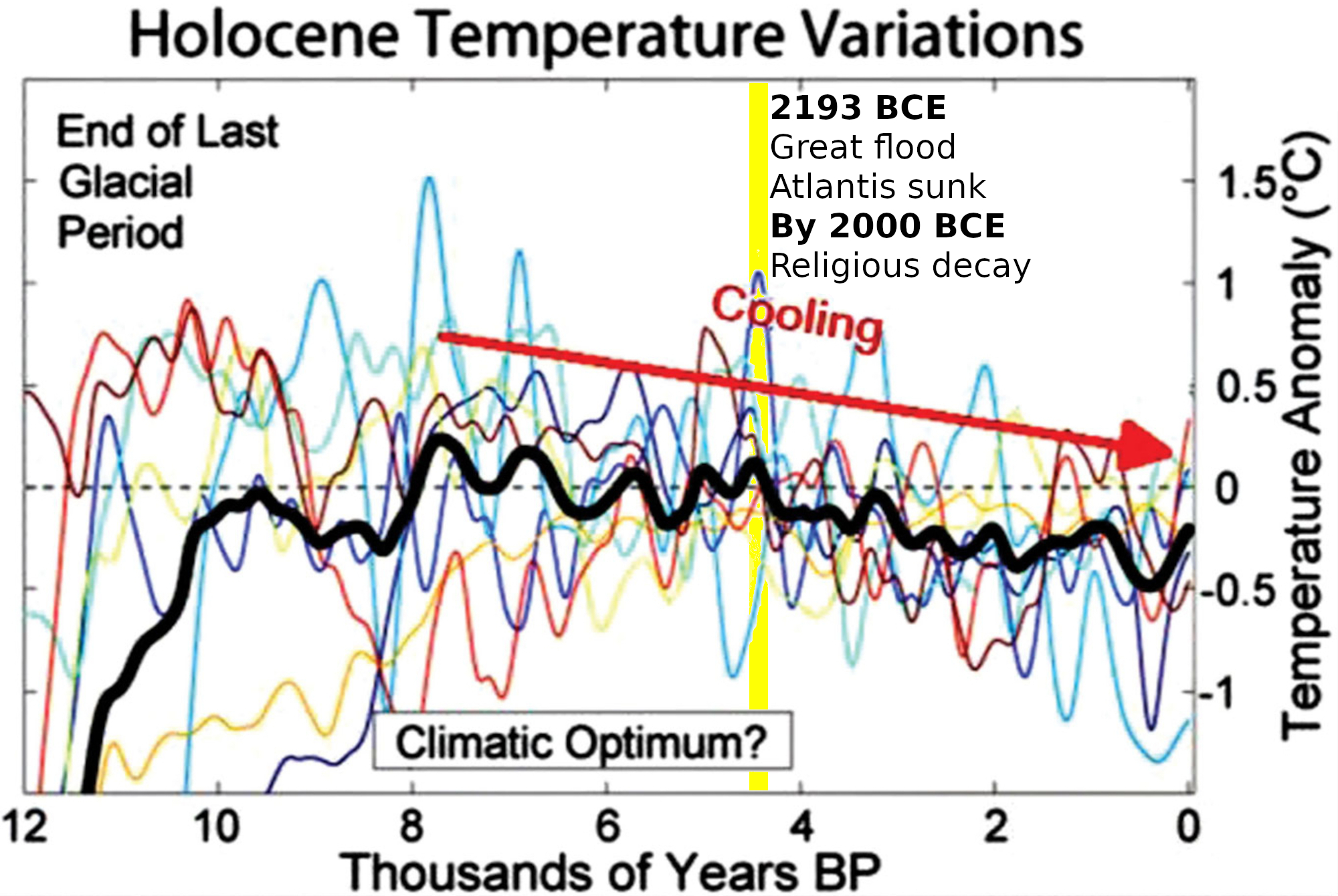
    Warm temperatures of the Holocene period spawned agricultural and industrial advances over the past 10,000 years, making modern civilization possible. Since peaking about 8,000 years ago, temperatures in the Holocene have trended downward. According to the OLB,1 in 2193 BCE a great flood occurred and Atlantis sank. This catastrophe was part of what scientists today know as the 4.2-kiloyear (thousand years) BP aridification event,7 one of the most severe climatic events of the Holocene epoch. It involved flooding in some areas and drought in others.

    That catastrophic event marked the onset of religious decay as global cooling continued. Donald A. Mackenzie (1915, in Myths of Babylonia and Assyria)8 found that (a) religion in Mesopotamia peaked and started to decline by no later than 2000 BCE and (b) this decline was associated with the arrival in Mesopotamia of Akkadians, a people of Semitic speech with pronounced Semitic affinities, and who from the earliest times were depicted by sculptors as having abundant locks, long full beards, and the prominent distinctive noses and full lips, which we usually associate with the characteristic jew type.

    2.2 Religion

    Religious symbols and myths that manifest from a people’s collective unconscious are experiences of deep spiritual realities, consciousness-raising, favourable to life by Nature’s laws, and a coping resource to increase individual and group resilience.9, 10

    If the flow of spiritual Force via organic religious roots is corrupted, we can die as a nation, race and species. A viable religion cannot be contrived or forced onto people. The violent imposition of an alien Semitic religion (Christianity) onto Europeans, who in turn corrupted the successful religions of non-Europeans, has had disastrous consequences. The decisive role of viable religion in determining the fate of a community, nation and race is well known to sociologists, e.g. Wallis and Bruce (1992).11


    Ice age, great flood, and religious decay

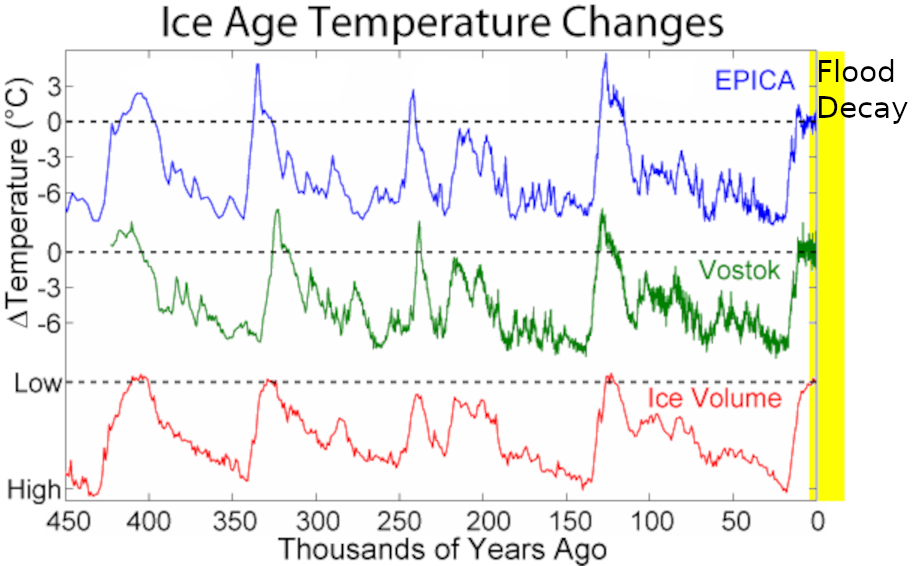
    This chart shows the catastrophe of 2193 BCE and the downturn in both global temperature and religion in the wider context of the present ice age.

    Within relatively small contexts and time-frames, we can see evidence of cause and effect as it applies to humans. However humans are subject to cosmic processes that are beyond their control and comprehension. Within larger contexts and time-frames (e.g. glacial / inter-glacial periods, geological ages, solar system) the significance of human behaviour vanishes. Everything in our universe is subject to cycles and has a lifespan, including stars, species and civilizations. We can reasonably assume that if our civilization had not decayed via Judaism and its negative expressions (Christianity, Islam, materialism, liberalism, multi-racialism, atheism), it would have succumbed to other similarly-destructive mediating factors. When a system (e.g. tree, human, civilization) nears the end of its life, the universe (God) will have ways to weaken / remove it from the manifest realm of evolution.

    2.3 Yin and yang

    Yin and Yang is the foundational principle of Chinese philosophy and Chinese medicine. The concept offers a way of understanding the rise / fall of our civilization in conjunction with the rise / fall of global temperatures.

    Yin and Yang

    • In Chinese the term Yin means the shady side of the hill, and Yang means the sunny side of the hill.
    • Is a symbol of balanced opposites.
    • Are contradictory and inseparable, e.g. day and night.
    • Are equal — neither is superior.
    • Everything contains a bit of its opposite – shown by two small dots within the Yin and Yang symbol.
    • Can be used to describe any and everything in the universe.
    • Increase in one leads to decrease in the other.

    Examples of Yin — Yang: feminine — masculine, moon — sun, passive — active, cold — hot, death — life, young — old, dark — light, negative — positive, lies — truth, ignorance — knowledge.

    Evil and good cannot be classified as yin or yang. Appropriate terms would include dark — light, negative — positive, lies — truth, ignorance — knowledge.

    Agents of Yin (e.g. jews, Christians, Muslims, materialists, liberals, multi-racialists, atheists) are neither evil nor good.

    Similarly, agents of Yang (e.g. Pagans, nature-lovers, the spiritually enlightened, race realists, National Socialists / supporters of Hitlerism, truth-speakers, activists against the Yin-serving group) are neither good nor evil.

    Yin and Yang are equally important aspects of evolutionary (creative) processes.

    3. Concepts in the OLB

    3.1 Sky god and Earth mother

    Sky god


    The face sculpture in Cydonia, Mars

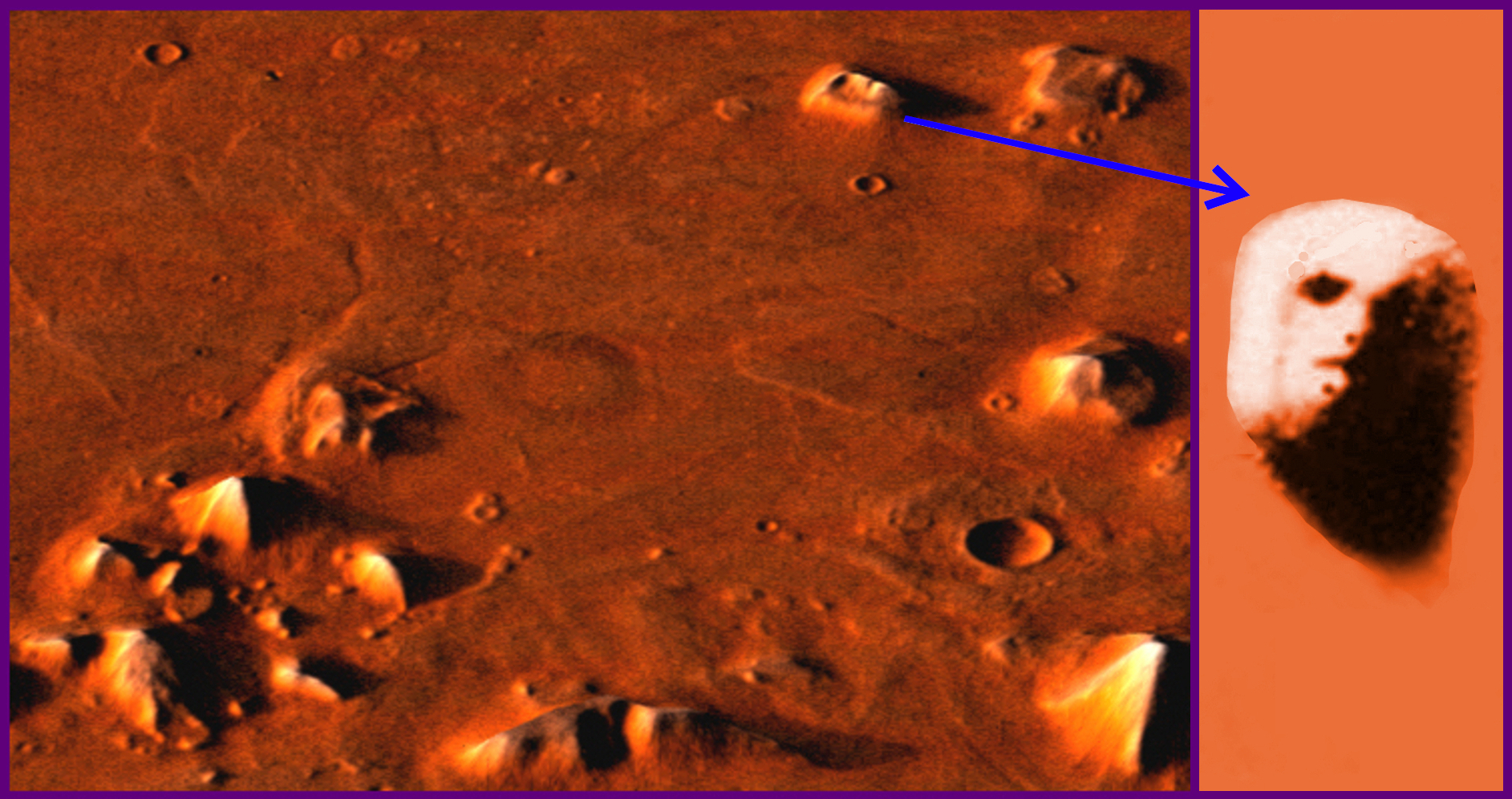
    These images from NASA,12 taken by Viking 1 Orbiter in 1976, show the face sculpture in the Cydonia region of Mars. The face sculpture is a kilometer wide, and the largest central pyramid is almost ten times larger than the famous pyramid of Cheops in Egypt.13

    In natural religion there is a recurring concept of a sky god or sky father, which can be traced to An (Sumerian) and Anu (Akkadian) of the Anunnaki.14 Evidence indicates that the huge face sculpture in the Cydonia region of Mars represents Anu (please see the explanation in Appendix 1).

    Other names for the sky god include Horus (Egyptian), Zeus (Hellenic) and Týr (Germanic). In the Oera Linda, the sky god is known as Wr-alda.

    From the OLB:

    “Wr-alda is the ancient of ancients, for he created all things. Wr-alda is all in all, for he is eternal and everlasting. Wr-alda is omnipresent but invisible, and therefore is called a spirit. All that we can see of him are the created beings who come to life through him and go again, because from Wr-alda all things proceed and return to him. Wr-alda is the beginning and the end. Wr-alda is the only almighty being, because from him all other strength comes, and returns to him. Therefore he alone is the creator, and nothing exists without him. Wr-alda established eternal principles, upon which the laws of creation were founded, and no good laws could stand on any other foundation.”(p 47)

    “To Wr-alda’s spirit only shall you bend the knee in gratitude—thricefold—for what you have received, for what you do receive, and for the hope of aid in time of need.” (p 9)

    Earth mother

    As with the sky god, there are many different names for the Earth mother, dating back to Ki and Ninḫursaĝ (Sumerian). Other names for the Earth mother include Gaia (Greek), Terra Mater (Rome), and Pachamama (Inca). In the OLB, the Earth mother is known as Irtha.

    From the OLB:

    “It is true that Irtha [the Earth] is named sometimes the feeder of all, because she brings forth all the fruits and grains on which men and beasts are fed; but she would not bear any fruit or grain unless Wr-alda gave her the power.” (p 74)

    3.2 Ethnocentrism

    Ethnocentrism is the tendency to view one’s group as centrally important and as superior to other groups at the expense of an out-group. It is a universal human reaction found in all known societies, in all groups and in practically all individuals. Everyone learns ethnocentrism while growing up. History for example, is often taught to glorify the achievements of one’s own nation, while religious, civic and other groups disparage their competitors openly. People such as White nationalists who exhibit a healthy and positive evaluation of their own ethnic group are normal human beings. Ethnocentrism is a key mechanism facilitating in-group cooperation. Groups high in ethnocentrism have a “we” feeling; loyalty to comrades; shared ethics and morality; less conflict; high contentment; a positive self-image; pride; love for self and community; and devotion to community, society and country. In-groups do not needlessly hate out-groups or seek to attack them. In-group members concentrate on the performance of altruism within the group rather than aggression toward outsiders unless the competing out-group comes to be seen as a threat.15, 16

    The OLB shows that Frisians had healthy levels of ethnocentrism.

    Racial and ethnic differences

    The OLB describes three archetypal racial figures named Lyda, Finda, and Frya:

    “Lyda was black, with hair curled like a lamb’s,” “violent,” “her voice was loud, and when she screamed in anger every creature quailed,” “she had no regard for laws; her actions were governed by her passions,” and “to help the weak she would kill the strong.” (p 7)

    “Finda was yellow, and her hair was like the mane of a horse,” “seductive” and “her voice was sweeter than any bird’s,” “her eyes were alluring and enticing, but whoever looked upon them became her slave,” “unreasonable,” “she wrote thousands of laws, but she never obeyed one,” “she despised the frankness of the good, and gave herself up to flatterers,” “she loved nobody but herself, and she wished that all should love her,” “false,” “selfish,” “treacherous,” “one wrong word would irritate her, and the cruelest deeds did not affect her,” and “she wished to rule everybody.” The “fruits of [Finda’s] vanity: the earth overflowed with blood.” (pp 7-8)

    “Frya was white like the snow at sunrise, and the blue of her eyes vied with the rainbow,” “beautiful,” “like the rays of the sun shone the locks of her hair, which were as fine as spiders’ webs,” “clever,” “powerful,” “pure,” “sensible,” “wise,” “generous,” and “happy.” “The first lesson that she taught her children was self-control, and the second was the love of virtue; and when they were grown she taught them the value of liberty; for she said, ‘Without liberty all other virtues serve to make you slaves, and to disgrace your origin.’ . . . She never allowed metal to be dug from the earth for her own benefit, but when she did it it was for the general use.” (p 8)

    Other (healthy) negative comparisons with groups seen as inferior to Frisians:

    • “Lyda’s people can neither make laws nor obey them, they are too stupid and uncivilized. Many are like Finda. They are clever enough, but they are too rapacious, haughty, false, immoral, and bloodthirsty.” (p 19)
    • “The toad blows himself out, but he can only crawl. The frog cries “Work, work;” but he can do nothing but hop and make himself ridiculous. The raven cries “Spare, spare;” but he steals and wastes everything that he gets into his beak. Finda’s people are just like these. They say a great deal about making good laws, and every one wishes to make regulations against misconduct, but does not wish to submit to them himself. Whoever is the most crafty crows over the others, and tries to make them submit to him, till another comes who drives him off his perch.” (p 19)
    • “. . . the spiteful Finda’s people with their false priests come and attack your ports, ravish your daughters, corrupt your morals, and at last throw the bonds of slavery over every freeman’s neck.” (p 20 )
    • “. . . we must not have anything to do with Finda’s people, wherever it may be, because they are full of false tricks, fully as much to be feared as their sweet wine with deadly poison.” (p 22)
    • “The people of Finda have also their rules and regulations, but these are not made according to what is just — only for the advantage of priests and princes — therefore their states are full of disputes and murder.” (p 23)
    • “Finda’s people are a wicked people, for although they presumptuously pretend among themselves that they are gods, they proclaim the unconsecrated false gods, and declare everywhere that these idols created the world and all that therein is — greedy idols, full of envy and anger, who desire to be served and honoured by the people, and who exact bloody sacrifices and rich offerings; but these presumptuous and false men, who call themselves God’s servants and priests, receive and collect everything in the name of the idols that have no real existence, for their own benefit.” (p 48)
    • “The people who live on the south side of the Mediterranean Sea, come for the most part from Phœnicia. The Phœnicians (Puniers or Carthaginians) are a bastard race of the blood of Frya, Finda, and Lyda. The Lyda people were there as slaves, but by the unchastity of the women these black people have degenerated the other people and dyed them brown.” (p 77)
    • “You must teach the children how great our country has been, what great men our forefathers were, how great we still are, if we compare ourselves to others. . . . You must tell them of the sea-heroes, of their mighty deeds and distant voyages. All these stories must be told by the fireside and in the field, wherever it may be, in times of joy or sorrow; and if you wish to impress it on the brains and the hearts of your sons, you must let it flow through the lips of your wives and your daughters.” (p 5)

    3.3 Respectful treatment of other groups

    • No slaves. “Frya has said we must not admit amongst us any but free people; but what have they done? They have imitated our enemies, and instead of killing their prisoners, or letting them go free, they have despised the counsel of Frya, and have made slaves of them.” (p 4)
    • No interference or harm. “Meddle not with the people of Lyda, nor of Finda, because Wr-alda would help them, and any injury that you inflicted on them would recoil upon your own heads.” (p 10)
    • Help if requested but retaliate violently. “If it should happen that they come to you for advice or assistance, then it behoves you to help them; but if they should rob you, then fall upon them with fire and sword.” (p 10)
    • No intervention unless the request is insistent. “If any of our neighbours quarrel and fight about any matter except land, and they request us to arbitrate, our best course will be to decline; but if they insist upon it, it must be done honourably and justly.” (p 18)
    • No involvement in others’ conflicts and problems. “If any one comes and says, I am at war, you must help me; or another comes and says, My son is an infant and incompetent, and I am old, so I wish you to be his guardian, and to take charge of my property until he is of age, it is proper to refuse in order that we may not come into disputes about matters foreign to our free customs.” (p 18)
    • Kindness toward non-Whites at arm’s length. “Ten years after that the seafarers came from Forana and Lydasburgt. They wished to drive the black men, with their wives and children, out of the country. They wished to obtain the opinion of the mother upon the subject. She asked them: Can you send them all back to their country? If so, then lose no time, or they will find no relatives alive. No, they said. Gosa replied: They have eaten your bread and salt; they have placed themselves entirely under your protection. You must consult your own hearts. But I will give you one piece of advice. Keep them till you are able to send them back, but keep them outside your citadels. Watch over their morals, and educate them as if they were Frya’s sons.” (p 54)

    Note: The tone of OLB advice on dealing with other groups echoes that which ET Aliens (presumably Tall Whites / Nordics / Pleiadians / Anunnaki) gave Wilbert B. Smith (1910-1962, B.Sc. and M.Sc. in Electrical Engineering, occupied a responsible position in the Canadian government, authored several technical papers, and undertook formal research into the subject of ETs). The ETs told Wilbert Smith that (a) ETs are interested in us and (b) they stand by ready, able and willing to help us, but (c) ETs cannot help us until we are ready for their help, because (d) to intervene before we are ready would be in violation of a universal law against interference in the affairs of others and (e) violation of this universal law leads to suffering.17

    3.4 Freedom

    • “Every man knows that he wishes to live free and undisturbed, and that others wish the same thing.” (p 23)
    • “All free-born men are equal, wherefore they must all have equal rights on sea and land, and on all that Wr-alda has given.” (p 13)
    • “Prosperity awaits the free. At last they shall see me again. Though him only can I recognise as free who is neither a slave to another nor to himself.” (p 9)
    • [Wichhirte to Alexander] “Oh greatest of kings, we sailors go everywhere; we have heard of your great deeds, therefore we are full of respect for your arms, and still more for your wisdom; but we who are free-born Fryas children, we may not become your slaves; and even if I would, the others would sooner die, for so it is commanded in our laws.” (p 55)
    • “If by force or necessity any regulations should be imposed upon us at variance with our laws and customs, we must submit; but should we be released, we must always return to our own again.” (p 10)
    • “Our descendants shall teach their people and their slaves the meaning of three words; they are universal love, freedom, and justice. At first they shall shine, then struggle with darkness, until every man’s head and heart has become bright and clear. Then shall oppression be driven from the earth, like the thunder-clouds by the storm-wind, and all deceit will cease to have any more power.” (p 63)

    Threats to freedom

    • Defencelessness. “At last they were at a loss themselves for weapons and necessaries, and this difficulty was their punishment. Their bodies were brilliantly adorned, but their cupboards and their sheds were empty. . . . The child asked its mother for food; she had no food to give, only jewels. The women applied to their husbands, the husbands appealed to the counts; the counts had nothing to give, or if they had, they hid it away. . . .” “. . . the Finns came to the defenceless villages and ran away with the children. As they had no good weapons, they lost the battle, and with it their freedom, and Magy became master.” (pp 39-40)
    • Timidity. “The Hindoos are timid and submissive before their princes, like hinds before wolves. Therefore the Yren and others have called them Hindoos, which means hinds. But their timidity is frightfully abused.” (p 72)
    • Traitorous religious figures. “Beloved successors, for the sake of our dear forefathers, and of our dear liberty, I entreat you a thousand times never let the eye of a monk look on these writings. . . . they destroy in an underhand manner all that relates to us Frisians. In order to gain rich benefices, they conspire with foreign kings, who know that we are their greatest enemies, because we dare to speak to their people of liberty, rights, and the duties of princes.” (p 3)

    3.5 Contempt for arrogance

    • “The foreign kings, who follow their own will, place Wr-alda below the crown. . . . they had statues of themselves made, and erected in the churches beside the statues of the idols, and those who would not bow down to them were either killed or put in chains.” (pp 74-75)
    • “But it is not only that some of your men have been guilty of stealing titles, I have also much to complain of against your wives. If there are men among you who wish to put themselves on a level with Wr-alda, there are also women who wish to consider themselves equals of Frya.” (p 75)
    • “You all fancy that you are the better for this name-stealing, but you forget that jealousy clings to it, and that every wrong sows the seed of its own rod. If you do not alter your course, in time it will grow so strong that you cannot see what will be the end. Your descendants will be flogged by it, and will not know whence the stripes come. . . . Your ghosts will rise frightened out of their graves.” (p 75)
    • “God’s servants and priests, receive and collect everything in the name of the idols that have no real existence, for their own benefit. They do all this with an easy conscience, as they think themselves gods not answerable to any one. If there are some who discover their tricks and expose them, they hand them over to the executioners to be burnt for their calumnies, with solemn ceremonies in honour of the false gods; but really in order to save themselves.” (p 48)
    • “Among Finda’s people there are false teachers, who, by their over-inventiveness, have become so wicked that they make themselves and their adherents believe that they are the best part of Wr-alda, that their spirit is the best part of Wr-alda’s spirit, and that Wr-alda can only think by the help of their brains.” (pp 47-48)
    • “The Romans, moreover, live at enmity with the Phœnicians; and their priests, who wish to assume the sole government of the world . . . and they have always driven away the Phœnician priests . . . .” (p 77)

    3.6 Language

    • “When Wr-alda gave children to the mothers of mankind, he gave one language to every tongue and to all lips.” (p 69)
    • “As thus our language . . . is rightly named the language of the gods, and all those by whom it is held in honour derive honour from it”. (p 69)
    • “. . . you must never allow any language but God’s language to pass your lips, and take care that your own language remains free from outlandish sounds.” (p 70)
    • “If foreigners come to buy ironwares from you, and want to talk and bargain, they must come back to God’s language. If they learn God’s language, then the words, “to be free” and “to have justice,” will come to them, and glimmer and glitter in their brains to a perfect light, and that flame will destroy all bad princes and hypocritical dirty priests.” (p 71)
    • “The deceitful priests and the malignant princes, who always clung together, wished to live according to their own inclinations, without regard to the laws of right. In their wickedness they went so far as to invent other languages, so that they might speak secretly in anybody’s presence of their wicked and unworthy affairs without betraying themselves . . . .” (p 70)

    3.7 Other

    • Dishonest foreigners. “Whenever a foreign trader comes to the open markets at Wyringen and Almanland, if he cheats, he must immediately be fined, and it must be published by the maidens throughout the whole country. If he should come back, no one must deal with him. He must return as he came.” (p 18)
    • Ill-treatment in a foreign market. “If we should be ill-treated in a foreign market, whether distant or near, we must immediately attack them; for though we desire to be at peace, we must not let our neighbours underrate us or think that we are afraid.” (pp 18-19)
    • Usurers. “There shall be no usurers in the market. If any should come, it will be the duty of the maidens to make it known through the whole land, in order that such people may not be chosen for any office, because they are hard-hearted. For the sake of money they would betray everybody—the people, the mother, their nearest relations, and even their own selves.” (p 14)
    • Sale of freedom. “If ever it should happen that one of your people should sell his freedom, he is not of you, he is a bastard. I counsel you to expel him and his mother from the land. Repeat this to your children morning, noon, and night, till they think of it in their dreams.” (p 10)
    • Depriving another of liberty. “If any man shall deprive another, even his debtor, of his liberty, let him be to you as a vile slave; and I advise you to burn his body and that of his mother in an open place, and bury them fifty feet below the ground, so that no grass shall grow upon them. It would poison your cattle.” (p 10)
    • Traitors. “If any man should prove a traitor and show to our enemies the paths leading to our places of refuge, or creep into them by night, he must be the offspring of Finda; he must be burnt.” (p 24)
    • The common good. “Whenever new laws are made or new regulations established, they must be for the common good, and not for individual advantage.” (p 16)
    • Wisdom and rectitude. “Eternal and unalterable are the signs wisdom and rectitude, which must be sought after by all pious people, and must be possessed by all judges. If, therefore, it is desired to make laws and regulations which shall be permanent, they must be equal for all men.” (p 19)
    • Education. “The writer must teach the girls to read, to write, and to reckon. The elders, or “Greva,” must teach them justice and duty, morals, botany, and medicine, history, traditions, and singing, besides all that may be necessary for them to give advice.” (p 51)

    4. The destruction of Atlantis

    The OLB records the destruction of Atland (âldland, old land, in Latin Atlantis) in 2193 BCE. That date is given by the year 1256 of our era, when Hiddo overa Linda made the copy, stating that it was was 3449 years after Atland sank (3449 – 1256 = 2193 BCE).

    “From this writing it appears that [Atlantis] was land stretching far out to the west of Jutland, of which Heligoland and the islands of North Friesland are the last barren remnants. This event . . . occasioned a great dispersion of the Frisian race . . . . [and] is known by geologists as the Cimbrian flood” (Dr J. G. Ottema, 1871, in the introduction to the OLB English translation by William R. Sandbach, 1876, p 85).1

    From the OLB:

    “Before the bad time came our country was the most beautiful in the world. The sun rose higher, and there was seldom frost. The trees and shrubs produced various fruits, which are now lost. In the fields we had not only barley, oats, and rye, but wheat which shone like gold, and which could be baked in the sun’s rays. The years were not counted, for one was as happy as another.” (p 26)

    How the bad time came

    “During the whole summer the sun had been hid behind the clouds, as if unwilling to look upon the earth. There was perpetual calm, and the damp mist hung like a wet sail over the houses and the marshes. The air was heavy and oppressive, and in men’s hearts was neither joy nor cheerfulness. In the midst of this stillness the earth began to tremble as if she was dying. The mountains opened to vomit forth fire and flames. Some sank into the bosom of the earth, and in other places mountains rose out of the plain. Aldland, called by the seafaring people, Atland, disappeared, and the wild waves rose so high over hill and dale that everything was buried in the sea. Many people were swallowed up by the earth, and others who had escaped the fire perished in the water.

    It was not only in Finda’s land that the earth vomited fire, but also in Twiskland (Germany). Whole forests were burned one after the other, and when the wind blew from that quarter our land was covered with ashes. Rivers changed their course, and at their mouths new islands were formed of sand and drift.

    During three years this continued, but at length it ceased, and forests became visible. Many countries were submerged, and in other places land rose above the sea, and the wood was destroyed through the half of Twiskland (Germany). Troops of Finda’s people came and settled in the empty places. Our dispersed people were exterminated or made slaves. Then watchfulness was doubly impressed upon us, and time taught us that union is force.” (p 27)

    “At the time of the submersion of Atland, the first spoke of the Juul [winter solstice, Yule] stood at the top. After that it went down, and our freedom with it. When two spokes, or two thousand years, shall have rolled down, the sons shall arise who have been bred of the fornication of the princes and priests with the people, and shall witness against their fathers. They shall all fall by murder, but what they have proclaimed shall endure, and shall bear fruit in the bosoms of able men, like good seed which is laid in thy lap. Yet a thousand years shall the spoke descend, and sink deeper in darkness, and in the blood shed over you by the wickedness of the princes and priests. After that, the dawn shall begin to glow. When they perceive this, the false princes and priests will strive and wrestle against freedom; but freedom, love, and unity will take the people under their protection, and rise out of the vile pool. The light which at first only glimmered shall gradually become a flame.” (pp 40-41)

    “When our land was submerged I was in Schoonland. It was very bad there. There were great lakes which rose from the earth like bubbles, then burst asunder, and from the rents flowed a stuff like red-hot iron. The tops of high mountains fell and destroyed whole forests and villages. I myself saw one mountain torn from another and fall straight down. When I afterwards went to see the place there was a lake there.” (p 59)

    “One hundred and one years after the submersion of Aldland a people came out of the East. . . . like the Egyptians, they have priests and also statues in their churches. The priests are the only rulers; they call themselves Magyars, and their headman Magy. He is high priest and king in one. . . . they are slaves to their priests, and still more to their creeds. . . . of Wr-alda’s spirit they know nothing. . . . When they were well established, the Magyars sought our friendship . . . they always kept their people within their own boundaries, and that outwitted our watchfulness. . . . Eighty years afterwards, just at the time of the Juulfeest, they overran our country like a snowstorm driven by the wind. All who could not flee away were killed.” (pp 27-28)

    5. Jessos

    The OLB (pp 61-62 ) records that at the time Atlantis was submerged, upon a mountain, on a plain called Kasamyr (Cashmere), Jessos was born. His mother was the daughter of a king, and his father was a high-priest. “In order to hide the shame they were obliged to renounce their own blood. Therefore it [Jessos] was taken out of the town to poor people. As the boy grew up, nothing was concealed from him, so he did all in his power to acquire wisdom. His intellect was so great that he understood everything that he saw or heard. The people regarded him with respect, and the priests were afraid of his questions.” (p 61) Jessos wandered about. Wherever he went he taught the people:

    • To not tolerate rich men or priests.
    • To guard themselves against false shame, which harms love and charity.
    • The earth bestows her treasures on those who dig and plough.
    • To sow if they wish to reap.
    • No one is obliged to do anything for another unless it be out of goodwill.
    • Do not seek gold, silver, or precious stones, which causes envy and destroys love.
    • No man is able to make everybody equally rich and happy.
    • But it is the duty of all men to make each other as equally rich and as happy as possible.
    • Men should not despise any knowledge.
    • Justice is the greatest knowledge, because it wards off offences and promotes love.

    The priests hated Jessos but the people called him Krishna (shepherd) and his Frisian friend called him Buddha (purse), because he had in his head a treasure of wisdom, and in his heart a treasure of love.

    Eventually Jessos had to flee from the wrath of the priests but his enemies followed him like his shadow. Wherever Jessos went, his teaching had preceded him. After traveling like this for twelve years, he died. His friends preserved his teaching and shared it wherever they found listeners.

    6. References

    1. The Oera Linda Book, English translation by William R. Sandbach, 1876.
    2. Wikipedia: Oera Linda Book
    3. Der Tag, Berlin, 31 December 1933.
    4. Dugin, Aleksandr (1996). The Racial Archetypes of Eurasia in the Oera Linda Chronicle (1996). Transl. Jafe Arnold) (Absoliutnaia Rodina), Moscow, Arktogeya: 1999, chapter 8.
    5. Cooper, Paul. Fall of Civilizations
    6. Wikipedia: List of empires
    7. Wikipedia: 4.2-kiloyear event
    8. Mackenzie, Donald A. (1915). Myths of Babylonia and Assyria.
    9. Lazarus, Richard, & Folkman, Susan (1984). Stress, appraisal, and coping, New York: Springer.
    10. Lazarus, Richard (1999). Stress and emotion: A new synthesis, New York: Springer.
    11. Wallis, R. & Bruce, S. (1992). Religion and Modernization. Pub. Oxford University Press.
    12. NASA
    13. Petrovych, V. A. & Fedorovich, S. A. (2023). Microrelief of the Martian surface.
    14. Wilkin, Stanley (2019). Jesus and Bel Christianity and the Continuation of Paganism.
    15. MacDonald, Prof. Kevin (2012) Ethnocentrism is normal and rational.
    16. Sociology Guide (2019).
    17. Smith, Wilbert B. (1958). Video: The Ottawa Address, 31 Mar 1958.


    7. Appendices

    1. Tall Whites on Mars

    The Greada Treaty

    According to former naval intelligence officer William Cooper in Chapter 12 of his book Behold a Pale Horse (1991), in 1953 astronomers discovered large objects heading toward Earth. Later evidence revealed that the objects could only be spaceships. The spaceships contained Grey ETs and took up a very high orbit around the equator. Through radio communications using the computer binary language, face-to-face contact with the ETs was arranged. Consequently during 1954 these Greys landed at Holloman Air Force Base for a meeting with President Eisenhower and others. At this meeting an agreement known as The Greada Treaty was signed. According to William Cooper, the treaty included the following: (a) We would keep their presence on Earth a secret, (b) They would give us advanced technology and help us to develop technologically, and (c) They could abduct humans on a limited and periodic basis for scientific and medical purposes.

    Tall Whites’ reaction to the above

    According to William Cooper in Chapter 12 of his book Behold a Pale Horse (1991), when Grey ETs visited Earth in 1953 and 1954, Tall Whites (aka Nordics, Pleiadians, Anunnaki, although these are not necessarily all the same beings — please see Appendix 2) quickly reacted by contacting the US Government, warning against the Grey ETs then orbiting the equator. The Tall Whites offered to help us with our spiritual development. They refused to share their advanced technology with us, saying that we were not spiritually ready for it and would use such technology for destructive purposes.

    Literature reviewed by engineer and educator Andrew Johnson (2019) in Acknowledged: A perspective on UFOs, Aliens and Crop Circles indicates that on 20 February 1954 at Edwards (Muroc) Air Force Base, President Eisenhower and others met with two white-haired Tall Whites / Nordics. They had pale blue eyes and colourless lips. These ETs arrived in a bi-convex saucer that stood on tripod landing gear on the landing strip. The Eisenhower administration rejected the Nordics’ offer of spiritual rather than technological help and instead formed the above-mentioned agreement with the Greys.

    The Tall Whites’ immediate origin

    Their observation of the Greys’ arrival, quick reaction, and speedy visit to Earth suggests that the Tall Whites were relatively close to Earth at that time.

    Specifically, evidence suggests that they could have been on Mars:

    In May 1984 the US Government discovered an ET race on Mars via the remote viewing (non-local perception, sensing with the mind) of the esteemed remote viewer Joseph McMoneagle. In addition to other features of Mars such as huge dust storms, massive pyramids, megaliths, intersecting roads, and aqueducts, Joseph McMoneagle saw a group of tall and slender humanoids. His description of these ETs seems to suggest that they were Tall Whites.

    As will be shown in future posts, the evidence linking Tall Whites (typically referred to as Anunnaki in this context) to both Mars and Earth is now compelling, and includes (a) matching human/oid-made structures on Mars and Earth, (b) matching symbolism of those structures, (c) physical remains found on Earth of fair-skinned, blonde- and red-haired humanoids with substantially larger-than-human cranium capacities (superior intelligence), (d) related evidence indicating the historic presence of highly-advanced Aryan-type ETs on Earth, and (e) a genetic link between those ETs and humans. As the Anunnaki sky god is An (Sumerian) and Anu (Akkadian), (Stanley Wilkin, 2019, University of London, Jesus and Bel Christianity and the Continuation of Paganism) and the huge Face sculpture faces the sky, logically, the Face sculpture is most likely an Anunnaki representation of Anu.

    2. German crews of ET-type craft

    There is reason to believe that the beings who are variously referred to as Tall Whites, Nordics, Pleiadians, and Anunnaki are not all the same beings. For example, Ernst Zündel’s (1974) carefully researched book UFOs: Nazi secret weapon? suggests that Germans are pursuing the Aryan cause secretly with advanced technology from bases on Earth and perhaps elsewhere. This seems to explain (a) the reported encounters with German-speaking / looking anti-gravity craft crews who do not fit the usual picture of ET Alien encounters and (b) the onset of those ET-type encounters — they only occurred post-WW2. For example, it is written that in 1959, three large newspapers in Chile reported front-page articles about encounters with UFOs that seemed to be crewed by German soldiers, and in the early 1960s there were reports in New York and New Jersey of ET-type flying saucers crewed by ‘aliens’ who spoke German or English with a German accent.