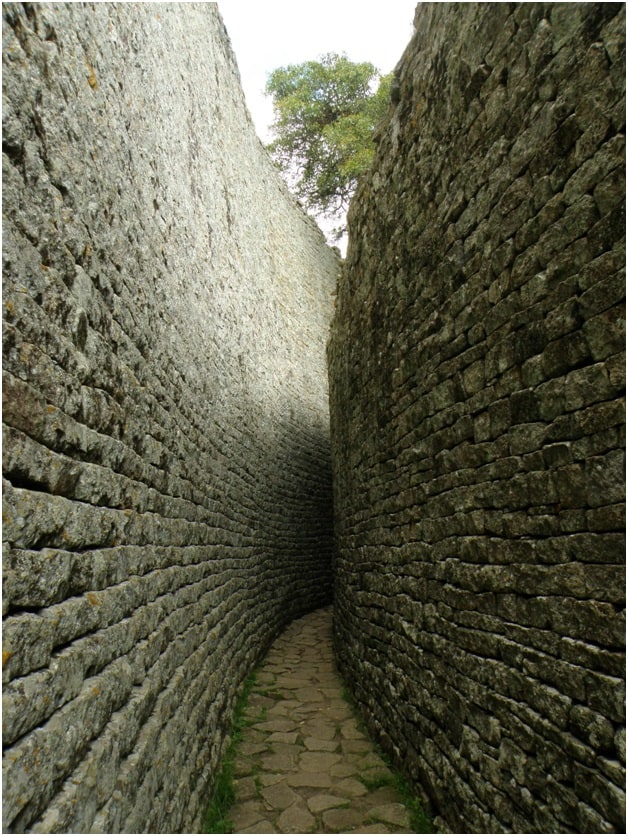
A passage in the great enclosure of Great Zimbabwe
Great Zimbabwe was a city built between the 11th and 15th centuries in the south-eastern hills of the modern country of Zimbabwe, near Masvingo. The city is renowned for its impressive stone structures, which are the largest in precolonial Southern Africa. Great Zimbabwe was a major center of trade and culture, housing a population comparable to London at the time.1
Post outline
- Authoritative conclusions about the builders
- Non-African architecture during that period
2.1 Andean Inca architecture (Peru, Bolivia, Ecuador)
2.2 Medieval European dry-stone structures - Implications
- Which tribe is trying to erase Aryan history?
- References
1. Authoritative conclusions about the builders
Following are authorities who concluded that Great Zimbabwe was built by non-Africans:
- Carl (Karl) Mauch (1837–1875), German explorer and geologist. In 1871 Mauch became the first European to document the site. He declared that the ruins could not have been built by “native Africans.” In the view of Mauch, Africans were not capable of such sophisticated stone architecture.2
- Richard N. Hall (1853–1914), Curator of Great Zimbabwe (appointed by British South Africa Company, 1902) claimed that Great Zimbabwe was built by non-Africans.3
- Theodore Bent (1852–1897), British archaeologist, claimed on the basis of his 1891 excavation at Great Zimbabwe that it was built by non-Africans.4
- Cecil Rhodes (1853–1902), Founder, British South Africa Company; and colonial administrator. Rhodes claimed that African societies were incapable of such great architectural achievement and that Great Zimbabwe must have been built by non-Africans.5
- Ian Smith (1919–2007), founder of the Rhodesian Front party and Prime Minister of Rhodesia from 1964 to 1979. Smith’s official position about Great Zimbabwe, based on the investigations of archaeologists, was that it must have been built by non-Africans.6
2. Non-African architecture during that period
At the time Great Zimbabwe was built (between the 11th and 15th centuries), the archaeological and historical record shows that comparable dry-stone masonry constructions existed at these locations outside Africa:
2.1 Andean Inca architecture (Peru, Bolivia, Ecuador)
Key examples:
- Sacsayhuamán (Cusco, Peru) – Massive zigzag walls, up to 6m high
- Machu Picchu (Peru) – Terraced dry-stone architecture
- Ollantaytambo (Peru) – Giant polygonal blocks
The construction techniques used in Andean Inca Architecture are highly similar to that of Great Zimbabwe in that they all involve dry stone.
However their construction style is different to that of Great Zimbabwe, as might be expected due to different environmental requirements. Inca walls were designed for seismic resistance with precise polygonal fitting within geometric/rectilinear forms. In contrast, Great Zimbabwe relied on mass and curve for stability.7,8,9,10,11,12
2.2 Medieval European dry-stone structures
In Ireland (Skellig Michael beehive huts) dry-stone corbelling was used; in Scotland (Scottish brochs and field walls) there were dry-stone walls and defensive towers; in Britain/Ireland (Monastic enclosure walls) there were double-layered dry-stone boundaries; and in Wensleydale, England, large limestone blocks with no mortar were used for castle foundations.
These constructions used the same technique as at Great Zimbabwe.7,8,13,14
3. Implications
- The building knowledge and skills required to construct Great Zimbabwe were available to non-Africans during the time that Great Zimbabwe was built. In particular, dry-stone wall builders from Europe could have built that city.
- Evidence presented in the post Aspects of Aryans shows that seafaring Aryans were exploring the world and settling in distant lands since thousands of years ago. It seems likely that Aryans were in Southern Africa since long before Great Zimbabwe was built and it would have been Aryans who built that city.
- Claims1 that Great Zimbabwe was built entirely by Black Africans (specifically the Shona people), without any involvement (e.g. training, supervision) of non-Africans, are incompatible with the evidence and the above-mentioned authorities’ conclusions.
- As the most efficient coastal landing site for a seafarer heading to the Great Zimbabwe site is the Port of Beira in Mozambique, the Aryan builders of Great Zimbabwe would have landed at the Port of Beira in Mozambique before undertaking the roughly 550 to 600 kilometer overland journey. That would have also been the trade route, e.g. between Zimbabwe and Europe.
- Aryans were living in Southern Africa at a much earlier date than official history would have us believe. The evidence concerning Great Zimbabwe indicates that Aryans were living in Southern Africa at least one thousand years ago. Evidence of world-wide travel by seafaring Aryans since long before that time indicates that Aryans could even have been living in Southern Africa at a very much earlier date.
4. Which tribe is trying to erase Aryan history?
The question of “Who built Great Zimbabwe?” is easy to answer with some research and evaluation of the evidence. The next question can also be answered with effort and thought: Which tribe is trying to erase Aryan history?
The same tribe that is trying to erase Aryans. See articles under Killer religion for more information.
Fish swim, birds fly, psychopaths lie. Predators prey. Unsuspecting prey invite predation. Fit and alert individuals are not easy prey. Victim or Victor? It’s our choice.
5. References
- Wikipedia: Great Zimbabwe
- Burke, E.E., Editor, (1969). The Journals of Carl Mauch: His travels in the Transvaal and Rhodesia, 1869–1872. National Archives of Rhodesia, Salisbury (now Harare)
- Hall, R.N. & Neal, W.G. (1902 1st ed.; 1904 2nd ed.). The ancient ruins of Rhodesia (Monomotapae Imperium). London: T. Fisher Unwin
- Bent, J. Theodore (1892). The ruined cities of Mashonaland: Being a record of excavation and exploration in 1891. London: Longmans, Green & Co.
- BSAC Board Minutes (multiple meetings, 1895–1902) recorded Rhodes’ view that the ruins were “ancient and foreign.”
- Smith, Ian Douglas (1997). The Great Betrayal: The Memoirs of Ian Douglas Smith. London: Blake Publishing
- Department of the Arts of Africa, Oceania, and the Americas (2001). Great Zimbabwe (11th–15th Century), The Metropolitan Museum of Art, New York, October 2001.
- Chirikure, S. & Pikirayi, I. (2008). Inside and outside the dry stone walls: Revisiting the material culture of Great Zimbabwe, Antiquity, 82 (318), 976–993.
- Gasparini, G. & Margolies, L. (1980). Inca architecture (P. J. Lyon, Trans.). Bloomington: Indiana University Press (Original work published 1977)
- Hyslop, J. (1984). The Inka road system. New York: Academic Press
- Hyslop, J. (1990). Inka settlement planning. Austin, TX: U of Texas Press
- Moseley, M. E. (1992). The Incas and their ancestors: The Archaeology of Peru. London: Thames & Hudson
- UNESCO (2018). Art of dry stone construction, knowledge and techniques. Ref. 02106.
- Wikipedia: Dry Stone

Black Africans built Great Zimbabwe???

