Tag: ET Humanoids

  • Long-heads of Sub-Saharan Africa

    Long-heads of Sub-Saharan Africa

    Maasai woman in traditional clothing and jewelry

    Previous posts in this series:
    Long-heads of Europe

    Long-heads of Asia
    Long-heads of America

    Symbols of our gods
    Long-heads of Egypt

    Post outline

    1. Canteen Kopje skull
    2. Peers Cave skull
    3. Boskop Man
    4. Dolichocephalic heads of Africans today
    5. Climate and head shape
    6. Cranial volume and genetics
    7. References

    1. Canteen Kopje skull


    Canteen Kopje Skull. Image credit: Smith et al.1

    The Canteen Kopje skull was found in 1925 at Canteen Kopje, outside Barkly West, Northern Cape, South Africa. It was studied and reconstructed by British-South African medical doctor and palaeontologist Robert Broom, who described it in Nature in 1929.2 Although Broom’s reconstruction of the skull showed features that were similar to those of the archaic Boskop Man (discussed below) in terms of morphology and size, Smith et al. (2012)1 dated the skull to the Holocene period [last 12,000 years].

    2. Peers Cave skull


    The Peers Cave skull. Image credit: Stynder et al.3

    In the late 1920s, Victor Stanley Peers and his son Bertie discovered this skeleton of a human male in a rock shelter known as Skildergatkop Cave until 1941, since when it has been called Peers Cave. The cave is in the False Bay region of Cape Town, South Africa, overlooking the suburbs of Noordhoek and Fish Hoek.

    The skull was previously estimated to be of the late Middle Stone Age [at least 25,000 years before present]. However, more recently, AMS radiocarbon dating at the Oxford Radiocarbon Accelerator Unit (ORAU), UK, gave a calibrated age of 7266–7179 years BP at 68.2% probability and 7346–7145 years at 95.4% probability.3

    3. Boskop Man


    Drawing of Boskop Man from Robert Broom (1918).4

    Boskop Man is an anatomically modern human fossil of the Middle Stone Age [the Middle Paleolithic, a period from 300,000 to 50,000 years ago], found at Boskop, Transvaal, South Africa, in 1913.5 The fossil was studied by British-South African medical doctor and palaeontologist Robert Broom4, who found that the Boskop Man had an extraordinarily large cranial capacity of 1,980 cc and was of a separate human species, Homo capensis.

    Neurologists Gary Lynch and Richard Granger (2008)6 wrote the following about the Boskop skull:

    1. It seems that the Boskop skull housed a brain at least 25 percent larger than our own.
    2. Later discoveries of more Boskop skulls indicated that very large skulls were normal for this race.
    3. In addition to the very large cranial capacity, the skulls were distinguished by their small, childlike faces (pedomorphosis).
    4. Although Neanderthals and Homo erectus are widely known, Boskops are almost entirely forgotten. Facts of ancient ancestors like the Boskops, who seem to have been intellectually superior to us, run counter to cherished ideas about evolution and progress, and were therefore never destined to be popular.
    5. Boskops show that humans with big brains, and perhaps great intelligence, lived in southern Africa until quite recently, until giving way to us — smaller-brained and possibly less advanced Homo sapiens.
    6. The much larger brains of Boskops compared to us implies that their brain function was substantially different to ours:
    • Brain size increase occurs mostly in the cortex (not in more ancient structures) and within the cortex the areas that grow by far the most are the association areas. Consequently, the prefrontal cortex of Boskops would have been an enormous 53 percent larger than ours.
    • The prefrontal cortex is closely involved in our highest cognitive functions — making sense out of the complex stream of events flowing into the brain, placing mental contents into appropriate sequences and hierarchies, and planning future actions. In essence, the prefrontal cortex is at the heart of our most flexible and forward-looking thoughts. Boskops’ greater brains and extended internal representations may have made it easier for them to accurately predict and interpret the world.
    • Even if brain size only accounts for 10 to 20 percent of an IQ test score, this implies that Boskops would have had an average IQ of 149 (genius level).

    Concerning the demise of the Boskops, Lynch and Granger (2008) note that:

    • Human history is characterized by oppression, savagery, and genocide.
    • The preternaturally civilized Boskops likely had no chance against our barbarous ancestors.
    • If they had survived, the Boskops could have been leaders of society today.
    • Some genes persist in a population or mix themselves into surrounding populations via interbreeding, thus remaining on the periphery, neither becoming widely fixed in the population at large nor being entirely eliminated from the gene pool.

    Further to the last point above, Boskop features are still occasionally seen in living populations of Bushmen (aka San peoples), and long-head people with large cranium capacities can also sometimes be seen among other populations of Africans. Earlier in the modern era, it seems that dolichocephaly was more typical of Bushmen. In Journal of the Ethnological Society of London (1870) Scientific Memoirs III,7 Thomas Henry Huxley wrote:

    The Bushmen of the Cape area must be regarded as a special and peculiar modification of the Negroid type. They are remarkable for their low stature, the males rarely much exceeding four feet in height, while the females may fall considerably below that stature. Both sexes are remarkably well made. The skin is of a yellowish-brown colour, the eyes and hair black, and the latter woolly. They are all dolichocephalic; and the brim of the female pelvis has its anteroposterior diameter longer than the transverse, in a larger proportion of cases than in other forms of mankind.” (page 566)

    4. Dolichocephalic heads of Africans today

    San people


    L San woman, R San boy


    Two San men

    Other Africans


    Maasai women in traditional clothing and jewelry


    Sudanese children as refugees in Uganda

    5. Climate and head shape

    Differences in human head shapes, such as a higher tendency toward dolichocephaly (long, narrow heads) are driven by evolutionary adaptations to climate, natural selection, and genetic variation over thousands of years.8 Concerning climate adaptation, Allen’s rule suggests that mammals in warmer climates often evolve longer, leaner body proportions — including narrower cranial and facial structures — to help maximize body surface area and dissipate heat efficiently.8

    There is an inverse relationship between head length (cephalic index) and climate: longer heads (dolichocephalic) are predominant in hot climatic regions and broader heads (mesocephalic or brachycephalic) are predominant in less hot regions.9 Under cold stress, the most advantageous head shape is round (brachycephalic), as this most closely approximates the spherical ideal. Under hot climatic conditions, a long head would be more advantageous.10

    There are notable exceptions to the climate – head shape relationship among modern humans. In particular, consistent with the works of early anthropologists, the long skull (dolichocephalic) has always been associated with the “Nordic race.” In fact a dolichocephalic skull was a defining factor in determining whether or not someone was of the Nordic race. The term “dolichocephalic blond” was often used to describe these northern peoples.11

    6. Cranial volume and genetics

    The volume of a skull is genetically predetermined. Climate influences skull shape, not skull volume. Climate cannot explain the formation of the large-volume long skulls that have been found all over Earth, in both hot and cold climates.12,13

    7. References

    1. Smith, P., Nshimirimana, R., de Beer, F., Morris, D. et al., (2012). Canteen Kopje: A new look at an old skull, South African Journal of Science 108(1-2), 1-9, Jan 2012.
    2. Broom, R. (1929). Australoid elements in the Korannas, Nature, 124(3127), 507.
    3. Stynder, B., Sealy, W., et al. (2009). A mid-Holocene AMS 14C date for the presumed Upper Pleistocene human skeleton from Peers Cave, South Africa, Journal of Human Evolution 56(4), 431-4.
    4. Broom, R. (1918). The evidence afforded by the Boskop skull of a new species of primitive man (Homo capensis), Anthropological Papers of the American Museum of Natural History 23(2), 63-79.
    5. Schwartz, J. & Tattersall, I. (2003). The human fossil record, craniodental morphology of genus Homo (Africa and Asia), Wiley Online Books.
    6. Lynch, G. & Granger, R. (2008). Big brain: the origins and future of human intelligence, New York: Palgrave Macmillan.
    7. Huxley, Thomas H. (1870). On the geographical distribution of the chief modifications of mankind, Journal of the Ethnological Society of London (1870) Scientific Memoirs III.
    8. Bogin, Barry (2020). Growth variation in living human populations, Cambridge University Press online.
    9. Beals, Kenneth L. (1972). Head form and climatic stress, Am. J. Phys. Anthropol., 37, 85-92.
    10. Bharati, S., Som, S., Bharati, P., & Vasulu, T. S. (2001). Climate and head form in India, American Journal of Human Biology, 13(5), 626-634.
    11. Heathen-Vegan (2018). The Neanderthal question, European or Jew? New American Government, 22 Jun 2018.
    12. Holloway, April (2014). Unravelling the genetics of elongated skulls – Transcript of interview with Brien Foerster, Ancient Origins, updated 8 Feb 2014.
    13. Foerster, Brien (2011). Elongated skulls of Paracas: A people and their world, Graham Hancock, 11 Aug 2011.


    Family from afar

  • Long-heads of Egypt

    Long-heads of Egypt

    Mummy head of Thutmose III, ruler of Egypt from 1479 until his death in 1425 BCE. Image credit: Cosmick Traveler1

    Previous posts in this series:
    Long-heads of Europe

    Long-heads of Asia
    Long-heads of America

    Symbols of our gods

    Post outline

    1. The Akhenaten lineage
    2. The Ramses lineage
    3. Young woman from DB320
    4. Gebelein Man “Ginger”
    5. Long-head red hair and fair skin
    6. Origin of the long-heads
    7. Other names for Shemsu-Hor
      7.1 Apkallu
      7.2 Nephilim
      7.21 What do the Nephilim look like?
      7.22 What became of the Nephilim?
    8. The original creation of humans
    9. References

    Most ancient Egyptians had long heads, i.e. their skulls were dolichocephalic. [The subject of dolichocephalic skulls (long skulls) and brachycephalic skulls (round skulls) is discussed in the post Long-heads of Europe.] This is shown in the 1939 publication Population Fluctuation over 7000 years in Egypt by anatomist and anthropologist Raymond A. Dart, referred to in Cosmick Traveler:1

    • Only 1% of pre-dynastic (c. 3300–3150 BCE) Egyptian skulls are round (brachycephalic).
    • No more than 1% of skulls from Dynasty I to VI (c. 3150–2181 BCE) are round.
    • However, by Dynasty IX (2160–2130 BCE) 11.6% of skulls are round.

    Following are examples of ancient Egyptians with long skulls.

    1. The Akhenaten lineage

    All members of the Akhenaten family had long skulls.1 Following are examples of long skulls in this family.


    Thutmose II. Image credit: Cosmick Traveler1

    Thutmose II ruled Egypt from 1493 to 1479 BCE or from c. 1482 to 1479 BCE. He was the father of Thutmose III and the great-great-great-grandfather of Akhenaten.


    Thutmose III. Image credit: Cosmick Traveler1

    Thutmose III ruled Egypt from 1479 until his death in 1425 BCE. He was the great-great-grandfather of Akhenaten.


    Queen Tiye. Image credit: Cosmick Traveler1

    Queen Tiye was a powerful queen and the Great Royal Wife of Pharaoh Amenhotep III. Queen Tiye and Amenhotep III were the parents of Akhenaten.


    A skull attributed to Akhenaten based on DNA results.1 Image credit: Cosmick Traveler1

    Akhenaten ruled Egypt from c. 1353–1336 BCE or 1351–1334 BCE.


    The “Younger Lady Mummy” found in tomb KV35. Image credit: Cosmick Traveler1

    DNA tests of the Younger Lady Mummy indicate that she is possibly the daughter of Amenhotep III and Queen Tiye and that she might be the mother of Tutankhamen.2


    X-ray and mummy of Tutankhamen. Image credit: Cosmick Traveler1

    Tutankhamen ruled Egypt from c. 1332 – 1323 BCE. Notable features of Tutankhamen’s body:1

    • His skin was completely black.
    • His body was of the sub-Saharan type.
    • His long skull is typical of the East African Nilotic population (peoples indigenous to the Nile Valley that speak Nilotic languages), especially the Kalenjiin and Maasai. Modern populations of these East African peoples have long skulls with cephalic readings between 73 and 74.

    Tutankhamen’s above-mentioned physical features suggest that one of his parents could have been a Black African.1

    2. The Ramses lineage

    Like the Akhenaten family, the Ramses lineage is of long-heads.


    Ramses I and his son Seti I. Image credit: Cosmick Traveler1

    Ramses I ruled Egypt from 1292–1290 BCE. He founded Egypt’s 19th Dynasty. His son Seti I took the throne after him and ruled Egypt from 1290 –1279 BCE.


    Ramses II (Ramses the Great) and his grandson Seti II. Image credit: Cosmick Traveler1

    Ramses II (Ramses the Great), son of Seti I, ruled Egypt from 1279–1213 BCE. He is widely regarded as the greatest, most celebrated, and most powerful pharaoh of the New Kingdom3 and his 66-year rule was the longest recorded reign of any pharaoh. He was also one of ancient Egypt’s most successful warrior pharaohs.4 Seti II ruled Egypt from c. 1203 to 1197 BCE.


    Siptah. Image credit: Cosmick Traveler1

    Siptah succeeded Seti II and ruled Egypt from 1197–1191 BCE. His father may have been Seti II or Amenmesse.5


    Ramses III and his son Ramses IV. Image credit: Cosmick Traveler1

    Ramses III ruled Egypt from c. 1185–1154 BCE. He ruled at a time of political, economic, and cultural decline in Ancient Egypt.6 Ramses IV ruled Egypt from 1154–1148 BCE.


    Ramses V. Image credit: Cosmick Traveler1

    Ramses V, the son of Ramesses IV, ruled Egypt from 1148 to 1144 BCE.

    3. Young woman from DB320


    An unknown young woman age about 21 years from DB320 near the Valley of Kings. Image credit: Cosmick Traveler1

    The young woman’s skull looks even more dolichocephalic than those of the mummies shown above.1 She died at about age 21 years 3,400 to 3,500 years ago. Her mummified remains and skull were found in the Deir el-Bahari royal cache (DB320) located in the cliffs near the Valley of the Kings area.7

    4. Gebelein Man “Ginger”


    The Gebelein Man “Ginger.” Image credit: Egypt Museum8

    The Gebelein Man is a naturally preserved 5,500-year-old Egyptian mummy from the Late Predynastic period (around 3400 BCE). He was named “Ginger” because of the distinct reddish-blonde hair preserved on his head. The man was about 18 to 21 years old when he died, about 5 feet 4 inches tall, and he had a figurative tattoo on his upper arm depicting a wild bull and a Barbary sheep [a tough, goat-like mammal native to the rocky mountains of North Africa. It is neither a true sheep nor a goat, but belongs to its own unique genus (Ammotragus)] — symbols of strength and power.8

    Typical of populations from the Predynastic period [approx. 6000 to 3100 BCE, bridging the late Neolithic Stone Age and the rise of the First Dynasty] in Upper Egypt, the head of the Gebelein Man is dolichocephalic, meaning it is long and narrow from front to back.9,10

    Archaeologist Professor Walter B. Emery (1903-71) found that, in addition to their dolichocephalic skulls, the remains of people who lived in predynastic times north of Upper Egypt had skeletons that are larger than the average for the zone and that all the bones are wider and heavier.10

    Emery concluded that these people fulfilled an important sacerdotal [priestly] role during their lifetime. Further, it seems that the dolichocephali was not a result of prehistoric evolution; it originated in a civilization prior to the flood; everywhere these long-skull people went they were consecrated to the priesthood and teaching; they formed a dominant priestly caste; and they built megalithic monuments.10 Concerning the flood, known by geologists as the Cimbrian flood, the Oera Linda Book records the flood (which destroyed Atland, in Latin Atlantis) as happening in 2193 BCE. For more information, please see The Oera Linda Book: Explosive power for Aryans.

    5. Long-head red hair and fair skin

    Of the above-mentioned Ancient Egyptian rulers, the following had red hair colour: Queen Tiye, Seti I, and his son Ramses II (Ramses the Great).1 In addition, Siptah had curly reddish-brown hair.11

    This red hair colour is consistent with the red hair colour of long-skull humanoid remains found in Paracas, Peru, some of which date to about 1,000 BCE (the Paracas remains are discussed in Long-heads of America).

    As was noted in Symbols of our gods, Egyptian religion teaches that the god Set (Seth, Setekh, Sut, Sutekh, Sety) had white skin and red hair, and people with red hair were his followers. In fact the name of red-haired Seti I means follower of Seth.”12

    Concerning white skin, the mummy of Ramses II was forensically tested in 1976 by Pierre-Fernand Ceccaldi, the chief forensic scientist at the Criminal Identification Laboratory of Paris. On the basis of the mummy’s slightly wavy, red hair and cranial features, Ceccaldi concluded that Ramses II was of a “Berber type” and thus fair-skinned.13

    In addition to the red-haired beings mentioned above, clearly the Gebelein Man “Ginger” had red hair and the baby long-heads Detmold child (dated to 4480 BCE) and the Paracas baby skull (dated to c. 800 BCE) pictured in Long-heads of Europe both have red hair. Further, in Long-heads of America it was shown that the remains of the long-skull Paracas beings (dated to c. 1000 BCE in some cases) were of humanoids with dark red and blond hair and light-coloured skin.

    6. Origin of the long-heads

    Before these men, they said, the rulers of Egypt were gods, but none had been contemporary with the human priests. Of these gods one or another had in succession been supreme; the last of them to rule the country was Osiris’ son Horus, whom the Greeks call Apollo; he deposed Typhon, and was the last divine king of Egypt. Osiris is, in the Greek language, Dionysus.

    Herodotus, Histories, Book II. 144.2

    As was indicated above, the long-head beings seem to have originated in an antediluvian (the era before the Flood) civilization. More specifically, Gamalein (2023)10 suggests that these beings are the remains of the famous Shemsu-Hor (meaning “Followers of Horus”) beings. The Shemsu-Hor are semi-divine companions, rulers, and priests in ancient Egyptian tradition. They form the transitional bridge in king-lists between the primordial reign of the gods and the first mortal pharaohs.14 The divine lineage of these beings is indicated in texts like the Turin King Papyrus and Edfu building records which describe them as an elite retinue or clan associated with the falcon god Horus.14 Concerning their ritual function, in funerary texts they act as sacred attendants who assist, steer the solar/funeral bark, and perform rites that justify and elevate the deceased king to an akh (effective spirit).14

    Of interest in the present discussion, Gamale (2023)10 notes that the exact phrase found on the walls of the temple of Edfu [built on the west bank of the Nile River in Egypt between 237 and 57 BCE and dedicated to the falcon-headed god Horus] is “Ntr ntri hpr m sp tpy” i.e. “the divine god who came into existence in the first time” (or “the sanctified god who came to be born at the first time”). The “First Time” is called Zep Tepi, a sacred concept in ancient Egyptian mythology describing the primordial creation epoch when order emerged from watery chaos and gods ruled directly on Earth.15

    According to an oral tradition in Egypt, Ntr ntri hpr m sp tpy refers to a time when the divine manifested itself in humans to try stem the degradation and loss of their senses, to try preserve communion with the 360 Neters (the 360 divine principles, cosmic forces, or aspects of creation), and to raise their level of consciousness.10

    7. Other names for Shemsu-Hor

    The Shemsu-Hor of Ancient Egypt are the Apkallu of Mesopotamia and the Nephilim of the Hebrew Bible.

    7.1 Apkallu

    The Apkallu were the seven legendary sages or wise men in ancient Mesopotamia, created by the god of wisdom Enki (or Ea) to bring civilization, arts, and moral codes to humankind before the great flood.16 They were Divine Emissaries created in the subterranean sweet-water ocean (Abzu); they served as advisors to the earliest antediluvian (pre-Flood) kings of Sumer;17 and they brought Gifts of Civilization — the Apkallu taught humanity writing, law, architecture, agriculture, and the proper worship of the gods.18 Famous Apkallu figures included U-Anna (Oannes), who reportedly emerged from the sea daily to instruct people, and Adapa, considered the chief sage.19

    7.2 Nephilim

    The Nephilim are explicitly named in Genesis 6:4 and Numbers 13:33.

    Genesis 6:4

    “The Nephilim were on the earth in those days, and also afterward, when the sons of God came in to the daughters of man and they bore children to them. These were the mighty men who were of old, the men of renown.”20

    Numbers 13:33

    “And there we saw the Nephilim (the sons of Anak, who come from the Nephilim), and we seemed to ourselves like grasshoppers, and so we seemed to them.”20

    7.21 What do the Nephilim look like?

    The physical appearance of the Nephilim (aka Shemsu-Hor and Apkallu) is indicated by the photographs of Nephilim remains shown in this series of posts about the long-head beings. In particular, as was stated in relation to Paracas long-skull remains shown in Long-heads of America, those skulls are at least 25% larger and up to 60% heavier than normal human skulls, structurally different to normal human skulls, and genetically very different to humans. That is what we might have expected the sons of God [Anunnaki] x human female hybrids to look like as per Genesis 6:4.

    7.22 What became of the Nephilim?

    As the Nephilim DNA spread across the human population, to varying extents the Nephilim became us. In other words, to varying degrees, we are descendants of the sons of God / Anunnaki — we are blood relatives of those ET humanoids.

    8. The original creation of humans

    In a future post it will be shown that:

    • The “sons of God” (Genesis 6:4) are the Anunnaki — a name that roughly translates from Sumerian and Akkadian as “those who descended from heaven” or “princely offspring” of the sky god An (Anu) and the earth goddess Ki21 and
    • Earlier in Earth’s history, before Anunnaki males mated with human females to produce the Nephilim hybrids, the Anunnaki created humans though genetic engineering involving their own genetic material. That evidence is consistent with the evidence referred to in The human body showing that (a) humans did not result from evolution and (b) humans (and some other creatures) are the result of genetic engineering.

    9. References

    1. Cosmick Traveler. Elongated Skulls from Africa.
    2. Hawass, Zahi, et al. (2010). Ancestry and Pathology in King Tutankhamun’s Family (PDF). J of the American Medical Association, 303 (7), 638–647.
    3. Bevan, Richard. Sky HISTORY TV channel, The greatest pharaohs of Ancient Egypt.
    4. Ji, Z., Kulkarni, P., Neskovic, M., Nolan, K., & Xu, Y. (2023). Exploring Semantic Perturbations on Grover.
    5. von Beckerath, Jürgen (1997). Chronologie des Pharaonischen Ägypten, MAS: Philipp von Zabern, (in German) (1997), p. 201.
    6. Robins, Gay (1997). The Art of Ancient Egypt.
    7. Narmer. Young woman of about 21 years. Ancient Egypt – Cache DB320 at Deir el Bahari
    8. Egypt Museum. Pre-Dynastic Mummies: The Gebelein Man “Ginger”
    9. Ikram, S., Kaiser, J., & Porcier, S. (Eds). ( 2021). The Ancient Egyptians and the natural world, Sidestone press.
    10. Gamale, Gamal (2023). Lost worlds and modern science.
    11. Callender, Gae. (2006). The Cripple, the queen and the man from the north. KMT : a modern journal of ancient Egypt, 17(1), 49-64.
    12. Brier, Bob (1994). Egyptian Mummies: Unravelling the Secrets of an Ancient Art. New York: William Morrow & Co.
    13. Ceccaldi, Pierre-Fernand (1987). Recherches sur les momies: Ramsès II, Bulletin de l’Académie de Médecine, 171 (1), 119.
    14. Levy, Sefy (2026). The Shemsu Hor Hypothesis — A continuation: What Egypt remembered, SSRN.
    15. Levy, Sefy (2026). Zep Tepi: People of the first time hypothesis — Saharan cultural memory and the origins of Egyptian sacred symbolism, SSRN.
    16. Livius.org (2010). Apkallū (Seven Sages).
    17. Fandom. Non-alien Creatures Wiki: Apkallu
    18. Nightbringer. Apkallu.
    19. Bondzhev, Asen (2024). Enki’s Seven Sages (Adapa/Oannes and the Apkallu): Humanity’s Cosmic Guardians, Open Journal for Studies in History 7(1):31-44.
    20. Bible Gateway
    21. Roberts Space Industries. Anunnaki.


    Family from afar
  • Teachings of Wilbert B. Smith

    Teachings of Wilbert B. Smith

    Wilbert B. Smith (1910-1962 )

    Wilbert Smith (B.Sc. and M.Sc. in Electrical Engineering) occupied a responsible position in the Canadian government, authored several technical papers, and undertook formal research into the subject of ETs. Smith benefited from his personal communication with ETs. He wrote a book, The New Science,1 based on what he learned from them. Although he was not able to complete the book before his death from cancer at only 52, the book is unique in its integration of material and spiritual aspects of reality according to Twelve Parameters of the Universe, in their Four Fabrics of Three Parameters each. This new science enables the study of the evolution of the basic building blocks of our universe from the Creator’s point of view.

    Wilbert Smith also gave an important talk (the Ottawa Address2 ) on 31 March 1958.

    Points from Smith’s talk and book

    Wilbert Smith and others established channels of communication with the ETs. Initially the humans focused on trying to learn about ET science and technology. The ETs suggested certain crucial experiments to confirm the validity of their science. The humans carried out these experiments successfully. However beyond that initial practical success, the ET science was so different to human science that it was incomprehensible. Therefore the humans focused instead on ET philosophy and learned the following:

    1. Oneness

    • There is a basic Oneness of the universe and all that’s in it.
    • Science, philosophy, religion, substance and energy are all facets of the same jewel.
    • Before any one facet can be appreciated the form of the jewel itself must be perceived.

    2. Family

    • This planet has been colonized many times by people from elsewhere.
    • We are not alone. The human race in the form of man extends throughout the universe and it is incredibly ancient.
    • Our present human race are blood brothers and sisters of these people.

    3. Help

    • ETs are interested in us. They stand by ready, able and willing to help us.
    • They cannot help us until we are ready for their help. To intervene before we are ready would be in violation of a universal law against interference in the affairs of others.
    • Violation of this universal law leads to suffering.

    4. Science

    • ETs told Smith that science really is much more simple than we imagine and all the component parts fit together perfectly without any corrections.
    • We need to start again and reassemble our knowledge in accordance with new science such as Smith outlined in the above-mentioned book.
    • According to Smith’s book, this would involve seeing our universe from the Creator’s point of view in terms of Twelve Parameters in Four Fabrics of Three Parameters each.

    Summary and Conclusion

    Together with the previous three posts about ET Humanoids (Do you know your Mars from your elbow? Meaning of geometric shapes, numbers and constructions on Mars and Highly advanced life on Mars now), we can infer the following about these ET Humanoids:

    1. The ETs are highly advanced, including their spirituality, science and technology.
    2. Like Odinism (the European form of paganism), which involves a profound understanding of the laws of Nature and of our purpose in life,3 this ET religion is based on the laws of Nature / the Universe, e.g. as symbolized by the D&M pyramid on Mars.
    3. Before our spiritual decay via Abrahamic religion, humans were substantially involved with ETs.

    References

    1. Smith, Wilbert B. The New Science.
    2. Smith, Wilbert B. Video: The Ottawa Address, 31 Mar 1958.
    3. Turner, Jost (1994). The Path of Wotan.


    Family from afar
  • Meaning of geometric shapes, numbers and constructions on Mars

    Meaning of geometric shapes, numbers and constructions on Mars

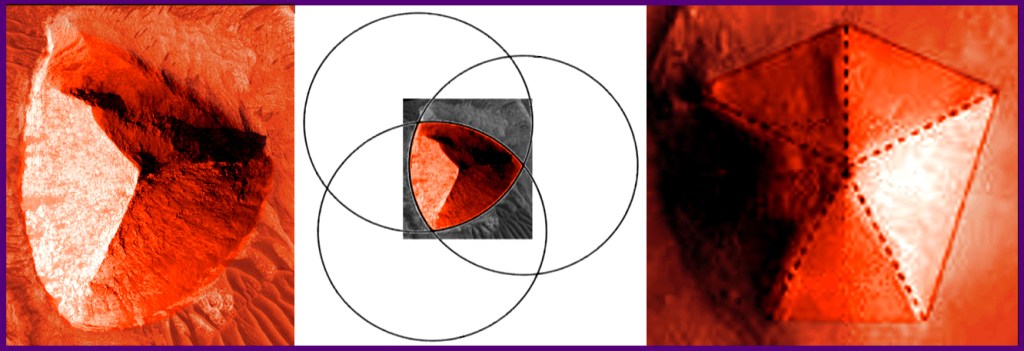
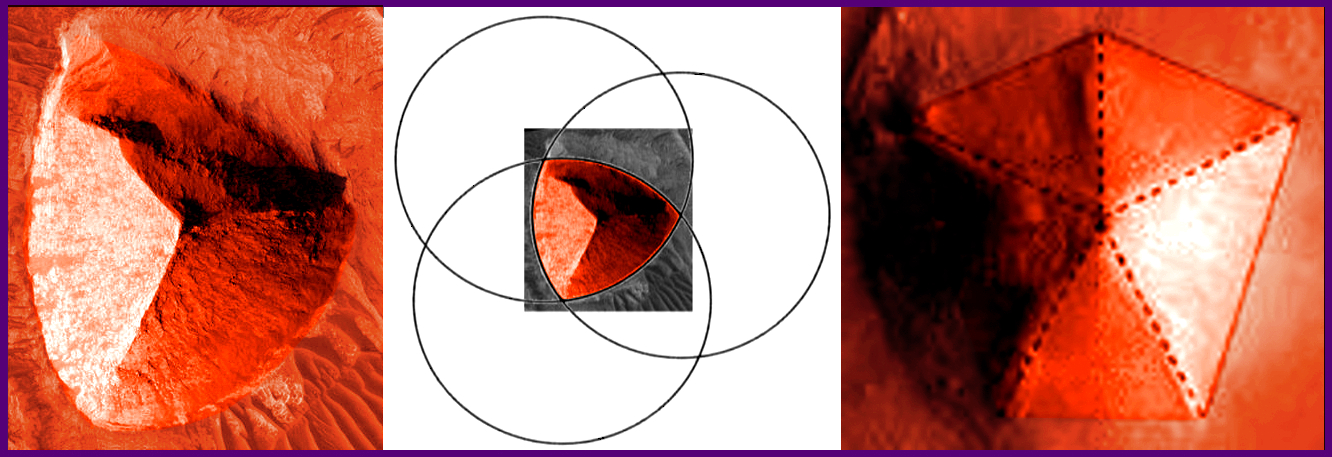
    A Reuleaux pyramid(L, C) and the D&M pyramid on Mars. Image credit: Haas et al.1

    Meaning of Geometric Shapes

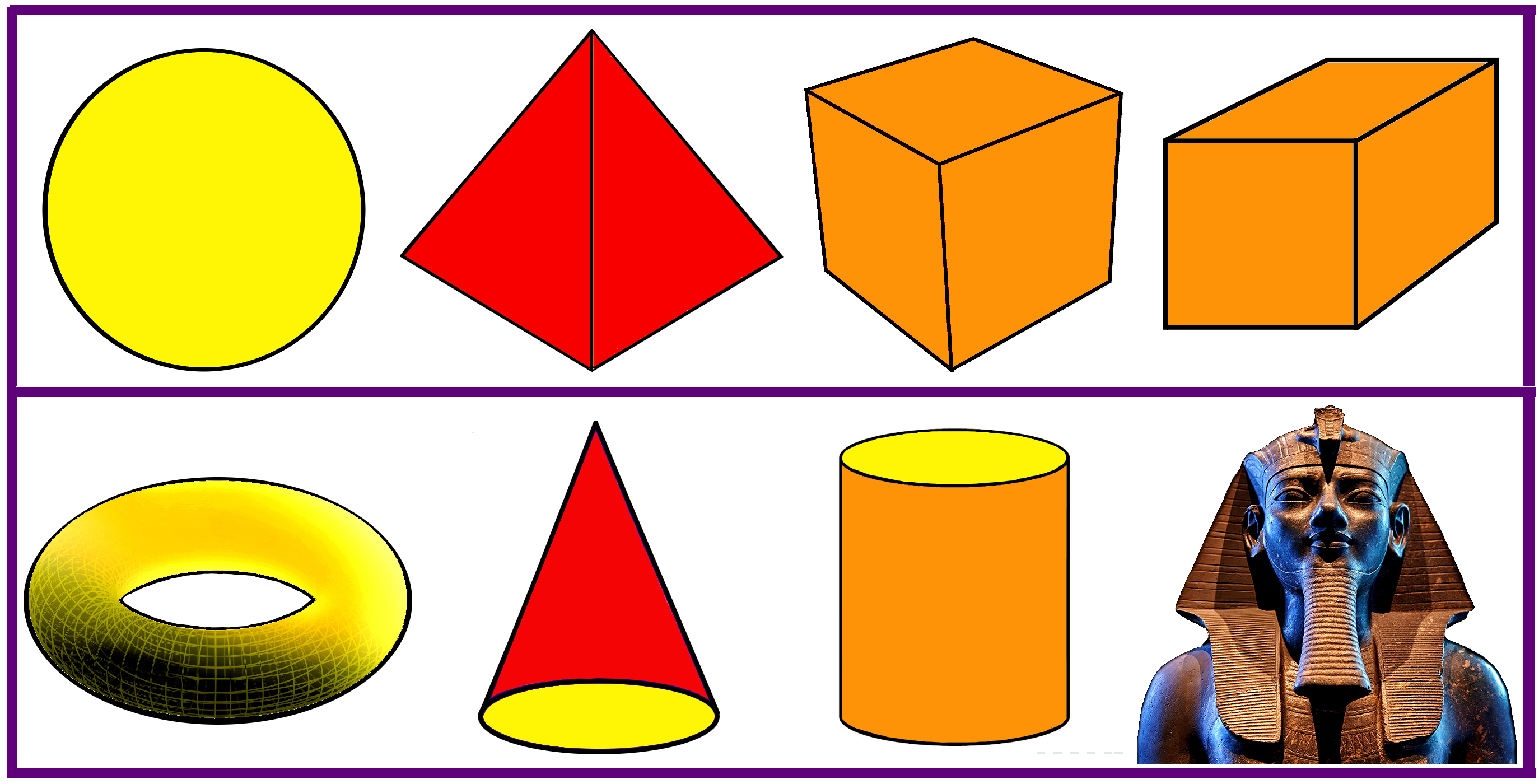
    L to R. Top: a. circle/sphere, b. triangle/pyramid, c. square/cube, d. rectangle/cuboid. Bot: a. circle/torus, b. circle/triangle/cone, c. circle/rectangle/cylinder, d. sculpture (Pharaoh).

    Since antiquity humans and ET humanoids (judging by the constructions on Mars) have used geometric diagrams to visually express universal truths. These symbols can be used to induce certain mental states and encourage the spirit to move forward along its path of evolution.2 Noted below are the meanings of basic shapes according to A Dictionary of Symbols,2 one of the best-known references of its kind. The Dictionary compiles information on hundreds of symbols and their meanings from a wide variety of sources. In brackets after the shape names below are the numerical values of the shapes.

    Circle (1). Heaven, oneness, wholeness, cosmos, the All, eternal order, eternity, continuity, cyclic processes, stability, the sun. The wheel is a common symbol of this Centre and the cycle of transformations. The number one (the Creator, Centre, unity) never corresponds to the manifest world or spatial reality. As is explained below in Meaning of Numbers, the circle can also be associated with the number twelve.2

    Triangle (3). Fire (agent of destruction and regeneration), communication between the material world and heaven. The number three denotes spirit and spiritual synthesis, e.g. in the cosmic tree of Odinism the nine worlds are on three basic levels of consciousness.2

    Square (4). The earth, material world, longing for power and domination, things quaternary, e.g. the four elements, seasons, stages of Man’s life, points of the compass. The square, or where necessary the rectangle, is the shape most frequently used by man, e.g. for a house, room, table, bed. It corresponds to the cross formed by the four cardinal points (north, south, east, west).2

    Cross (4). The cosmic tree (called Yggdrasil in Odinism), spiritual ascension, conjunction of opposites (positive – negative, superior – inferior, life – death). There are many different forms of cross, including those in a Y-shape or T-shape. A cross formed by the four cardinal points has the same quaternary meanings as a square.2

    Shape combinations in a diagram

    • The superior (or principal) elements are always those nearest the centre of a geometric diagram.
    • A round empty space in the centre of a diagram represents unity, the realm that is beyond space and time.
    • A circle around a square denotes unity of the contradictions and irregularities (angles and sides) of the material world.
    • A triangle (with apex uppermost) between a square and a circle symbolizes the relationship (represented by the triangle) between earth and heaven.
    • Although the geometric symbol of the earth is a square (or cube) and the symbol of heaven is a circle (or sphere), sometimes an outer circle is used to denote the earth (outer world) while an inner circle represents heaven (inner world).
    • Further to the above, it follows that as One refers to the Creator, outer circles would refer to the multiplicity of material phenomena.2

    Shapes with bulk

    The meanings of two- and three-dimensional shapes overlap, e.g. the sphere (circle) is associated with heaven, the pyramid (triangles) with communication between the material world and heaven, and the cube (square) with earth. Beyond these shared meanings, three-dimensional shapes combine the meanings of their constituent shapes.2

    Hemisphere and Mound

    In Egyptian hieroglyphics the symbol for a hemisphere (a semicircle with the diameter as the base) refers to the sun’s orbit. It symbolizes the Origin counterbalanced by the End or birth counterbalanced by death. Similarly, in its combination of a semicircle with a circular base (cyclic processes, transformation), in Egyptian hieroglyphics the symbol for a mound of earth (a rectangle with two sides incomplete) represents the intermediate stages of matter.2

    Pyramid

    The pyramid is a profound architectural symbol that indicates totality (tending toward Oneness).2

    It is a synthesis of different forms, each with its own significance. It combines the shape of its base (usually square, i.e. representing the earth) with triangles (representing communication between the material world and heaven). In a quadrangular pyramid, each face of the pyramid corresponds to one of the cardinal points and the summit (apex) represents the centre. The apex is the starting-point and finishing-point of all things —the mystic Centre.2

    Cone, cylinder and other geometric shapes with bulk

    As with the above-mentioned three-dimensional shapes, these shapes derive their meaning from the shapes of which they are made. For example, the cone signifies psychic Oneness by combining the meanings of the circle and triangle, and the cylinder (tower, pipe / tubular structures) indicates unity of the material and spiritual worlds by combining the meanings of the circle and square / rectangle.2

    Sculpture

    Chronology of sculpture on Earth:3

    • 230,000 BC. Primitive stone effigies.
    • 35,000 BC. Sculpture proper — carvings of animals, birds, and therianthropic figures.
    • 10,000 BC. Free-standing sculpture.
    • 4,000 BC. Free-standing sculpture and bronze statuettes.
    • 3,000 BC. Spectacular sculpture associated with Egyptian pyramid architecture (3,000 BC onward), e.g. divine statues, colossal figures guarding the pylons, and long avenues of sphinxes. The art and architecture of Ancient Egypt reflected Egyptians’ belief that life in this world is followed by eternal afterlife.

    Meaning of Numbers

    It is suggested that after the numbers three (triangle) and four (square), the next most important numbers are seven (their sum) and twelve (their multiplication).2


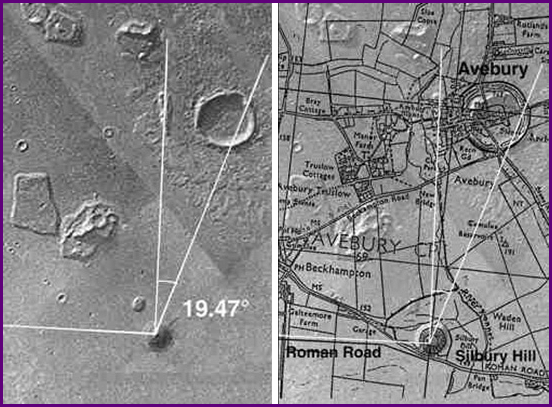
    Matching formations on Mars (L) and Earth (R). Image credit: S. Onstott.4

    Seven

    Seven is shown graphically by joining the triangle and the square. The triangle is either superimposed upon or inscribed within the square. The significance of this number is shown by examples such as the seven colours of a rainbow, days of the week, notes of the diatonic musical scale, seas, planets, directions of space, deadly sins.

    Further to the above image, the number seven also occurs in the beautiful correspondence between structures made by human/oids on Mars (Cydonia) and Earth (Avebury, England). These structures have the same shapes (circles, mounds, triangles), the same spatial relationships, and the same angles (19.47 degrees). This coincidence cannot have occurred by chance. It indicates that human/oids on Mars and Earth were involved with one another. Further, the ratio of the Cydonia : Avebury formation sizes is 7:1. Engineer and educator Andrew Johnson5 of CheckTheEvidence6 discusses this subject in detail.


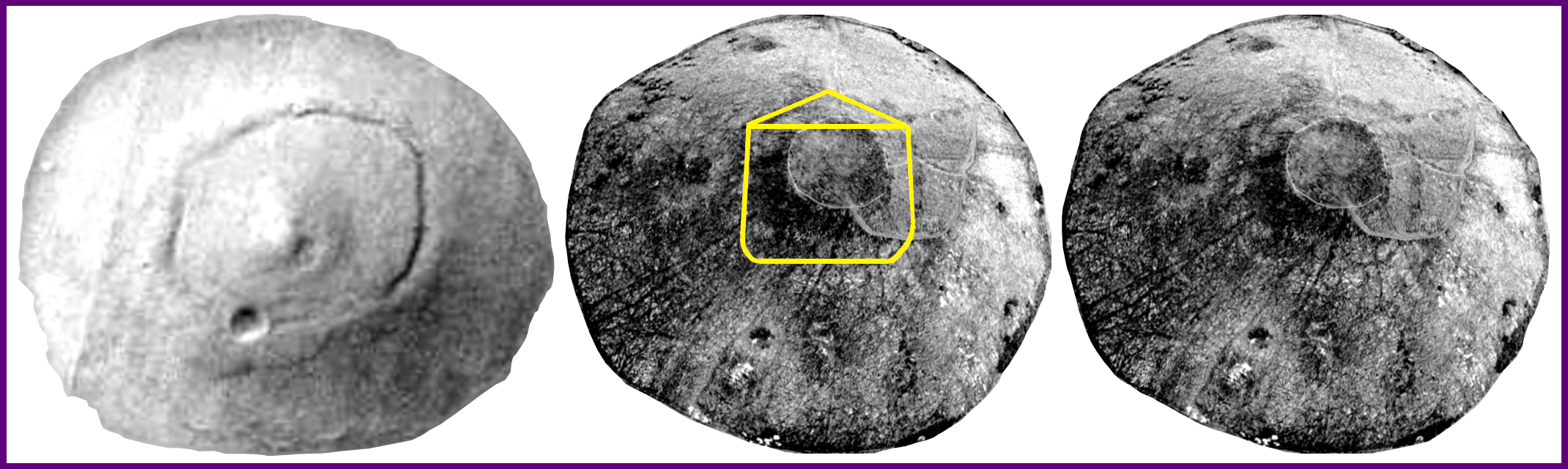
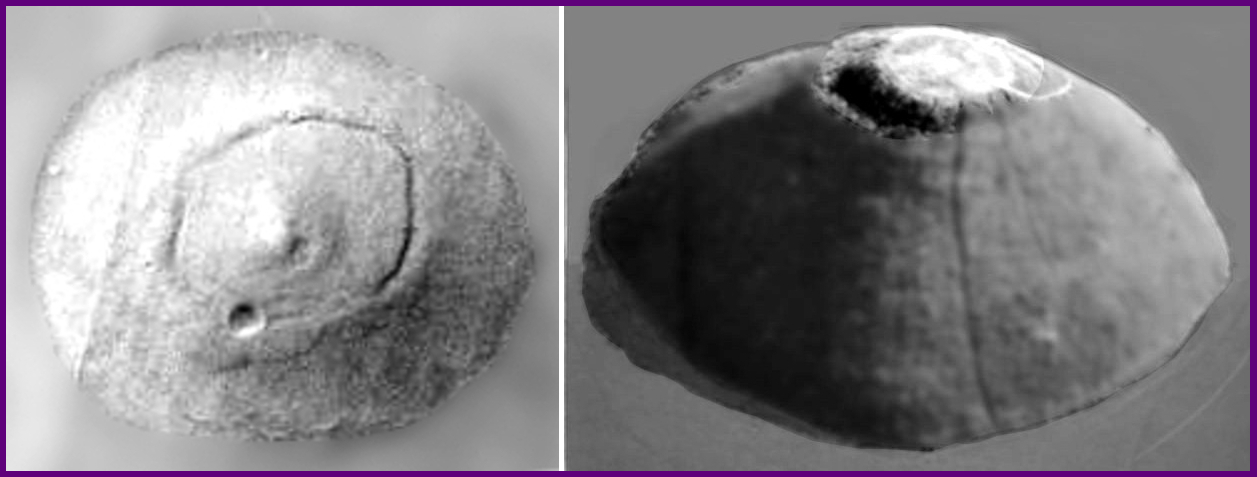
    Tholus (L) and Silbury Hill. Tholus image credit: A. Johnson5

    The large mound that is part of the formation in Cydonia is called the Tholus. It is similar to Silbury Hill, which is part of the corresponding formation in England. On top of the Tholus are the outlines of a triangle joined to a square, similar to the diagram on top of Silbury Hill.

    Note: (a) The triangle bases of the Tholus and Silbury Hill are implied; (b) There are other images of Silbury Hill online that show aspects of the square and triangle more clearly than this photo does; and (c) Silbury Hill is a prehistoric human/oid-made mound that was completed 4,300 years ago, its shape has deteriorated, we need to look carefully to see the triangle + square diagram.

    The meaning of the Tholus and Silbury Hill diagrams is equivalent to that of the quadrangular pyramid as the pyramid also combines the square (base) and triangle (triangular sides). Specifically, the diagrams on the Tholus and Silbury Hill represent (a) the number 7 in their combinations of the triangle (no. 3, spirit) and square (no. 4, material world), (b) communication between the material world and heaven (this meaning is reinforced by the contact between the triangle apex and the circular mound), (c) Oneness (the diagrams occur within circular mounds), and (d) Universal Oneness in view of the correspondence between the Cydonia and Avebury formations. Universal Oneness would be further emphasized by the likely correspondence between these formations and similar formations built by the ETs on other planets in our universe.


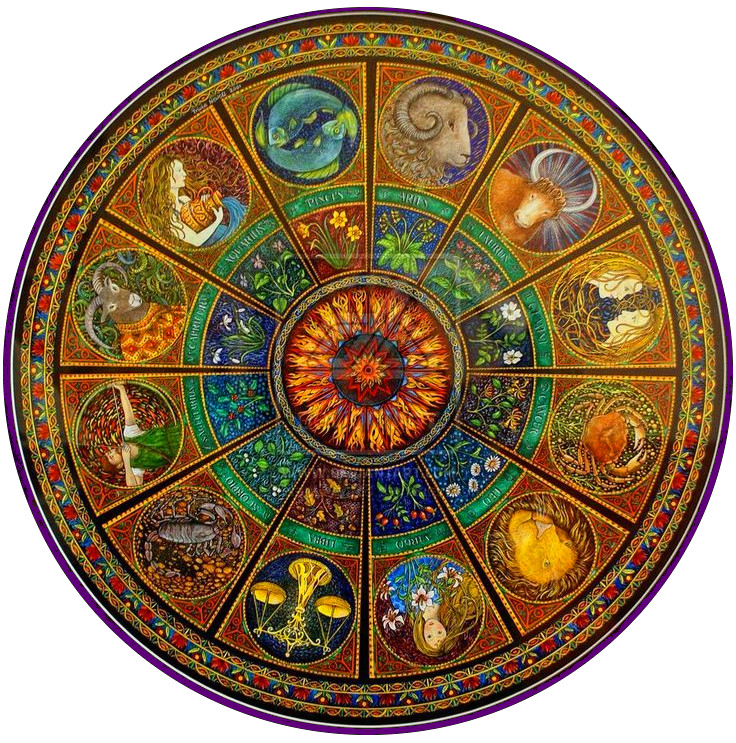
    Signs of the Zodiac

    Twelve

    As the symbolism of a dodecagon (a polygon with 12 sides and 12 angles) is practically identical to that of a circle, the number twelve is associated with the circle (cosmic order). Therefore systems or patterns based upon the circle or the cycle tend to have twelve as the end-limit, e.g. the twelve signs of the zodiac, hours on the clock-face, months of the year, major gods of many mythologies (including Odinism, in which there are twelve principal gods). Such examples evidence an order founded upon patterns of twelve.2

    On Mars we see examples of the circle (associated with the number twelve) and square (4) x triangle (3) combinations in ET structures. This is consistent with ETs’ science, which is based on twelve dimensions of reality (this is discussed below in relation to Wilbert Smith).

    Analysis of two pyramids


    A Reuleaux pyramid(L, C) and the D&M pyramid on Mars. Image credit: Haas et al.1

    As examples of ET pyramid symbolism, we can consider the Reuleaux and D&M pyramids.

    Reuleaux pyramid

    This Reuleaux pyramid is in the Candor Chasma region of Mars.1 As the illustration shows, the ETs incorporated three circles in the design of its base to create the most powerful symbol of the Divine — a Triunity (also called Trinity) of Triunities in the three lines of the Y-shaped cross, the three faces, and the three circles.

    D&M pyramid

    This five-sided pyramid is in the Cydonia region. At its apex there are two 90 degree angles and three 60 degree angles.1

    Symbolism of the D&M pyramid

    • Odd numbers and their geometric forms (e.g. three, five, triangle or pentagon) indicate dynamism. In contrast, even numbers and their forms (e.g. four, six, eight, square, hexagon, octagon) indicate stability, firmness, definition.2
    • The number five corresponds to the five Elements (four material Elements + spirit or quintessence).2
    • The number five denotes love, health and humanity.2
    • The number five is analogous with the human figure (four extremities + head).2
    • The pyramid looks like a stick man with legs apart and raised arms.

    This pentagon (5 sides) pyramid symbolizes a dynamic (interactive, aware / active) relationship with our Creator (all pyramids are about material world – heaven communication) in all things (the five Elements) for the purposes of love, health and humanity.

    References

    1. Haas G.J., Saunders, W.R., Miller, J.S. et al. Three-Sided Pyramidal Formation in the Western Region of Candor Chasma, J Space Explor. 2017; 6 (3): 133.
    2. Cirlot, Juan E. (1962, extensively revised in 1971). A dictionary of symbols.
    3. Encyclopedia of Art. Sculpture History.
    4. Onstott, Scott (date?). Sacred geometry in plain sight.
    5. Johnson, Andrew (2018). Secrets in the Solar System: Gatekeepers on Earth. Andrew Johnson discusses this book with Richard Hall in this video on RichPlanet TV.
    6. Johnson, Andrew. CheckTheEvidence.


    Family from afar
  • Do you know your Mars from your elbow?

    Do you know your Mars from your elbow?

    The images of Mars were taken from craft in orbit around that planet. Images from the Rovers are excluded because there is evidence to suggest that those vehicles are actually on Devon Island, Canada.1

    Please look at each picture and decide upon (a) the location (Earth or Mars) and (b) the meaning of the ET humanoid / human-made shapes. Answers to the test and image credits are given below, immediately before the references.

    1. Circles, inner and outer circle, mounds in circular shapes (suggesting the torus), narrow-based triangle (wedge).

    2. Circles, inner and outer circles, a square.

    3. Circular mounds with matching diagrams.

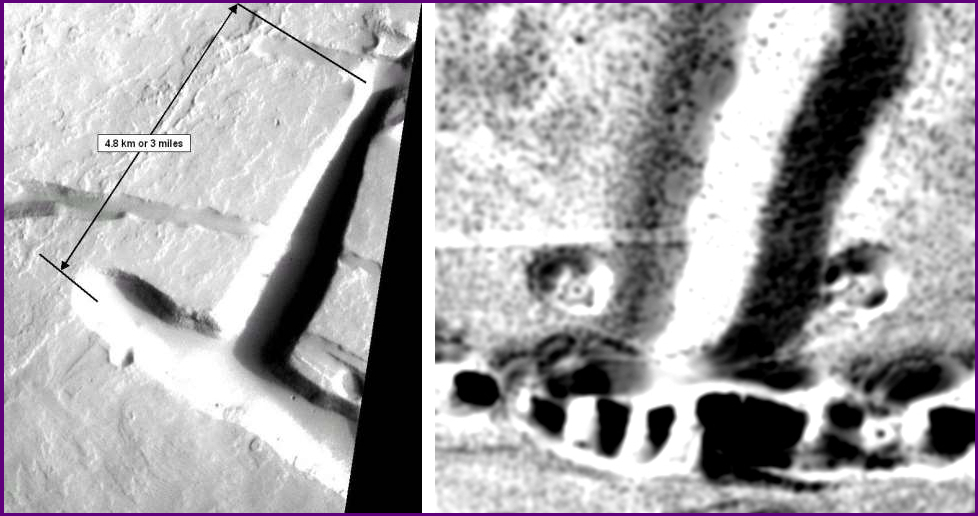
    4. Channels in the shape of a T-cross.

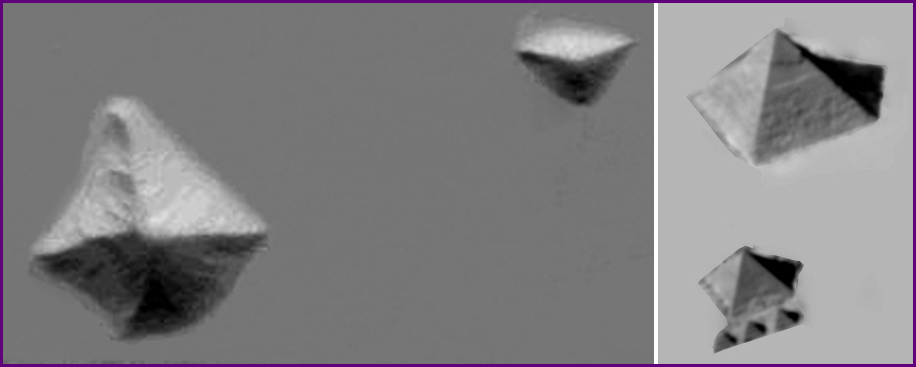
    5. Pyramids.

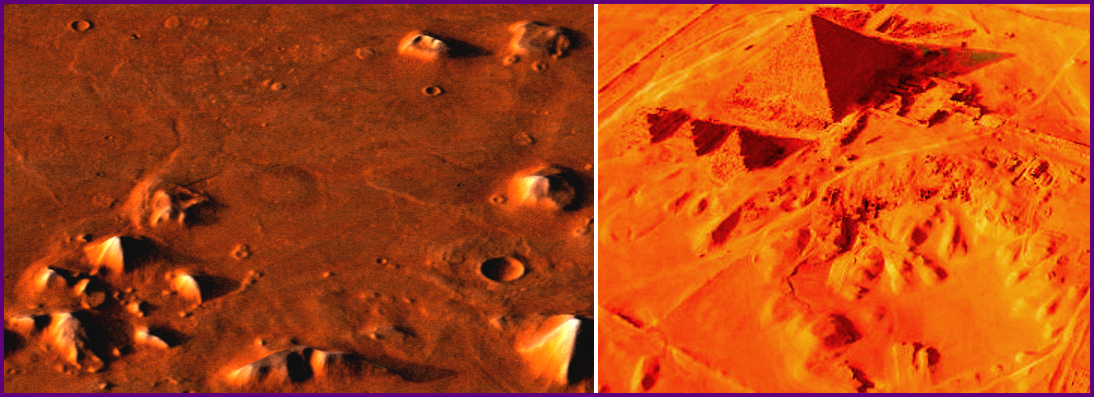
    6. Pyramids and other objects including sculpture, outlines of square / rectangular shapes on the ground.

    7. Pyramids.

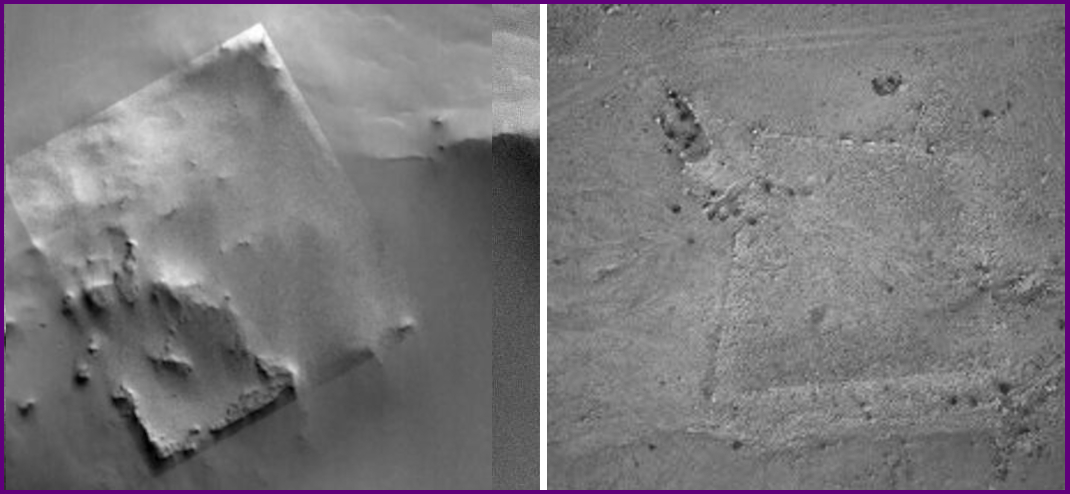
    8. Outlines and walls of square / rectangular structures.

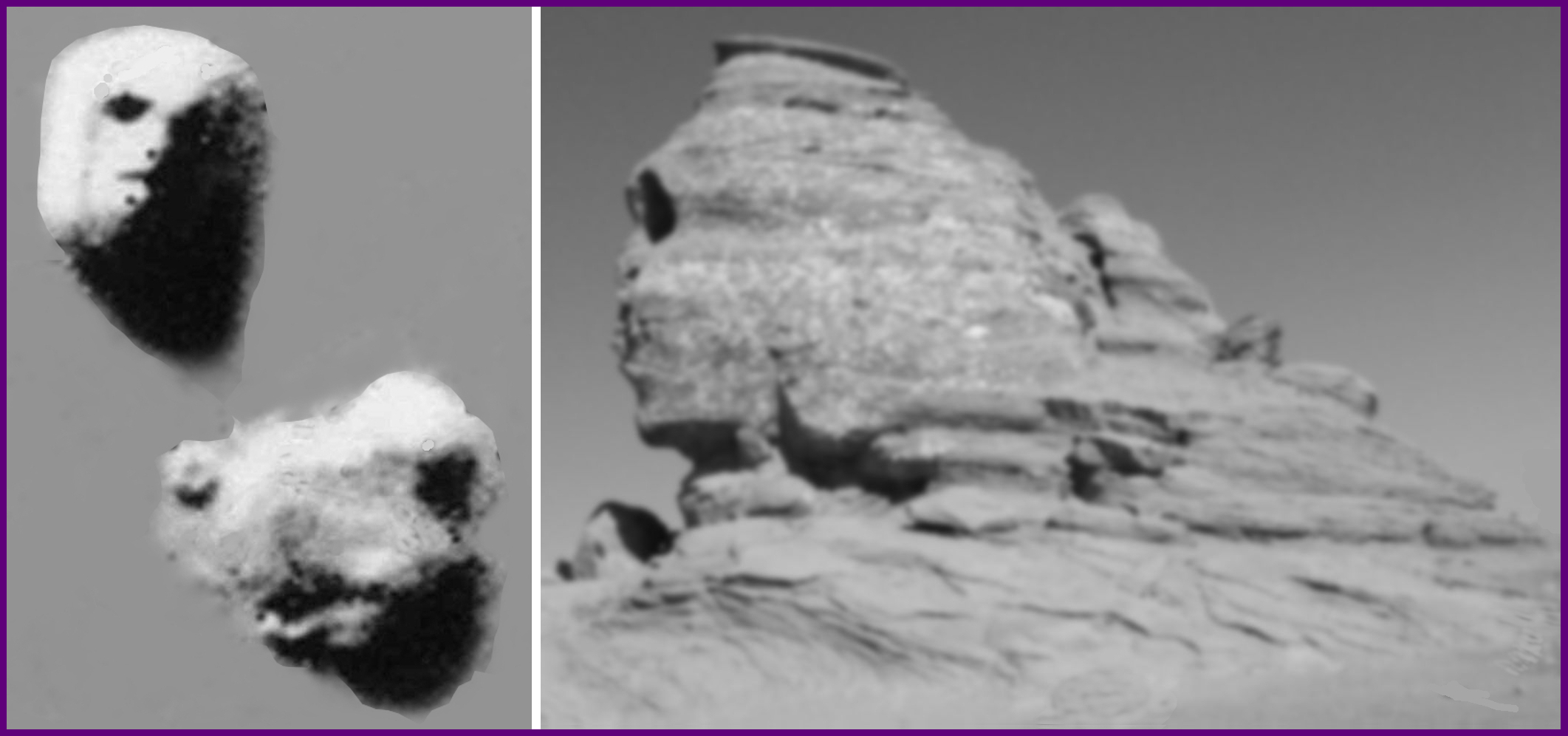
    9. Faces (one of these faces is a geological feature, i.e. not human/oid-made).

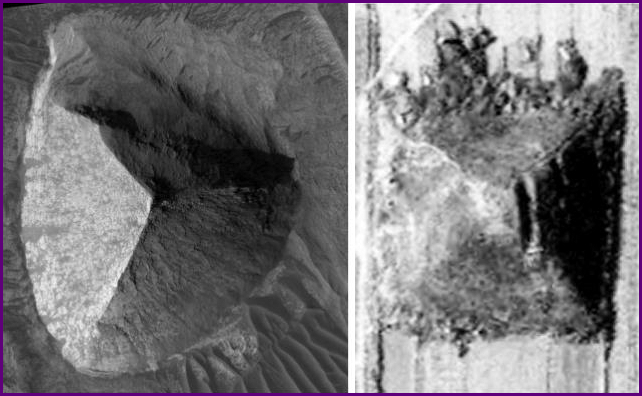
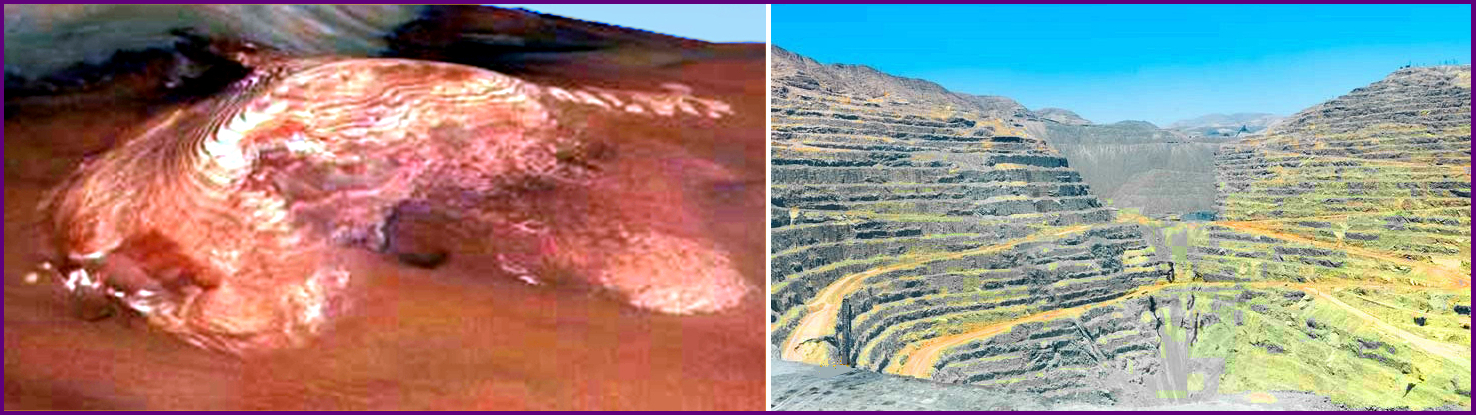
    10. Open-cut mines showing the characteristic ‘benches’.

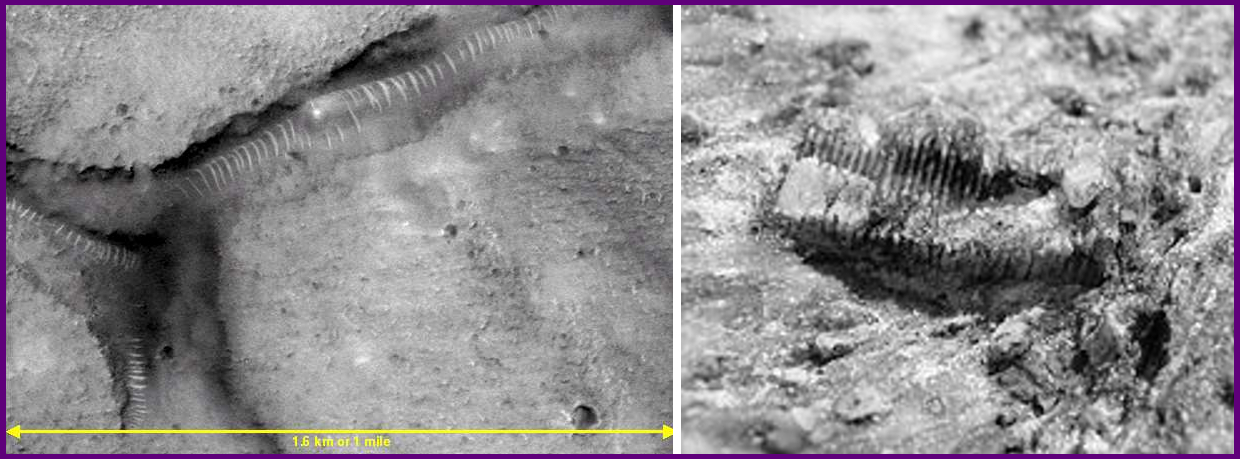
    11. Tubular structures.

    12. Aircraft (one is a real craft, the other an artist’s impression).

    End of test.

    Answers to the test

    All the images on the left are of Mars, except in the case of no. 12 . All the images on the right are of Earth, or visible from Earth in the case of no. 12.

    1.
    L. Cliff and crater in Cydonia, Mars.2
    R. The Neolithic henge monument (2,500 BCE) of Arbor Low, Derbyshire, UK.3

    The torus. A recent study4 suggests that the universe could be shaped like a torus (a donut, a car tyre tube) and not infinite. Perhaps ETs knew that and refer to the torus in their symbols.

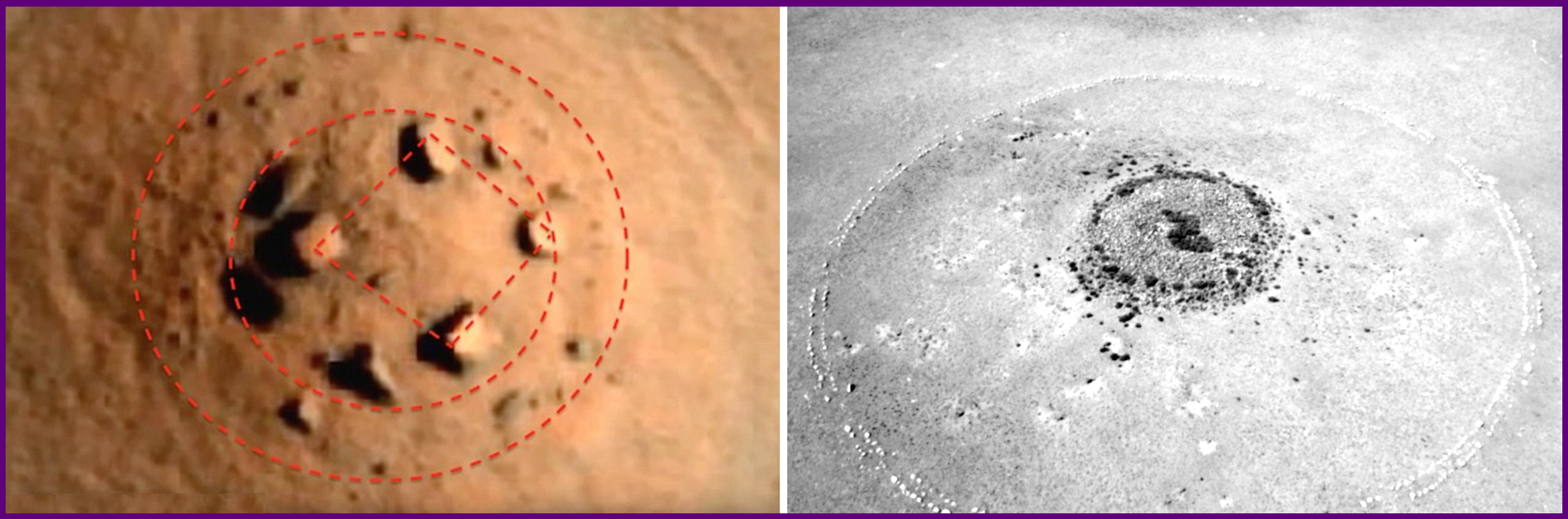
    2.
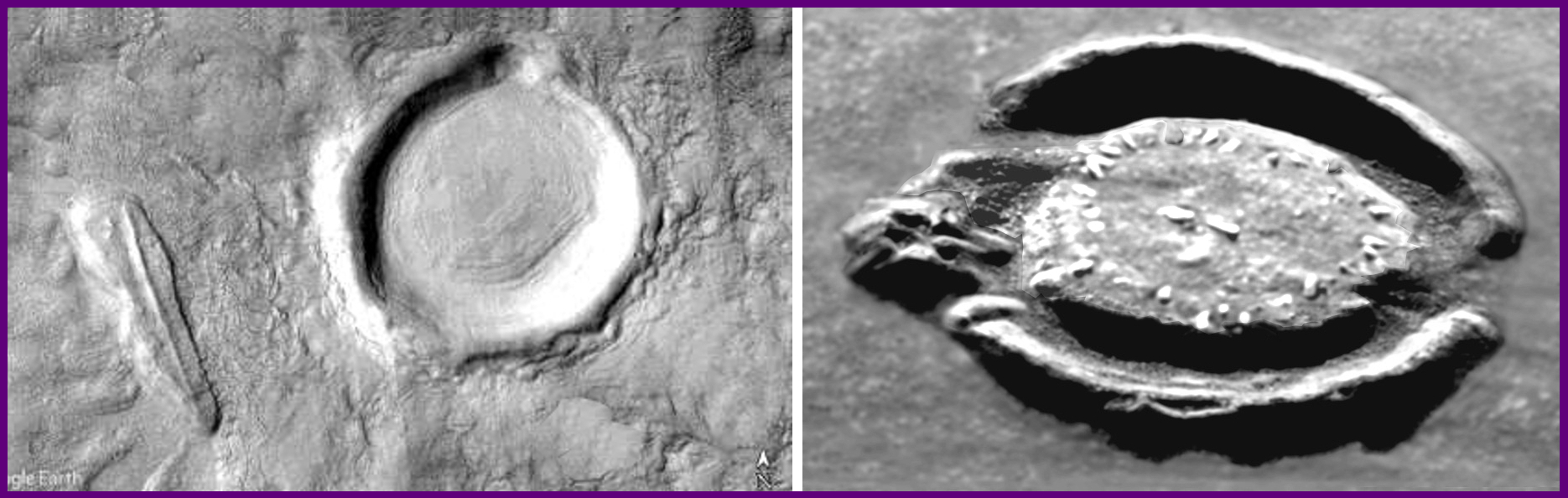
    L. Arrangement of stones in Nilosyrtis Mensae, Mars.5 The circle diameters are about 90 and 47 metres. The formation is comparable to Stonehenge (constructed from 3,000 to 2,000 BCE), Wiltshire, UK.6
    R. Stone circles on Earth (location unknown).

    3.
    L. Tholus in Cydonia, Mars.2
    R. Silbury Hill (constructed from 2,400–2,300 BCE), Wiltshire, UK. It is the tallest prehistoric man-made mound in Europe and similar in size to some of the smaller Egyptian pyramids of the Giza Necropolis.7

    4.
    L. T-shape (a form of cross) channel, south east of Olympus Mons, Mars.2
    R. A Persian Qanat, an ancient water management system in the Arabian Peninsula.

    5.
    L. Pyramids in the Cerebrus region, Mars.2
    R. Pyramids of Egypt (dating from c. 2,630 BCE).8

    6.
    L. Pyramids and other objects in the Cydonia region, Mars.9
    R. Pyramids of Egypt (dating from c. 2,630 BCE).8

    7.
    L. Pyramid in the Western Region of Candor Chasma, Mars.10
    R. Ancient pyramid in China.10

    8.
    L. Structures on Mars.2
    R. Hibabiya, an early Islamic village in the Jordanian desert.

    9.
    L. Face in the Cydonia region, Mars.2
    R. “Sphinx” in the Bucegi Natural Park, Romania.

    10.
    L. Open-cut mine on Mars — mountain in Juventae Chasma.2
    R. Open-cut mine on Earth.

    11.
    L. Tubular structures on Mars.2
    R. Ribbed pipe on Earth.

    12.
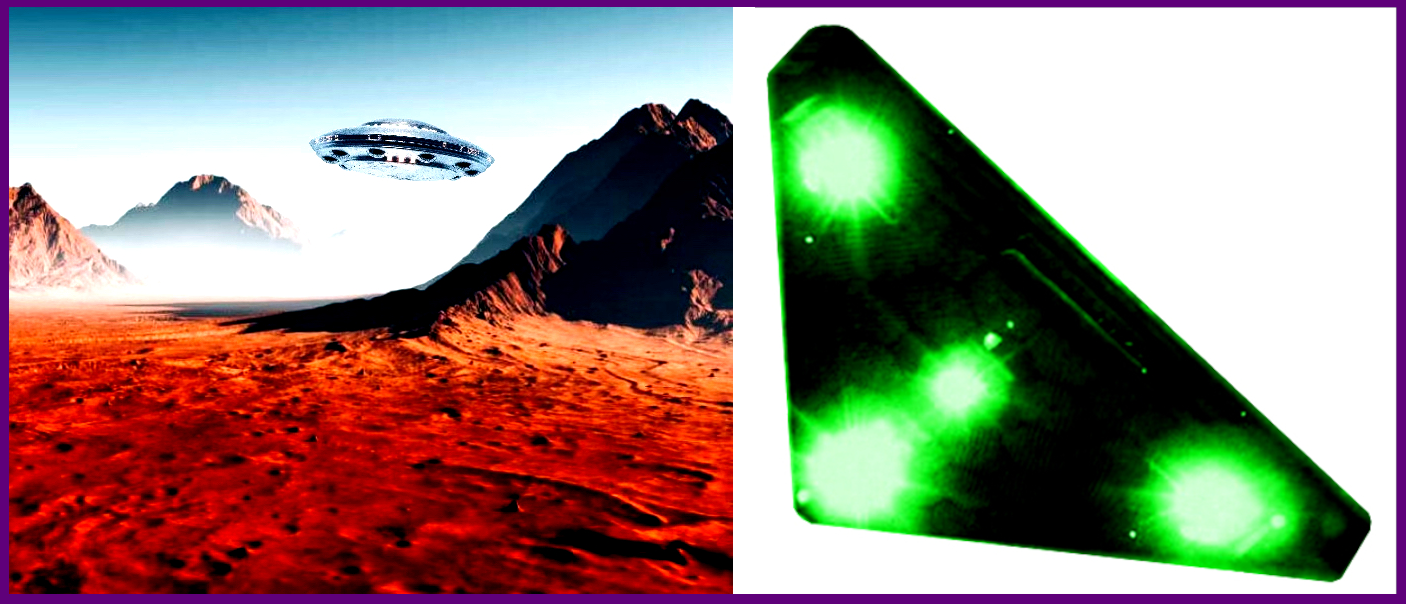
    L. An artist’s impression of a craft that could be on Mars.
    R. A flying triangle (the TR-3B) filmed using night vision in Longview, Texas on 27 Oct 2015.11

    References

    1. Christians For Truth (2021). Proof From NASA Software Engineers: Mars Rovers Are On Earth — Not On Mars.
    2. Johnson, Andrew (2018). Secrets in the Solar System: Gatekeepers on Earth. Andrew Johnson discusses this book with Richard Hall in this video on RichPlanet TV.
    3. Wikipedia: Arbor Low
    4. Aurich, R., Buchert, T., France, M.J. & Steiner, F. (2021). The variance of the CMB temperature gradient: a new signature of a multiply connected Universe, Class. Quantum Grav. 38 (2021) 225005. Anton Petrov explains the study on YouTube here.
    5. Savia, Chris (date?). Did Martian Druids Build Marshenge? Daily Grail.
    6. Wikipedia: Stonehenge
    7. Wikipedia: Silbury Hill
    8. Wikipedia: Egyptian pyramids
    9. Carlotto, Dr. Mark J. (2017). The Martian enigmas.
    10. Haas G.J., Saunders, W.R., Miller, J.S. et al. Three-Sided Pyramidal Formation in the Western Region of Candor Chasma, J Space Explor. 2017; 6 (3): 133.
    11. Triangle-shaped UFO flying over Texas filmed using night vision, Revealed, 17 Oct 2020.


    Family from afar