Tag: Aryans

  • Aryan makers of man 1: Aryans

    Aryan makers of man 1: Aryans

    Aryan man

    This is the first part of a three-part article series that will cover (i) Aryans, (ii) the Aryan ETs known as Anunnaki, and (iii) the creation and civilization of humans by the Anunnaki, including the true religion of Aryans.

    Post outline

    1. The importance of education about Aryans
      1.1 Individual psychological benefits
      1.2 Inter-generational and family-level benefits
      1.3 Community and societal benefits
      1.4 Health outcomes
      1.5 Educational and economic advantages
      1.6 Heinrich Himmler and Adolf Hitler
    2. What is an Aryan?
    3. Language of the gods
    4. Outflow of Aryans
    5. Interconnectedness of Aryan populations
      5.1 Supporting evidence
      5.2 Recommended viewing
    6. References

    1. The importance of education about Aryans

    There are well-documented positive effects for people who engage with their history, ancestry, culture, and collective identity.

    1.1 Individual psychological benefits

    This includes stronger sense of identity, higher self-esteem, internal locus of control, reduced anxiety, and greater emotional resilience.1,2,3

    1.2 Inter-generational and family-level benefits

    This includes improved parent-child relationships, healthier adolescent development, and transmission of coping strategies.4

    1.3 Community and societal benefits

    This includes enhanced social cohesion, stronger interpersonal networks and access to support, improved mental health at community level, long-term community building and quality of life improvements.5,6

    1.4 Health outcomes

    This includes lower cortisol and inflammatory markers (linked to cardiovascular health) and improved healthcare access.7

    1.5 Educational and economic advantages

    This includes educational achievement, economic collaboration, and civic engagement.8

    1.6 Heinrich Himmler and Adolf Hitler

    Heinrich Himmler, chief of the SS, was a highly educated man with a strong research interest in ancient Aryan lore, Germanic traditions, and the primeval Teutonic past. In 1935 he created an elite research institute called the Ahnenerbe to investigate and document the vast history of white Aryan accomplishment as of the Paleolithic or Old Stone Age.9

    His research showed that the Aryan race has roots far beyond just Celtic, Slavic or Germanic. He found that the Aryan race shows a unity of language, ethnicity and culture extending into a much more distant antiquity. Specifically, like other investigators of this subject, Himmler’s findings indicated that the Aryan race descended from the gods as described in the Eddas and other Icelandic sagas.9

    Concerning the value of this race, in Mein Kampf (Chapter XI, Race and People) Adolf Hitler is clear:

    All that we admire in the world today, its science, its art, its technical developments and discoveries, are the products of the creative activities of a few peoples, and it may be true that their first beginnings must be attributed to one race. The maintenance of civilization is wholly dependent on such peoples. Should they perish, all that makes this earth beautiful will descend with them into the grave.

    2. What is an Aryan?


    Aryan children


    Aryan man and woman

    After World War 2, “Aryan” was replaced by “White” in everyday use and by “Indo-European” for use by historical and linguistic specialists. However, the racial identity of White people remains Aryan. Similar to the designations of Asian, African, and Arab, we are Aryan (not “White”).10

    The name Aryans means the “Noble Ones.” The name is related to the Greek words aristos (“the best”) and arete (“excellence in virtue”).10

    Prehistoric Europe comprised three distinct populations of Aryans:

    • Western hunter-gatherers. This primordial population arrived in Europe about 45,000 years ago and developed a culture of egalitarian individualism in the northwest areas of Europe.
    • Early Farmers. The farmers arrived from Anatolia about 8,000 years ago and had the greatest genetic effect on the hunter-gatherer population in the southern areas of Europe.
    • Indo-Europeans. These Aryans migrated from the Pontic-Steppes as of about 4,500 years ago and had the greatest genetic impact on central Europe and some regions in the north, with less effect in the east and south.11

    This racially homogeneous collection of tribes called themselves the “Aryans,” all spoke the same language, and they had a common religion, legal system and social structure.10

    3. Language of the gods

    Concerning Aryans’ initially shared language, perhaps the following quote from the Oera Linda Book12 (discussed in this post) is a reference to that ancient language:

    “When Wr-alda [God] gave children to the mothers of mankind, he gave one language to every tongue and to all lips. . . . As thus our language . . . is rightly named the language of the gods, and all those by whom it is held in honour derive honour from it.” (p 69)

    Especially as the OLB always uses the word Wr-alda when referring to God, could this “language of the gods” be a reference to the language of the god-like beings known in ancient Sumer as the Anunnaki? Evidence presented by the distinguished British philologist Sir William Jones (1746 – 1794) is consistent with this view. In his Third Anniversary Discourse to the Asiatic Society (1786) Jones suggested that Sanskrit, Greek and Latin languages had a common root and that they might all be related to Gothic and the Celtic languages, as well as to Persian. He postulated a proto-language uniting Sanskrit, Iranian, Greek, Latin, Germanic and Celtic:13

    The Sanscrit language, whatever be its antiquity, is of a wonderful structure; more perfect than the Greek, more copious than the Latin, and more exquisitely refined than either, yet bearing to both of them a stronger affinity, both in the roots of verbs and the forms of grammar, than could possibly have been produced by accident; so strong indeed, that no philologer could examine them all three, without believing them to have sprung from some common source, which, perhaps, no longer exists; there is a similar reason, though not quite so forcible, for supposing that both the Gothic and the Celtic, though blended with a very different idiom, had the same origin with the Sanscrit; and the old Persian might be added to the same family.14

    Further, languages like Lithuanian and the Dutch Friesian Saxon Germanic root tongue appear to be even more similar to the lost proto-European language than Hebrew, Greek or Latin.15

    Perhaps the lost common source of these languages is indeed the language referred to in the OLB as “the language of the gods,” with the gods being the god-like ET humanoids known in ancient Sumer as the Anunnaki.

    4. Outflow of Aryans

    The great out-flowing of Aryans from their homeland in the Pontic-Steppes as of about 4,500 years ago involved:

    • The above-mentioned migration into Europe.
    • Migration across the Hindu Kush mountains and into the Indus valley, where they gave birth to the Classical Indian civilization.
    • Migration to the area now known as Iran, where they created the ancient Persian civilization.
    • Journeying further east, across the the Takla Makan desert and into Western China.10

    The Eastern Aryans intermarried with the more-numerous non-Aryan peoples whom they conquered, lost their distinctive racial identity, and eventually became extinct. The Western Aryans, who poured into Europe, conquered Greece, Italy, swept across Northwestern Europe as far as Ireland, and established the distinctive culture of the Germanic peoples.10

    The names “Ireland” and “Iran” both mean “land of the Aryans” and evidence the extent of Aryan settlement. Similarly, among the ancient Aryan civilization of the Hittites, there are documents referring to non-Hittites as “nata ara” (“non-Aryan”).10

    Excepting for the (racially related) Basques in the west and the Finno-Ugric peoples in the northeast, all the nations and peoples of Europe are descended from the Western Aryans. As the people they conquered were racially similar to them, the Western Aryans maintained their distinctive racial identity to this day after mixing with the “Old Europeans.”10

    5. Interconnectedness of Aryan populations

    From about 2,000 to 3,000 BCE especially, signs of deeply interconnected peoples began springing up everywhere, from the Tarim Basin in China to India and Persia, to Sumer, Egypt and Crete, to the Caucuses and the Steppes, with traces found as far away as North and South America, China, Japan, and Koreas.15

    Written descriptions, artistic depictions, and the most ancient remains exhumed, clearly illustrate that:15

    • These Aryans were a highly competent seafaring people who explored, mined, and settled far and wide.
    • Aryans formed the elite and ruling class of the regions that they occupied.
    • This widely distributed ruling class were close relatives or family in most cases, and they saw themselves as a race, tribe or extended family with kinship ties.
    • As this Aryan family spread across the world, they often became known by different names, with a single branch sometimes being referred to by several different names simultaneously.
    • These Aryans produced many great sages and leaders.

    In many cases, the populations living today in the once Aryan-ruled regions are poorly representative of those who lived and ruled there long ago. Also, modern border demarcations and labels for nations and cultures often bear little to no resemblance whatsoever to those in common usage long ago.15

    5.1 Supporting evidence

    A sample of the evidence showing interconnectedness of key Aryan populations in antiquity:

    Aryans –> Sumer

    When stripped of the specifics and reduced to their core elements, Sumerian stories and myths have countless parallels with the stories and myths of Northern Europeans.27 Further, evidence presented by Donald Mackenzie28 indicates that Aryans laid the foundations for the brilliant civilizations of the ancient world in southern Europe, Egypt, and the valley of the Tigris and Euphrates:

    • Much circumstantial evidence indicates that Sumerian culture originated from Central Asia, where vast areas of desert country were once lush and densely populated by advanced communities. For example, the Anau culture in southern Turkmenistan dates to 4,500 BCE, and it was preceded in the same region by Jeitun culture, which may have begun prior to 7,000 BCE.29 From these ancient centres of civilization, large migrations would have occurred in response to the gradual encroachment of wind-distributed sand and the increasing shortage of water. Evidence suggesting such early migrations from Central Asia include Copper Age artifacts: Clay votive statuettes found at Anau resemble those which were used in Sumer for religious purposes.28
    • A comprehensive study of thousands of ancient crania in London and Cambridge collections showed that Mediterranean peoples were distributed between Egypt and the Punjab. This indicates that the ancient Sumerians belonged to the same race as the pre-Dynastic inhabitants of Egypt and the Pelasgians and Iberians of Europe.28
    • The statuettes from Tello, the site of the Sumerian city of Lagash, have distinctly Mediterranean skull forms and faces.28
    • Fine and exact sculpture of the later Sumerian period shows that the ruling classes’ eyes were similar to those of the Ancient Egyptians and southern Europeans.28
    • Sumerian noses were of the Egyptian and Grecian type and not Semitic.28
    • Like the Ancient Egyptians, Sumerians habitually shaved their scalps and faces.28
    • Like the Egyptian noblemen of the Old Kingdom period, Sumerians wore short, pleated kilts, and left the upper part of their bodies quite bare.28
    • Like the other people in their racial group, Sumerians spoke a non-Semitic language.28
    • Research shows that the originators of Mesopotamian civilization shared a common racial origin with other ancient agriculturists: Proto-Egyptians, the early Cretans, and the Pelasgians in southern Europe and Asia Minor. In the view of Professor Elliot Smith, the eastern branch of this racial group that included Sumerians reaches to India and the western branch reaches to the British Isles and Ireland.28

    It is also notable that the Sumerians, whose racial home was Eridu (originally a seaport) evidently possessed knowledge of navigation and they traded on the Persian Gulf.28

    Aryans –> Egypt

    There were red-headed Egyptian Pharos with a far stronger genetic connection to North-Western Europe than to present-day Egyptians.15 The subject of fair-skinned and red-haired Egyptian Pharos is discussed in the post Long-heads of Egypt.

    Aryans –> Rome

    Concerning the Romans, the investigations of Karl Earlson16 show that there was a predominance of Aryans among the Roman ruling class. Of the 18 emperors from Augustus to Commodus, 9 had blond or red hair, 5 had grey or white hair, 3 had no recorded hair colour, and just 1 (Hadrian) was referred to as dark-haired. Of those 18 emperors, 9 had blue or grey eyes, 2 had “wine-coloured eyes,” and 7 had no recorded eye colour. Although several of the emperors were white/grey-haired old men, some of them were depicted as light-eyed. It is likely that in their youth they too would have been described as fair-haired. Of the 9 emperors with fair hair, 5 are recorded as also having light eyes, with the remaining 4 having no eye colour noted. Only Hadrian is called dark-haired, but he was described as being light-eyed. None of these early Roman emperors are referred to as having dark eyes.

    Karl Earlson’s research totally exposes the misconception that Roman emperors were brunet like the majority of Romans during that era.

    Further, Earlson’s work “augments the findings of Wilhelm Sieglin [1935], who compiled a list of 27 blond-haired Roman gods and goddesses, 10 blond Roman heroes and heroines, and 63 blond Roman historical figures, many of whom were Patricians” and “it also confirms the theories of Hans F. K. Günther [1957], who argued that the frequent use by the Patricians, of names such as Rufi, Flavi or Fulvi (indicating fair hair), and Caesulla or Ravilia (indicating light eyes), demonstrated their strongly Nordic racial affinities.”16 In addition to showing that the hair and eyes of Roman emperors were Aryan, he also found that many of the Roman emperors were tall.16

    Aryans –> China

    At the beginning of the 20th century, European explorers found mummies preserved in the Tarim desert of Xinjiang in Western China. The Tarim Basin mummies have tartan pattern clothing of the style found in modern Scotland and the early Tarim mummies were exclusively Aryan, with phenotypic features including European traits such as tall stature up to 6 1/2 feet, high cheek bones, deep-set eyes, hair colors ranging from light blond to deep brown, long nose, elongated skulls, and high cranial vaults. The earliest mummies are dated to around 4,000 years ago and the latest to around 2,000 years ago. As of about 3,000 years ago, mummies of the Tarim’s eastern regions begin to show some Mongoloid/East Asian phenotypes. A genetic analysis on the mummies in 2021 showed that they belonged to a population known as West Siberian Hunter-Gatherers, who directly descended from the Ancient North Eurasians.17

    Aryans –> New Zealand

    New Zealand polymath Edward Tregear (1846 – 1931)18 expressed his research on comparative mythology and linguistics in his book The Aryan Maori (1885) in which he stated that (a) The Māori language is in the Indo-European language family, (b) Māori are descended from Hindu Brahmins who spread south from India, and (c) Māori have Indo-Iranian origins.

    Aryans –> Philippines, Hawaii, and Japan

    Scholars such as John Batchelor (1854-1944)19 reasoned that the Aryan invasion extended to the Philippines, Hawaii, and Japan, and they identified indigenous peoples whom they believed to be descendants of early Aryan conquerors. Concerning the Ainu:

    • They are a near-extinct group native to northern Japan with some Aryan features, including “European” eyes and eye sockets, and lighter skin pigmentation relative to other Japanese people.
    • The Ainu trace ~80% of their ancestry to the Hokkaido Jōmon.
    • In 2001 a craniometric study conducted on the Hokkaido Jōmon found numerous physical similarities between Jōmon and European skulls, and the researchers suggested that the Jōmon were at least partially descended from a ‘Eurasian’ population of the Upper Paleolithic.
    • Modern genetic studies have confirmed that the Ainu do in fact share some ancestry with Aryans, specifically those in ancient North Siberia, thus indicating gene flow between Ancient North Siberians and the ancestors of Jōmon.20

    Aryans –> Pakistan

    In a DNA study published in 2014, Garrett Hellenthal and colleagues21 found that the swiftly-disappearing Kalash people still living around modern Pakistan, and who claim to be descended from the soldiers of Alexander the Great, do in fact have DNA input from modern day Germany and Austria between 990 and 210 BCE.

    Aryans –> India

    A single genetic mutation, the western Eurasian -13910 C>T mutation, that enables lactose digestion after weaning, and is common in modern European populations but far less common in others, is the identical genetic mutation that still occurs frequently in northwest India and follows a general northwest to southeast declining pattern within the country.22

    In 2018 genetic evidence presented by leading Harvard geneticist David Reich showed that a Northern European input accounts for ~0-30% of South Asian ancestry, particularly in northwestern regions and among the upper classes of India. Although Indians belonging to higher castes are genetically closer to Europeans, individuals from lower castes are genetically closer to Asians.33

    Aryans –> Persia

    There are references to Frya (a Frisian deity and central figure in the Oera Linda Book, discussed in this post) in the Avesta, the primary collection of religious literature of Zoroastrianism, an Iranian religion centred on the Avesta. The Avesta dates back to some time after the Aryan invasion in c. 1,500 BCE, which coincides with the arrival of the Aryans (Germanic people, referred to as Geertmen in the Oera Linda Book12) in India, Parkistan, and later in Persia. The Avesta was only compiled in its current format some one thousand years later.27

    Prayer numbers and references to Frya in the Khorda Avesta:31

    110 We worship the Fravashi of the holy Frya.

    119 We worship the Fravashi of the holy Frya.

    Prayer numbers and references to Fryana in the Khorda Avesta:

    81. ‘To her did Yoishta, one of the Fryanas, offer up a sacrifice with a hundred horses, a thousand oxen, ten thousand lambs on the Pedvaepa of the Rangha.

    120. We worship the Fravashi of the holy Yoishta, of the Fryana house.

    Similarly, in the Yasna Avesta,32 in Chapter 46 it is written:

    12. When among the laudable descendants and posterity of the Turanian Fryana the right ariseth, through activity of piety that blesseth substance; then shall Good Thought admit them, and Mazda Ahura give them protection at the Fulfillment.

    India – Persia

    “Almost any Sanskrit word may be changed at once into its Avestan equivalent, or vice versa, merely by applying certain phonetic laws.”34

    Sumer – Egypt – India

    Laurence Waddell23 found correlations between various Sumerian king lists, the Egyptian list of pharaohs, the Bhagavata Purana, Mahabharata, Rigveda and numerous Indus Valley civilization seals and other monuments and relics and sources. Waddell used the Indian king list to validate the Sumerian king list. He explained that the Indian king list is just the Sanskrit version of the Sumerian king list.24

    Aryans –> S. America

    Spanish Conquistador Pedro Pizarro (1571) said the following about the people of Peru: “The ruling class in the kingdom of Peru was fair-skinned with fair hair about the colour of ripe wheat. Most of the great lords and ladies looked like white Spaniards. In that country I met an Indian woman with her child, both so fair-skinned that they were hardly distinguishable from fair, white men. Their countrymen called them ‘children of the gods’.”25

    Archaeologist Pierre Honoré30 stated that the pre-Columbian Mesoamerican civilizations were built by fair-skinned people from the vicinity of Crete.

    Aryans –> Middle East and S. America

    According to Ignatius Donnelly:26

    • The Mayan alphabet is similar to the Phoenician.
    • The original Mayan people were of the White race.
    • There are many strong connections between South American empires and Egypt and Egyptian cities and pyramids, including peculiarities in their construction and their unique cultural significance.
    • Prussian polymath and scientifically-minded explorer in South America, Alexander von Humboldt (1769 – 1859) came across numerous plants that he knew were not native to the area, including a certain palm tree found in the Middle East, indicating their recent introduction.26

    Aryans –> Easter Island

    When Mrs Scorseby Routledge (one of the first scholars to visit Easter Island) and others visited Easter Island in 1913, they saw that among the population there were tall, red-haired, white-skinned people with European features. These white people had ears stretched down to their shoulders with discs or chocks in their earlobes, and some of these Whites wore white feather headdresses.35 In 1964/5 a photograph was taken of such an Aryan-looking man (Nicolas Pakomio) on Easter Island. The photo is featured in the post Long-heads of America.

    Japan –> S. America

    The largest ever genetic study of native South Americans, published in PLOS Genetics in 2013, concluded that no more than 6,000 years ago there was contact between Ecuador and East Asia, while the Jōmon culture was flourishing in Japan. The study suggests that the contact could have been trans-oceanic or a late-stage coastal migration that did not leave genetic imprints in North America. This contact could explain the similarity between the pottery of the Valdivia culture of Ecuador and the Jōmon culture, the earliest major culture of prehistoric Japan.36

    Southern Africa: Great Zimbabwe

    This subject is discussed in the post Who built Great Zimbabwe?

    5.2 Recommended viewing

    More information on this subject is available in these videos:

    Skeletons in the Cupboard. This documentary created by Peter Marsh and Gabi Plumm is available in three episodes on YouTube:

    Episode 1 Episode 2 Episode 3

    The documentary presents unequivocal evidence of tall, fair-skinned people with reddish hair who arrived in the general area of New Zealand in ancient times. This distinctive population was peaceful and benevolent, offering gifts of culture, civilization, technology, and new concepts of philosophy and spirituality. The presentation also discusses the many cultural and genetic links between historical peoples in Peru, Egypt, the Middle East, and the Pacific, including Easter Island and New Zealand.

    Asha Logos: Oera Linda. This highly informed and professional discussion of the Oera Linda is presented in three parts:

    Part 1 Part 2 Part 3

    From the Asha Logos videos we learn:

    • The Frisians of the Oera Linda Book (OLB) [discussed in this post] seem to have been a seed people, with shared spiritual beliefs, acting as the central pillar at the head of a confederacy of kindred peoples, whose branches stretched out in all directions over time, and whose members played key roles in nearly every pivotal event in history. [Part 1]
    • Numerous historians from the ancient to the modern, spoke of the broader Germanic people group as something of a seed population, a wandering tribe from which branches constantly sprang. [Part 2]
    • In particular, in seems that Persia and India were an epicentre for much history, and branches of fair-skinned seafaring people extended far and wide, with the migrations often spurred by natural disasters or major wars or conflicts. [Part 3]
    • The branch that seems to have extended into South America and subsequently into the region of New Zealand and Easter Island, seems to have separated from the larger Aryan family at a very early date, likely around 1,500 BCE. [Part 3]
    • The Aryan invaders seem to have represented an aristocratic ruling class, equivalent to the knightly caste in feudal Europe, with membership of elite cavalry regiments signaling distinction and good breeding throughout much of Europe until just a century or two ago. [Part 3]
    • There certainly seems to have existed a seagoing empire with virtual limitless reach, as is clearly evidenced by similar megalithic structures found in key positions around the world, and constructed in similar manners. [Part 3]
    • It is possible that the sea kings of the OLB were of the cultural lineage and perhaps even genetic descendants of the sea kings of a more distant age. [Part 3]
    • It is not clear how unified the Aryan confederacy (in north and south America, Greece, the Middle East, India, Iran, New Zealand, Easter Island, and virtually everything in-between) was at any point after the cataclysmic deluge of 2193 BCE (the date given in the OLB for the great flood that submerged Atlantis). [Part 3]
    • However, evidence seems to indicate that these Aryans represented something of a royal lineage with several branches, and they only began to embrace this perspective of unity when their world began to crumble after the cataclysmic deluge and necessity demanded such unity. [Part 3]

    6. References

    1. Elias, A., & Brown, A. D. (2022). The role of inter-generational family stories in mental health and wellbeing, Frontiers in Psychology, 13, 927795.
    2. Haydon, C. G., Hill, B. J., Ward, P. J., & Eggett, D. L. (2023). Identity development and its relationship to family history knowledge among late adolescents, Genealogy, 7(1), 13.
    3. Lunt, B. M., Summers, K. R., & Wood, D. A. (2023). Improving psychological well-being of young adults by conducting family history research at a religious university , J of Genealogy and Family History, 6(1), 66–73.
    4. Moore, A. (2024). It can be life-changing: How exploring ancestry helps mental health, BBC Future, 29 Aug 2024.
    5. Yang, C.-H., Sun, Y., Lin, P.-H., & Lin, R. (2024). Exploring the impact of cultural identity on the revitalization benefits of rural communities, Social Sciences (MDPI), 14(6): 377.
    6. Fowler Davis, S., & Davies, M. (2025). Understanding the effects of social cohesion on social wellbeing: A scoping review, Int J of Public Health, 70, 1607414.
    7. Gallou, E. (2022). Heritage and pathways to wellbeing: From personal to social benefits, between experience, identity and capability shaping, Wellbeing, Space and Society, 3, 100084.
    8. Sullivan, A. (2001). Cultural capital and educational attainment, Sociology, 35(4), 893–912.
    9. Chouinard, Patrick (2017). The Ahnenerbe discovered ancient Aryans, Renegade Tribune, 20 Jun 2017.
    10. Harting, James (2015). “Aryan” is the correct and proper name of our race, National Vanguard, 26 July, 2015.
    11. Duchesne, Ricardo (2020). The Indigenous Europeans Consisted of Three Distinct White Population Movements, The Occidental Observer, 28 Jun 2020.
    12. The Oera Linda Book, English translation by William R. Sandbach, 1876.
    13. Patil, Narendranath B. (2003). The variegated plumage: Encounters with Indian philosophy: A commemoration volume in honour of Pandit Jankinath Kaul “Kamal,” Motilal Banarsidass Publications. p. 249.
    14. Jones, Sir William (1824). Discourses delivered before the Asiatic Society and miscellaneous papers, on the religion, poetry, literature, etc., of the nations of India, printed for C. S. Arnold, p.28.
    15. Asha Logos. Oera Linda Part 1
    16. Earlson, Karl. Pigmentation of the Early Roman Emperors, Racial History Research Website.
    17. Thuletide (2021). Tocharian update: CCP study on Xinjiang Tarim Basin mummies is full of lies, unproven claims, and disinformation. Thuletide, 29 Oct 2021.
    18. Tregear, Edward, (1885). The Aryan Maori, Wellington: G. Didsbury.
    19. Batchelor, John (1901). The Ainu and their folklore, London: Religious Tract Society.
    20. Thuletide (2021). Why do some Japanese Ainu look European? Mystery (almost) solved?, Thuletide, 16 Sep 2021.
    21. Hellenthal, Garrett; Busby, George B. J.; Band, Gavin; Wilson, James F.; Capelli, Cristian; Falush, Daniel; & Myers, Simon (2014). A Genetic Atlas of Human Admixture History, Science, 14 Feb 2014, Vol 343, 6172, 747-751.
    22. Romero, Irene Gallego; Mallick, Chandana Basu; Liebert, Anke; Crivellaro, Federica et al. (2011). Herders of Indian and European Cattle Share Their Predominant Allele for Lactase Persistence, Molecular Biology and Evolution, 29(1):249-60.
    23. Waddell, Laurence Austine (1930). Egyptian civilization: Its Sumerian origin and real chronology, London: Luzac & Co.
    24. Uno (2024). Ancient Civilization Makers, 28 Jul 2024.
    25. Chapman, A. B. (?date). Aryanity: Forbidden history of the Aryan race.
    26. Donnelly, Ignatius (1882). Atlantis: The antediluvian world, New York: Harper & Bros.
    27. Asha Logos. Oera Linda Part 3
    28. Mackenzie, Donald A. (1915). Myths of Babylonia and Assyria.
    29. Wikipedia: Anau, Turkmenistan
    30. Honoré, Pierre (1962). In quest of the white god: The mysterious heritage of South American civilization, Futura Publications.
    31. Avesta: Khorda Avesta (Book of Common Prayer). Translation by James Darmesteter (From Sacred Books of the East, American Edition, 1898).
    32. Avesta: Yasna: Sacred liturgy and gathas/hymns of Zarathushtra. Translation by L. H. Mills (from Sacred Books of the East, American Edition, 1898).
    33. Thuletide (2022). The genetic history of South Asia (India, Pakistan, etc).
    34. Jackson, A. V. Williams (1892). An Avesta grammar in comparison with Sanskrit, p 55. Stuttgart: Kohlhammer.
    35. Farra, Leonard (2015). Easter Island Revealed.
    36. Roewer, Lutz; Nothnagel, Michael; Gusmão, Leonor; et al. (2013). Continent-wide decoupling of Y-chromosomal genetic variation from language and geography in native South Americans, PLOS.
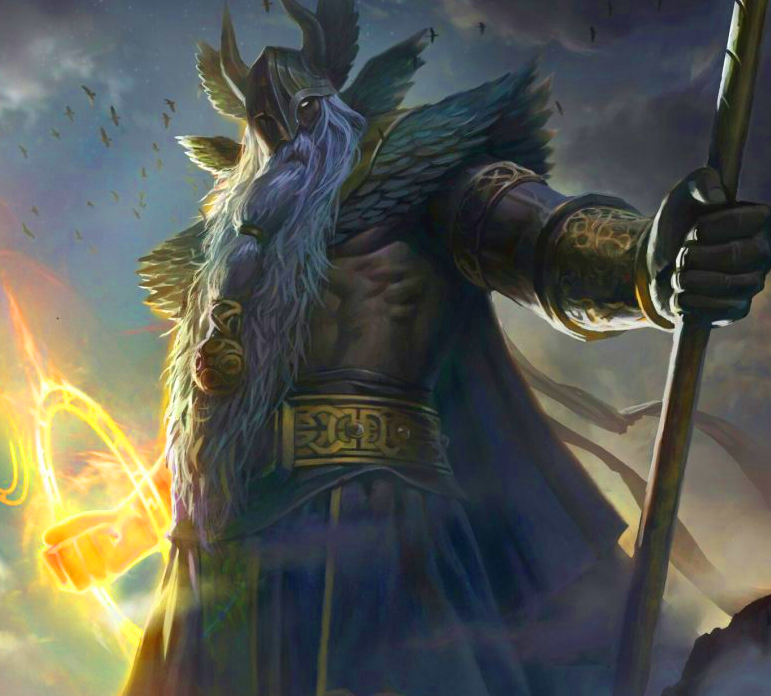


    Odin as the god of rage and battle

    From Dr Carl Gustav Jung, 1936, in The Wotan Essay:

    • As the god of rage and battle, Odin represents the archetype of the awakened Aryan man.
    • Inevitably, Odin will reveal the restless, violent, stormy side of his character.
    • When this occurs, it will be like a hurricane that breaks loose while people still believe it’s fine weather.
  • Symbols of our gods

    Symbols of our gods

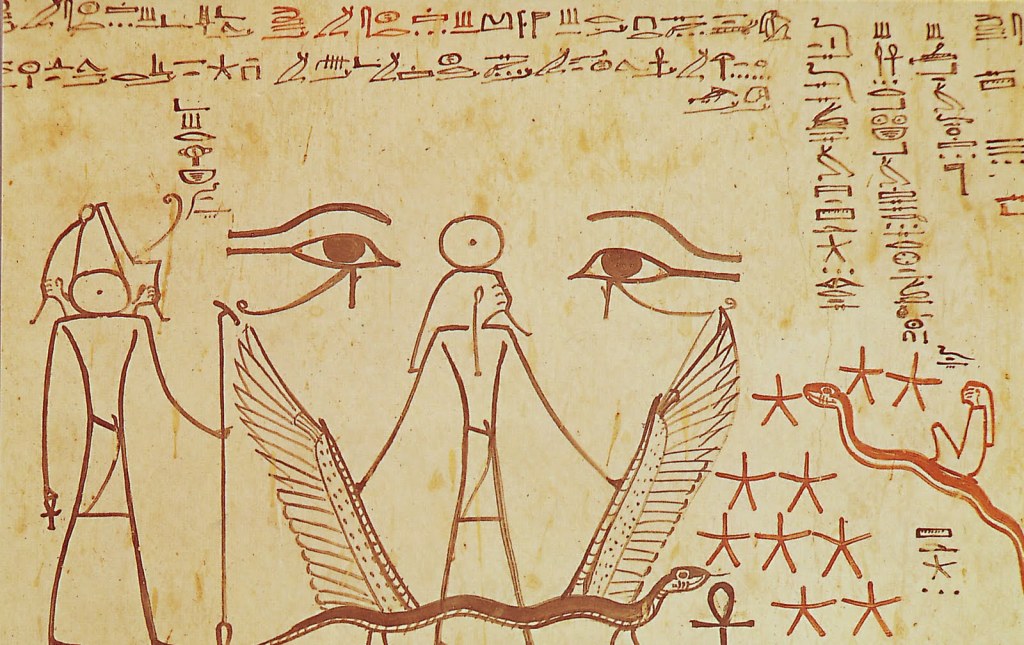
    A mural from the tomb of Thutmose III (discussed below).

    Previous posts in this series:
    Long-heads of Europe
    Long-heads of Asia
    Long-heads of America

    This post concerns ancient religion, art, and symbols of relevance to the next post, Long-heads of Egypt.

    Post outline

    1. ET god symbols: an Egyptian sculpture
    2. ET god symbols: an Egyptian tomb
    3. ET god symbols: Rapa Nui and Tula sculptures
    4. ET god symbols elsewhere
      4.1 Turkey: Karahan Tepe
      4.2 Turkey: Gobekli Tepe
      4.3 Turkey: Nevali Cori
      4.4 Mexico
      4.5 Bolivia
      4.6 Mesoamerica: Mayans
      4.7 Other
    5. References
    6. Appendix

    1. ET god symbols: an Egyptian sculpture

    According to ancient Egyptian religion, the god Set (Seth, Setekh, Sut, Sutekh, Sety) had white skin and red hair, and people with red hair were his followers.1 Set is one of the most ancient Egyptian gods, the son of Nut and Geb, and the brother of Osiris, Horus the elder, Isis, and Nephthys.1 The earliest known representation of Set is on a carved ivory comb from the Amratian period (Naqada I, from c. 4,000 to 3,500 BCE).1,2

    Set was most often depicted as a “Set animal” or a man with the head of a Set animal. There is no consensus about what exactly this animal is.1,2


    Set and Horus crowning Ramesses III

    Notable symbols in this sculpture include Set’s long geometric ears and the Ankh.

    Long ears

    The shape of Set’s ears comprise the rectangle (shape of the exterior and the interior) and the semicircle (the mound shape along the back of the ear). The square, or where necessary the rectangle, corresponds to the cross formed by the four cardinal points (north, south, east, west). Therefore the rectangular shape (outline and inner depression) of Set’s ears represents the conjunction of opposites (positive – negative, superior – inferior, life – death) and spiritual ascension.3 As this shape occurs in the ear, including the interior of the ear, the transcendence and spiritual ascension is by means of spiritual hearing.

    In Egyptian hieroglyphics a semicircle with a base (the shape of Set’s ears if observed from the ends) refers to the sun’s orbit. It symbolizes the Origin counterbalanced by the End, or birth counterbalanced by death.

    In combination, the rectangular and semicircular shapes of Set’s ears symbolize transcendence and spiritual ascension by spiritual hearing in worldly life and upon departure from this realm.

    The Ankh


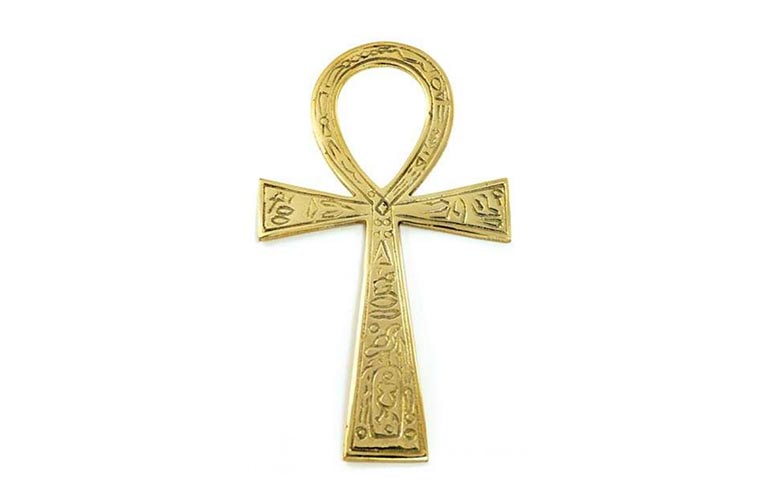
    The Ankh

    The Ankh represents eternal life. It was often used in Egyptian tomb paintings and other art, and it was associated with the cult of Isis.4 As a form of cross, the Ankh represents conjunction of opposites (positive – negative, superior – inferior, life – death) and spiritual ascension.3

    2. ET god symbols: an Egyptian tomb


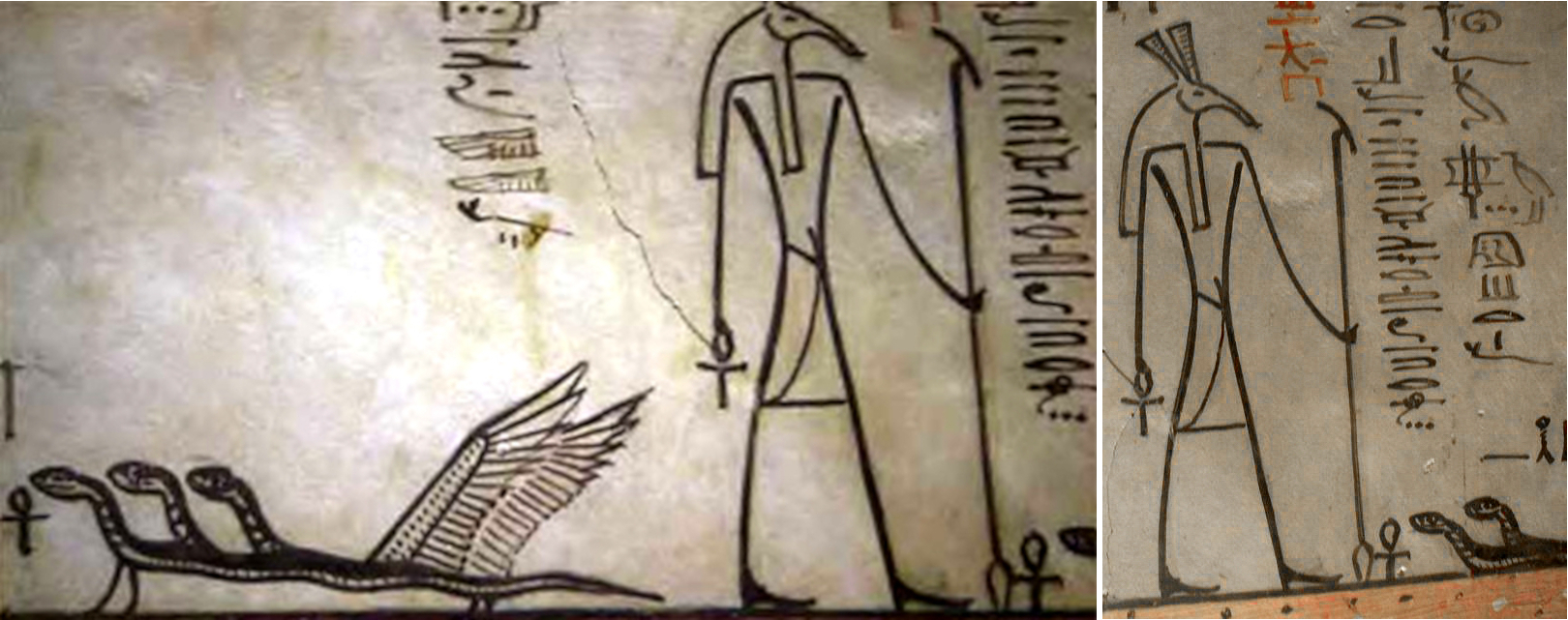
    Mural 1. A mural from the tomb of Thutmose III


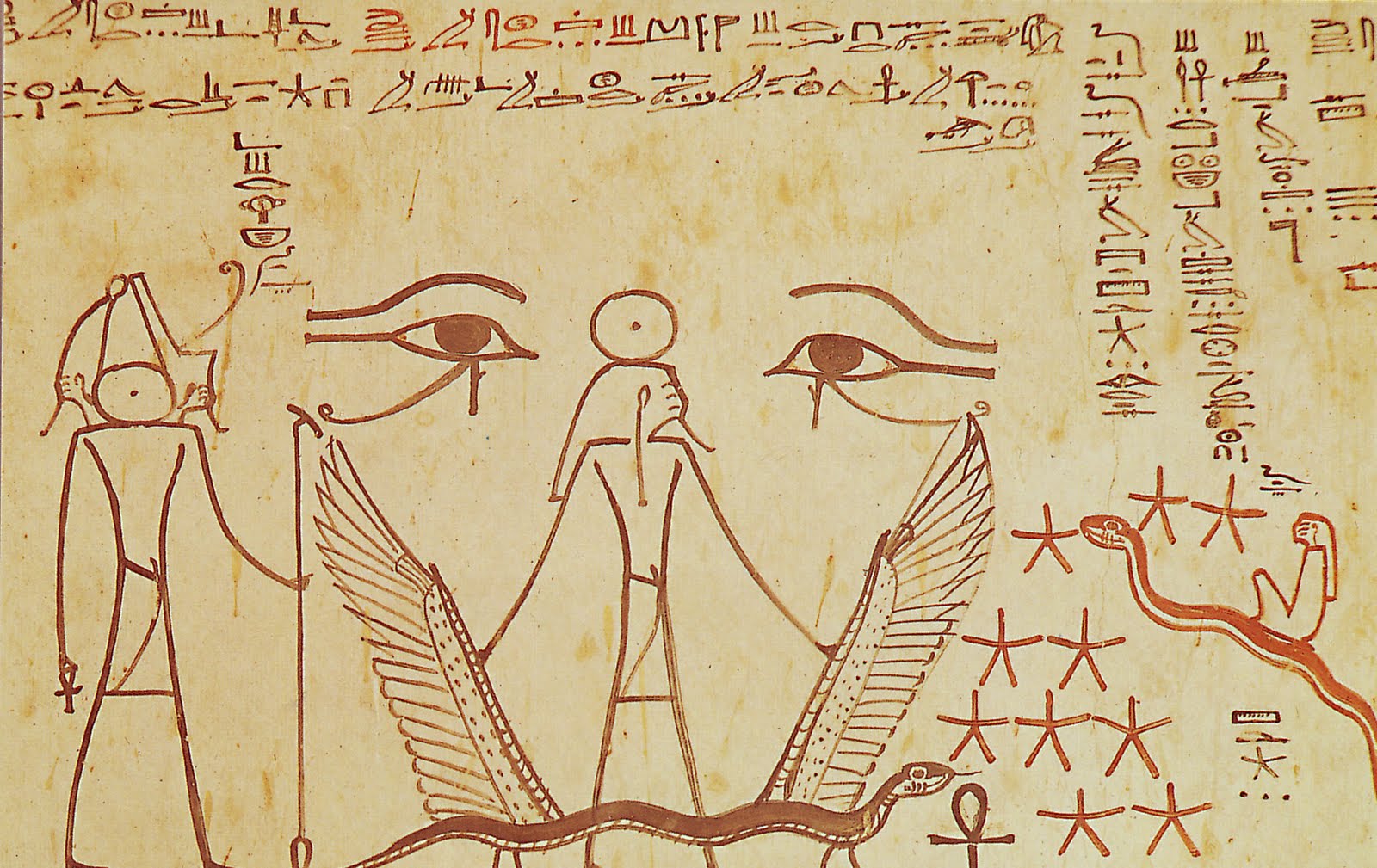
    Mural 2. Another mural from the tomb of Thutmose III

    Mural 1

    Notable features in this image include (a) the representation of Set (identifiable by his head), (b) the Ankh in Set’s right hand (also near his left foot and elsewhere), (c) the ‘Was’ symbol (the staff in Set’s left hand), (d) serpents (snakes approaching Set on the ground, and three winged snakes taking flight to his rear), and (e) a pair of wings (above the snakes’ wings).

    Mural 2

    Notable features in this picture include (a) Set (identifiable by his ears), (b) the Ankh in Set’s right hand (and elsewhere in the picture), (c) the ‘Was’ symbol (the staff in Set’s left hand), (d) a winged snake whose wings are held onto by Thutmose III, (e) a snake that seems to be flying upward with Thutmose III sitting on its back, (f) a large circle with a dot centre above the head of Thutmose III in the centre of the picture and another such circle behind the head of Set, (g) a large pair of stylized eyes within the space occupied by the person holding onto the snake’s wings, (h) twelve symbols (eleven ‘stars’ with five points and the Ankh) clustered in the area of the snakes’ heads (direction of travel), and (i) symbols directly below the seated person’s feet (from top to bottom): a horizontal rectangle containing seven vertical marks, the Egyptian hieroglyphics symbol for a hemisphere, a ‘star’, and three horizontal dots.

    Set, long ears, and the Ankh are discussed above. The remaining symbols of greatest relevance to this article are discussed below. The other symbols referred to in Mural 2 (large circles with dot centres, the eyes, eleven ‘stars’ and the Ankh, and the symbols directly below the seated person’s feet) are discussed in the Appendix.

    The ‘Was’


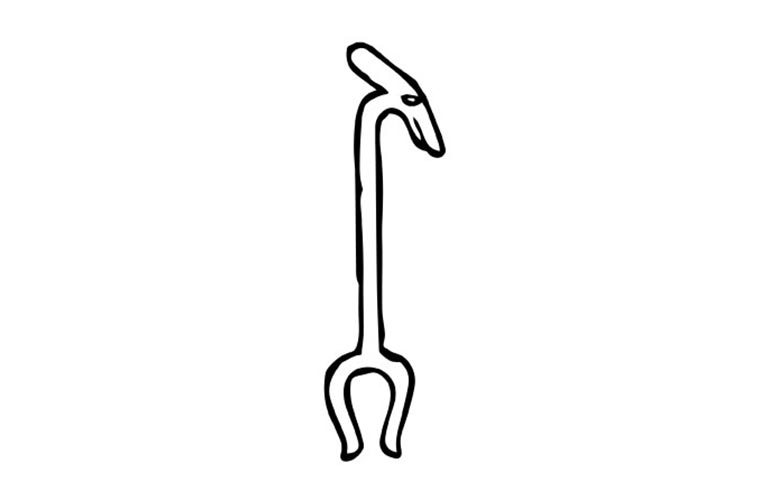
    The ‘Was’ symbol

    The crooked top of the staff represents the shape of Set’s head. The staff symbolizes power, the dominion of gods, and the continuance of a king’s prosperity.4

    3. ET god symbols: Rapa Nui and Tula sculpture


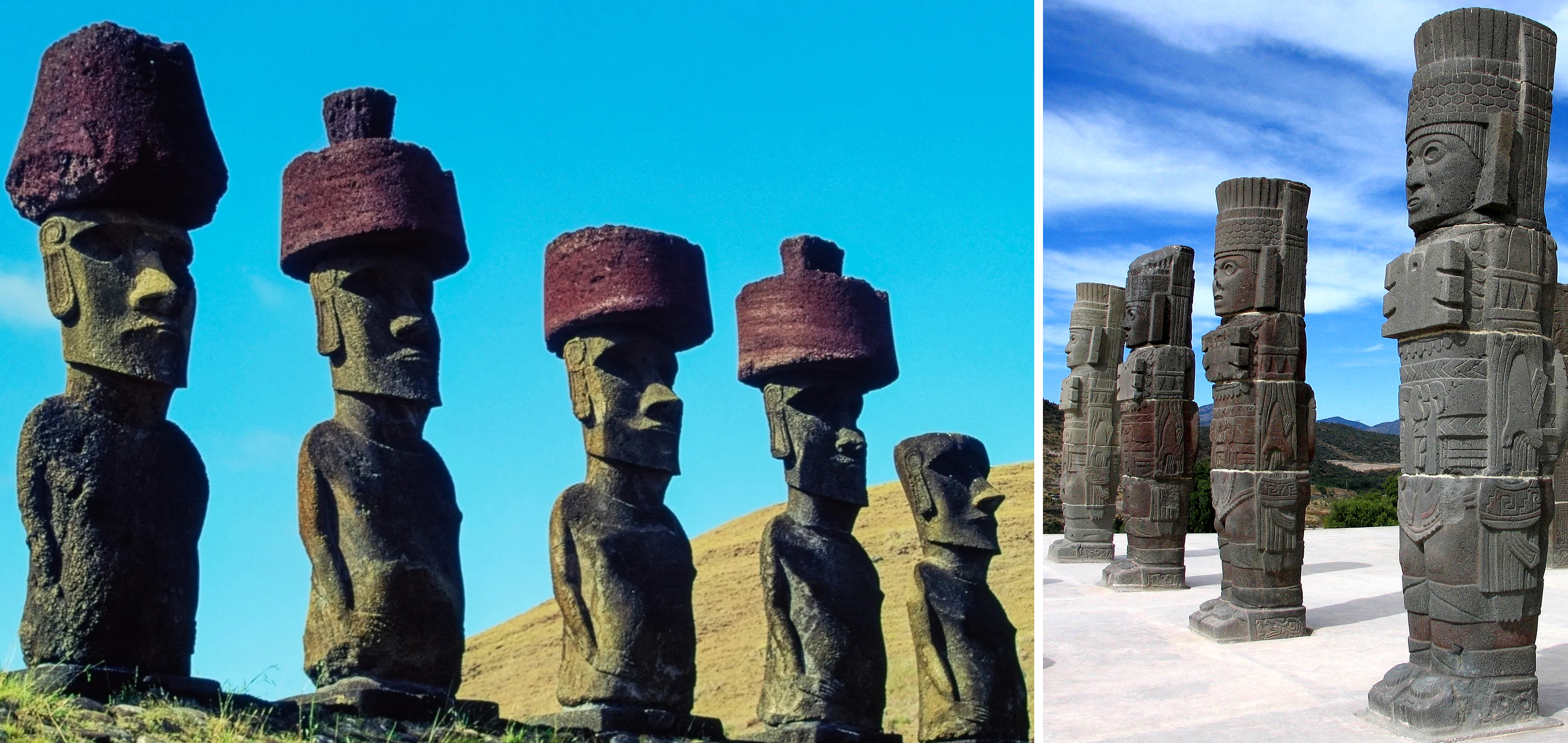
    Statues of Rapa Nui and Tula

    The monolithic human figures on Rapa Nui (Easter Island) were carved by the Rapa Nui people between the years 1,250 and 1,500 CE.5,6 The massive statues (“Atlantean figures”) in Tula (now the southwest of the Mexican state of Hidalgo) are in what was the ancient capital of the Toltec civilization, which ruled Mexico and flourished from about 850 to 1,150 CE.6

    The Rapa Nui and earlier Atlantean figures are similar in that they both show beings with long ears. Further, the rectangular long ears of the Atlantean figures are comparable to the rectangular long ears of Set in the sculpture pictured above.

    Alexander Koltypin is eminently qualified to write on this subject. He graduated with honours from the Moscow Geological Prospecting Institute of S. Ordzhonikidze, participated in geological expeditions for fifteen years, published many popular science books, was editor-in-chief for several science magazines, is Director of the Scientific Center of Fundamental Researches in Natural Science at the International Independent University of Environmental and Political Sciences (IIUEPS), is a member of the Academic Council of IIUEPS, a member of the editorial board of the bulletin MNEPU and other scientific works, and for many years Mr Koltypin has collected, analyzed and systematized scientific data on different aspects of the Unknown, with findings that went far beyond the bounds of traditional scientific theories and Internet pseudo-scientific hypotheses.7

    Mr Koltypin’s research led him to write as follows in his article Long ears as a sign of divinity (Koltypin, 2010):8

    • The only surviving lifetime portraits of Aryan gods are the stone statues of long-eared beings on Rapa Nui. Those statues represent fair-skinned, white-bearded people, with the Aryan straight narrow nose, sharply outlined lips, protruding chins, and red hair (denoted by the red stone pukao — the element placed on top of the statues’ heads).
    • The Rapa Nui statues depict Aryan gods who descended to Earth at the end of the Mesozoic Era, i.e. about 66 million years ago. These long-eared white gods were so long-lived that humans saw them as immortal.
    • The gods’ lengthened ears represent acute worldly and spiritual hearing.
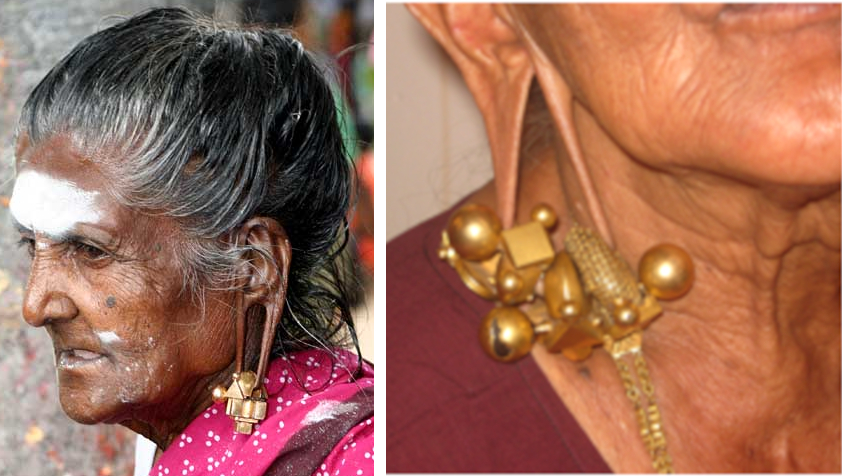
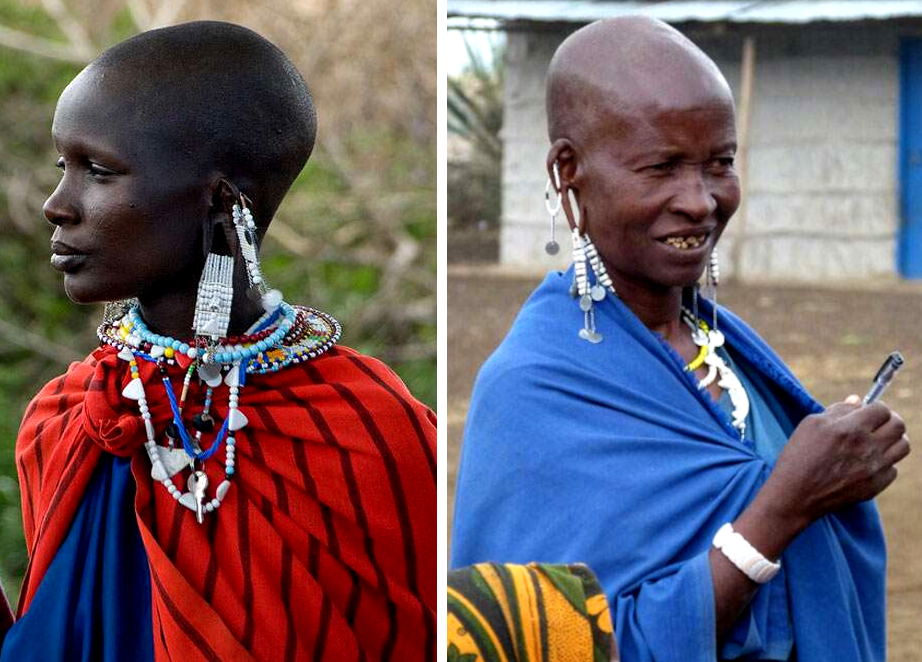
    • Almost all portraits of the white gods and demigods, as well as Buddhist saints, depict them as long-eared, very often with large, weighty earrings.
    • Statues, bas-reliefs and images of long-eared white gods (Indra, Varuna, Vishvakarman, Vaishvanara, Virochana and many others, named and unnamed) are found in India, Indochina, China, Polynesia, Melanesia, and South America.
    • To humans, the Aryan gods’ long ears were a sign of divinity. The custom of artificially lengthening ears was emulated by humans globally, including the inhabitants of Rapa Nui, the Marquesas Islands, Melanesia, and the ruling caste of the Incas.
    • The enormous influence of the Aryan gods on the populations around them can still be seen in humans of today.


    Long ears in India


    Long ears (and long heads) in Africa

    4. ET god symbols elsewhere

    Ancient peoples’ sky-god religion is attested to in many aspects of their lives, including their reverence for the snake. As of about 10,000 BCE, various versions of the sky-god religion sprang up around the world and they all associated the snake with gods and ultimately the Anunnaki, although these Aryan ET beings were often known by other names. The Sumerians associated the snake with the Anunnaki gods and the snake is found in legends and religious art in the Ancient Middle East, Egypt, Central Asia, North America, South America, West Africa, and East Africa.9,10,11

    4.1 Turkey: Karahan Tepe

    At Karahan Tepe (an archaeological site close to Göbekli Tepe, Turkey), a site dated to 11,000- 9,000-BCE,12,13 is art featuring snakes. The prominence of Karahan’s snake art indicates that the snake was especially significant to the local population. Further, the lines of zigzagging avenues of stones on the hill could represent the snake’s descent to the valley below. If so, this would symbolize a snake-like craft descending to Earth from the heavens.14


    Carvings of snakes at Gobekli Tepe (L) and Nevali Cori (R)

    4.2 Turkey: Gobekli Tepe

    As at nearby Karahan Tepe, the snake is the creature most commonly depicted at Gobekli Tepe (‘Potbelly Hill’), a settlement in modern-day Turkey that was inhabited from c. 9,500 to at least 8,000 BCE.14,15 The following symbols are visible in the Gobekli Tepe carving shown above: (a) a relatively large upward-facing top part of a snake (viewed from underneath) that curves forward toward the front of its nose (the hooded snake shape and left eye are clearly visible), (b) an I-shape symbol (below the snake’s jaw-line) that is embodied by the snake, and (c) four smaller snakes below the I-shape. These symbols are discussed below.

    • Large snake
      The relatively large size and skyward orientation of this snake suggest a supreme god, namely the sky god or sky father known as An (Sumerian) and Anu (Akkadian) of the Anunnaki16 and which is likely represented by the huge face sculpture in the Cydonia region of Mars (image and explanation in the post Family from afar 1: Long-heads of Europe). However, perhaps more likely considering that the smaller snakes seem to be leaving from and returning to the large snake, the large snake represents a mother-ship from which the smaller craft operate.
    • Symbol I
      The symbols H and I are the same basic shape (one is the other turned 90 degrees), H is a double T, and T indicates the connection of below with above and then the Cosmos. To clarify, the T forms half of a cross, with the other half in the spirit world. Many of the Mayan temples have T-shape windows and doorways to represent portals into the spirit world.17
    • Four snakes
      The four snakes have dome-like heads, similar in shape to that reported in some anti-gravity craft sightings. However, the heads most likely represent disc-shape ET craft with a trail from the sides and rear. Three of the snakes / craft are descending, and one (bottom right) is ascending. As was noted above in relation to the large snake, it seems most likely that these craft are shown leaving from and returning to a mother-ship, represented by the large snake.

    This carving represents snake-like ET craft, most likely a mother-ship and smaller craft, that arrived in the vicinity of Earth from the cosmos.

    4.3 Turkey: Nevali Cori

    Another early example of the culturally important snake was found at the now flooded Nevali Cori, an early Turkish site in Hilvan Province that is dated to 8,400-8,000 BCE. Among the statues and artefacts discovered at Nevali Cori is a life-size stone sculpture of a humanoid head with a snake against the back of the head and the snake’s head against the top of the humanoid head.14 The humanoid head and snake are shown in the image above.

    As with the snake symbols discussed above in relation to Gobekli Tepe, it is notable that the shape of the snake’s head is dome-like (as reported in some anti-gravity craft sightings), but the shape most likely represents a disc-shape ET craft with the rear obscured by a comet-like trail. It is also apparent that there are four circles around the perimeter of the snake’s head. Concerning the meaning of these circles, the circle denotes oneness, wholeness, cosmos, the sun, and it can also be associated with the number twelve, e.g. the twelve signs of the zodiac and the twelve major gods of many natural religions.3 In the present context, it seems most likely that the circles refer to the craft’s origin in the cosmos.

    Concerning the humanoid head shape, it is notable that the head is narrow with a pronounced ‘occipital bun’. This suggests that the sculpture is of someone with a long head, i.e. the head is dolichocephalic (this subject is discussed in the post Family from afar 1: Long-heads of Europe). This head shape of an apparent god is interesting in view of other evidence (the long skulls of people who were apparently close descendants of the Aryan gods) indicating that the gods had long heads and bigger brains than humans of today.

    Due to its close association with a snake (especially a snake with an ET craft-shape head with circles suggesting a cosmic origin, and what looks like a long-head humanoid), this sculpture represents an ET god, specifically an Aryan god of the ET race known as the Anunnaki.

    4.4 Mexico


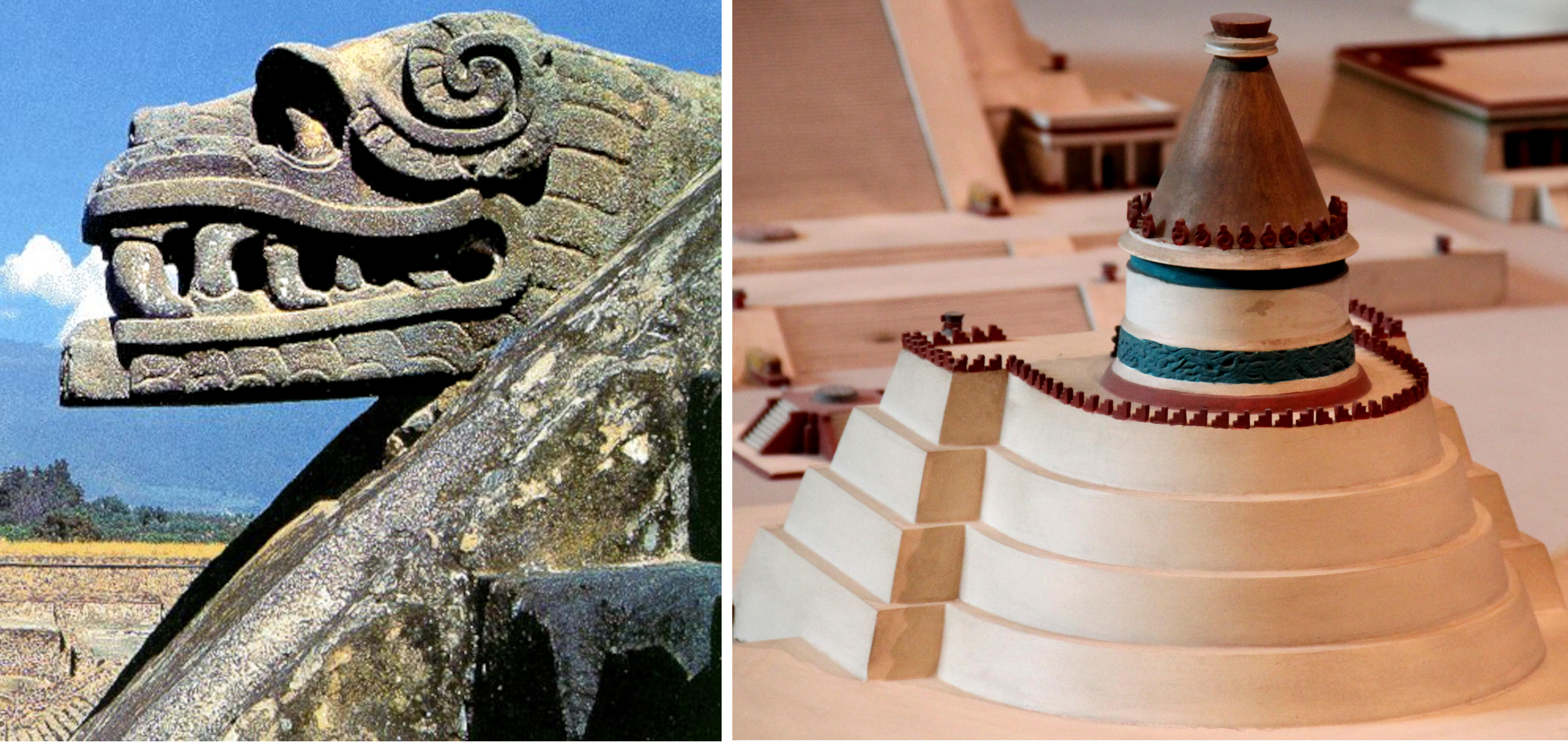
    L Temple of the Feathered Serpent in Teotihuacan, R Model of Quetzalcoatl’s temple in Tenochtitlan

    The Temple of the Feathered Serpent is in Teotihuacan, Mexico, and the model is of Quetzalcoatl’s temple in Tenochtitlan, Mexico.

    The name Quetzalcoatl means “the feathered serpent” and according to the Aztecs (a civilization that flourished in central Mexico from 1,300 to 1,521 CE) Quetzalcoatl is a white, white-robed, bearded man who carries a sceptre, and he will return when a comet is seen in the heavens.11

    Quetzalcoatl’s ‘sky/serpent temple’ in Tenochtitlan (shown as a model above) was an Aztec representation of a space craft. It was in the form of a cylinder on a pyramid base with its entrance in the shape of a snake’s open jaws. When the Aztecs celebrated the god Quetzalcoatl, the priest or person representing him emerged before the congregation of worshippers from a ‘flying, circular object’ which had long ago been seen as a snake flashing across the sky.11

    This flying object-snake association is consistent with the name for comets in Mexico: in Mexico comets were called ‘flaming serpents’.11 This flying object-snake association is also evident in the Bible (Isaiah 14:29): “Rejoice not thou, whole Palestina, because the rod of him that smote thee is broken: for out of the serpent’s root shall come forth a cockatrice [a serpent hatched from a cock’s egg and having the power to kill by its glance], and his fruit shall be a fiery flying serpent.” (King James Bible)

    4.5 Bolivia


    The Gate of the Sun in Tiwanaku

    The Gate of the Sun is a monolithic gateway at the site of Tiwanaku in Bolivia where an Andean civilization of Bolivia thrived around Lake Titicaca from about 500-950 CE.18 However, the Gate of the Sun has been dated to 300 or 200 BCE or possibly about 110 CE.19,20,21,22 The above images show a full front view of the gate, a section of the gate with the god and some surrounding features, and an artist’s illustration that shows details of that section more clearly.

    The Gate of the Sun is the best-known surviving example of a solar structure. It features carvings of deities and astronomical symbols of the Tiwanaku pantheon. The gate is part of a greater astronomical complex with massive stone pillars and ruined buildings, all aligned to the June and December solstice sun rise and set.23

    The central figure is most likely the Inca god Viracocha or a deity who evolved into him.23 Viracocha was the supreme god of the Incas, the father of all other gods, and he created the earth, sun, moon, planets, heavens, stars and all living beings. Viracocha was typically described as a tall, white, bearded man who wore a long white robe and and carried a staff.23,24 Like the Aztecs, it seems that the Incans linked this god to the snake. In the Serpent Temple at Cassamarca (in the northern highlands of Peru) there was a stone snake, there were effigies of snakes on many Incan buildings, Viracocha was depicted holding twin snake staffs, and in the gardens of Cuzco’s (a city in southeastern Peru) sacred Coricancha temple, there are carved effigies of a snake, a condor, and a puma.11

    On the gate this man is radiating 24 linear sun-rays and holding two downward-pointing twin snake ‘staffs’. To the sides of the man are 48 carved squares, each containing a winged character, 32 with human faces and 16 with condor heads.23

    The rectangular area

    The vertical sides of this large rectangular area are indicated by the twin snake ‘staffs’. Within this area we can see:

    • From above all the other visible symbols, the god is descending by means of the downward-pointing (the snake heads are pointing toward the earth) snakes (associated with ET craft and gods, as explained earlier) onto which he is holding.
    • The man’s head is enveloped by headgear such as might be worn by an astronaut.
    • Like the sacred number 12 featured in the number (12 x 2 = 24) of rays from his head, the number 12 is also featured in the temple-like structure onto which he is descending. Within that structure (an implied square as lines drawn vertically downward from the edges of the top line form a square) are 12 creatures: 6 snakes (3 on each side), 4 human-like figures (2 on each side on the highest level), and 2 creatures within the inner square.

    The meaning of the number twelve, which occurs three times within the rectangle (and another four times in the 48 carved squares and winged characters outside the rectangle), is practically identical to that of a circle, which denotes oneness, wholeness, cosmos, and the sun.3 In the present context, the number 12 (associated with the circle and sun) is consistent with the purpose of the gate as a solar structure and the sun-rays from the god’s head.

    Rectangles and squares. There are many rectangles and squares featured on the gate. This includes the large rectangular area referred to above and the two squares comprising the temple-like structure below the god. As was noted above, the square, or where necessary the rectangle, corresponds to the cross formed by the four cardinal points (north, south, east, west) and represents the conjunction of opposites (positive – negative, superior – inferior, life – death) and spiritual ascension.3 The cardinal points represented by the square / rectangle is consistent with the astronomical alignment of the gate and the spiritual significance of the cross is consistent with the spiritual importance of this god.

    Outside the rectangular area

    The god is shown descending into the midst of 32 winged characters with human faces and 16 winged characters with condor heads. The beings are kneeling toward the god in postures of reverence.

    Since antiquity, birds and wings have been used to denote flight and also beings from another world. Winged gods are featured in Assyrian religious art and in Christianity angels are always depicted with wings. In particular, across the Northern Hemisphere and North America, the eagle was associated with gods; in South America, the condor was a companion of the Aryan god Viracocha; there is a huge image of a condor among the mystical drawings in Peru’s Nazca Desert;25 and in Sumerian and ancient Egyptian religion, wings represent gods’ ability to fly.16,26 In the case of funerary art, in ancient Egypt wings symbolize the journey of the soul, the afterlife, and protection by the goddess Isis, who was often shown with wings spread out to indicate her ability to fly and protect souls of the dead.26

    In the context of the Gate of the Sun, the meaning of wings is consistent with the arrival of a being from another world and the condor in particular is a companion of the Aryan god Viracocha.

    In essence, although this information-rich solar structure offers the opportunity for more detailed interpretation, the Gate of the Sun shows an extraterrestrial Aryan god arriving on Earth.

    4.6 Mesoamerica: Mayans

    Kukulcan is a prominent Aryan god in Mayan religion (the Maya civilization arose in antiquity and ended in 1697 CE). As with the name Quetzalcoatl (the Aztecs’ Aryan god), Kukulcan means “the feathered serpent.” Kukulcan is a snake in his natural form but he can transform into an Aryan man with long white hair standing about 6 feet tall. Mayan writing and sculptures portray Kukulcan as a thoroughly European-looking man. Kukulcan civilized the Mayans by teaching them subjects including agriculture and medicine.27

    4.7 Other

    In Africa snake worship is as old as the hills. For example, among the West African Ashanti there are sky-god snake legends that are very similar to those of Central America25 and the Lebe or Lewe (fr. Lébé), a primordial ancestor of the Dogon tribe, arose from a serpent.28,29

    Leonard Farra (2014, The mystery of serpent worship)11 provides more information about the association of snakes and gods in various cultures.

    5. References

    1. Hill, J. (2008). Set (Seth), Ancient Egypt Online.
    2. te Velde, Herman (1967). Seth, God Of Confusion: A study of his role In Egyptian mythology and religion, Brill academic pub, translation by Mrs. G.E. van Baaren-Pape.
    3. Cirlot, Juan E. (1962, extensively revised in 1971). A dictionary of symbols.
    4. Cleopatra Egypt Tours (2021). Important ancient Egyptian symbols and their meanings.
    5. Fischer, Steven R. (2005). The island at the end of the world, London: Reaktion.
    6. Sutherland, A. (2020). Obscure history of Atlantean statues in ancient Toltecs’ city of Tula, Ancient Pages.
    7. Koltypin, A. His Books and Website on the “Unknown” – Earth before the Flood: Disappeared Continents and Civilizations.
    8. Koltypin, A. (2010). Long ears as a sign of divinity.
    9. Farra, Leonard (2012). The Ancient astronauts and a new history of man.
    10. Farra, Leonard (2012). Extraterrestials, the Flood and the Giants.
    11. Farra, Leonard (2014). The Mystery of Serpent Worship.
    12. Demirören news agency (2020). New Karahan tepe settlement may be older than Göbekli tepe, Daily Sabah, 27 Nov 2020.
    13. Thomas, Sean (2022). Is an unknown, extraordinarily ancient civilisation buried under eastern Turkey?, Spectator Magazine, 8 May 2022.
    14. Farra, Leonard (2015). My thoughts about Gobekli Tepe.
    15. Breuers, J., & Kinzel, M. (2022). Tracking the Neolithic in the Near East. Lithic Perspectives on Its Origins, Development and Dispersals, In Nishiaki, Y., & Maeda, O. (2022), The Proceedings of the 9th International Conference on the PPN Chipped and Ground Stone Industries of the Near East, Tokyo, 12th–16th November 2019.
    16. Wilkin, Stanley (2019). Jesus and Bel Christianity and the Continuation of Paganism.
    17. Tartaria tablets (2021). Symbols T, H, I close meanings in Gobekli Tepe and Mesoamerica /South-West North-America.
    18. Stone-Miller, Rebecca (1996). Art Of The Andes, New York: Thames & Hudson
    19. Marsh, Erik (2012). A Bayesian re-assessment of the earliest radiocarbon dates from Tiwanaku, Bolivia, Radiocarbon, 54 (2), 203–218.
    20. Browman, David (1980). Tiwanaku expansion and economic patterns, Estudios Arqueológicos, 5, 107–120.
    21. Janusek, John (2003). Vessels, time, and society: Toward a ceramic chronology in the Tiwanaku heartland, In Kolata, Alan (ed.). Tiwanaku and its hinterland: Archaeological and paleoecological investigations of an Andean civilization, 2, 30–89.
    22. Stanish, Charles (2003). Ancient Titicaca, Los Angeles: U of California Press.
    23. Cowie, Ashley (2016). Unearthing the Inca’s lost sun path, 22 Dec 2016.
    24. Farra, Leonard (2014). Machu Picchu’s E.T Connection.
    25. Farra, Leonard (2014). ETs and a new history of early civilised man.
    26. Seti (2023). Unlocking The Symbolic Meaning Of Wings: Exploring Their Spiritual And Cultural Significance.
    27. Farra, Leonard (2012). Alien Contact – Fact or Fiction?
    28. Heusch, Luc de (1985). Sacrifice in Africa: A Structuralist Approach, (trans. Linda O’Brien, Alice Morton), Manchester U Press.
    29. Imperato, Pascal James (1978). Dogon Cliff Dwellers: The Art of Mali’s Mountain People, Kahan Gallery.

    6. Appendix

    The Mural 2 symbols referred to that were not discussed above are explained below.

    Large circle with dot centre

    This symbol is above the head of of the person (Thutmose III) in the centre of the picture and also behind the head of Set.

    The circle denotes Heaven, oneness, wholeness, cosmos, the All, eternal order, eternity, continuity, cyclic processes, stability, the sun. The point within the circle represents the mystic Centre — the starting-point and finishing-point of all things.1

    The eyes


    The eye of Ra and the eye of Horus

    This symbol is within the space occupied by the person (Thutmose III) holding onto the serpent’s wings.

    The right eye is known as the Eye of Ra (sun god), it symbolizes the sun, and it represents divine perception, divine providence, and the eternal cycle of life. The left eye is known as the Eye of Horus (sky god who has the head of a falcon), it symbolizes the moon, and it represents divine perception, protection, healing, and wisdom. The eyes are often depicted in the curved shape of a falcon’s eye, with the eyeliner extending beyond the eye socket.2,3

    The eye symbol was used in rituals and ceremonies to invoke the protective power of the gods. In particular, the Eye of Horus was used in funerary art to guide the soul of the deceased to the afterlife. As a symbol of healing, the Eye of Horus was associated with the goddess Sekhmet (goddess of healing and medicine) and used in medical practices and rituals.2,4

    Eleven ‘stars’ and the Ankh

    These twelve symbols are clustered in the area of the snakes’ heads (direction of travel) and the eleven ‘stars’ have five points.

    Odd numbers and their geometric forms (e.g. triangle, pentagon) indicate dynamism; the number five in particular corresponds to the five Elements (four material Elements + spirit or quintessence) and it denotes love, health and humanity. Further, the number five is analogous with the human figure (four extremities + head).1

    In the present context, this symbol most likely represents a 5-point star. The 5-point star was used in Mesopotamia since at least 2,500 BCE. The five points represent the five elements: earth, air, water, fire, and spirit. This star was associated with the Sumerian goddess Inanna in her role as the queen of heaven and it symbolized her divine authority and power.3

    Concerning the number twelve (twelve symbols), it is suggested that after the numbers three (triangle) and four (square), the next most important numbers are seven (their sum) and twelve (their multiplication).1 The number twelve is associated with the circle (cosmic order). The importance of this number is indicated by examples such as the twelve signs of the zodiac, hours on the clock-face, months of the year, and major gods of many natural religions.1

    Symbols below the seated person’s feet

    These symbols are directly below the seated Thutmose III’s feet (from top to bottom):

    A horizontal rectangle containing seven vertical marks
    The Egyptian hieroglyphics symbol for a hemisphere
    A 5-point ‘star’
    Three horizontal dots

    Rectangle containing seven marks

    The square, or where necessary the rectangle, corresponds to the number four and a cross formed by the four cardinal points (north, south, east, west) and it represents the conjunction of opposites (positive – negative, superior – inferior, life – death) and spiritual ascension.1

    The number seven is the sum of the square (4) + triangle (3), with the number three represented by the three dots at the base of these symbols. The significance of the number seven is shown by examples such as the seven colours of a rainbow, days of the week, notes of the diatonic musical scale, and directions of space.

    Symbol for a hemisphere

    In Egyptian hieroglyphics the symbol for a hemisphere (a semicircle with the diameter as the base) refers to the sun’s orbit. It symbolizes the Origin counterbalanced by the End, or birth counterbalanced by death. In the present context, the symbol most likely refers to the end of Thutmose III’s life in this world.

    A 5-point ‘star’

    As was noted above in relation to the eleven ‘stars’, this symbol most likely represents a 5-point star. The 5-point star was used in Mesopotamia since at least 2,500 BCE. The five points represent the five elements: earth, air, water, fire, and spirit. This star was associated with the Sumerian goddess Inanna in her role as the queen of heaven and it symbolized her divine authority and power.3

    Three horizontal dots

    The triangle and the corresponding number three represents spirit, spiritual synthesis, and communication between the material world and heaven.1 The position of the three horizontal dots at the base of the symbol formation below the seated Thutmose III’s feet is consistent with what is now known as the primacy of consciousness (the primacy of spirit).

    In essence, the combined meanings of the symbols discussed in the body of this article and in this appendix can be summarized as follows in relation to the murals: The two murals in the tomb of Thutmose III record the departure of his soul to eternal life with Divine guidance and support.

    Appendix references

    1. Cirlot, Juan E. (1962, extensively revised in 1971). A dictionary of symbols.
    2. Seti, (2023). The fascinating history and symbolism behind the Egyptian eye symbol, Shunspirit, 26 Jul 2023.
    3. Seti (2023). The intriguing meaning behind the eye of Ra symbol, Shunspirit, 23 Jul 2023.
    4. Cleopatra Egypt Tours (2021). Important ancient Egyptian symbols and its meanings.


    Family from afar