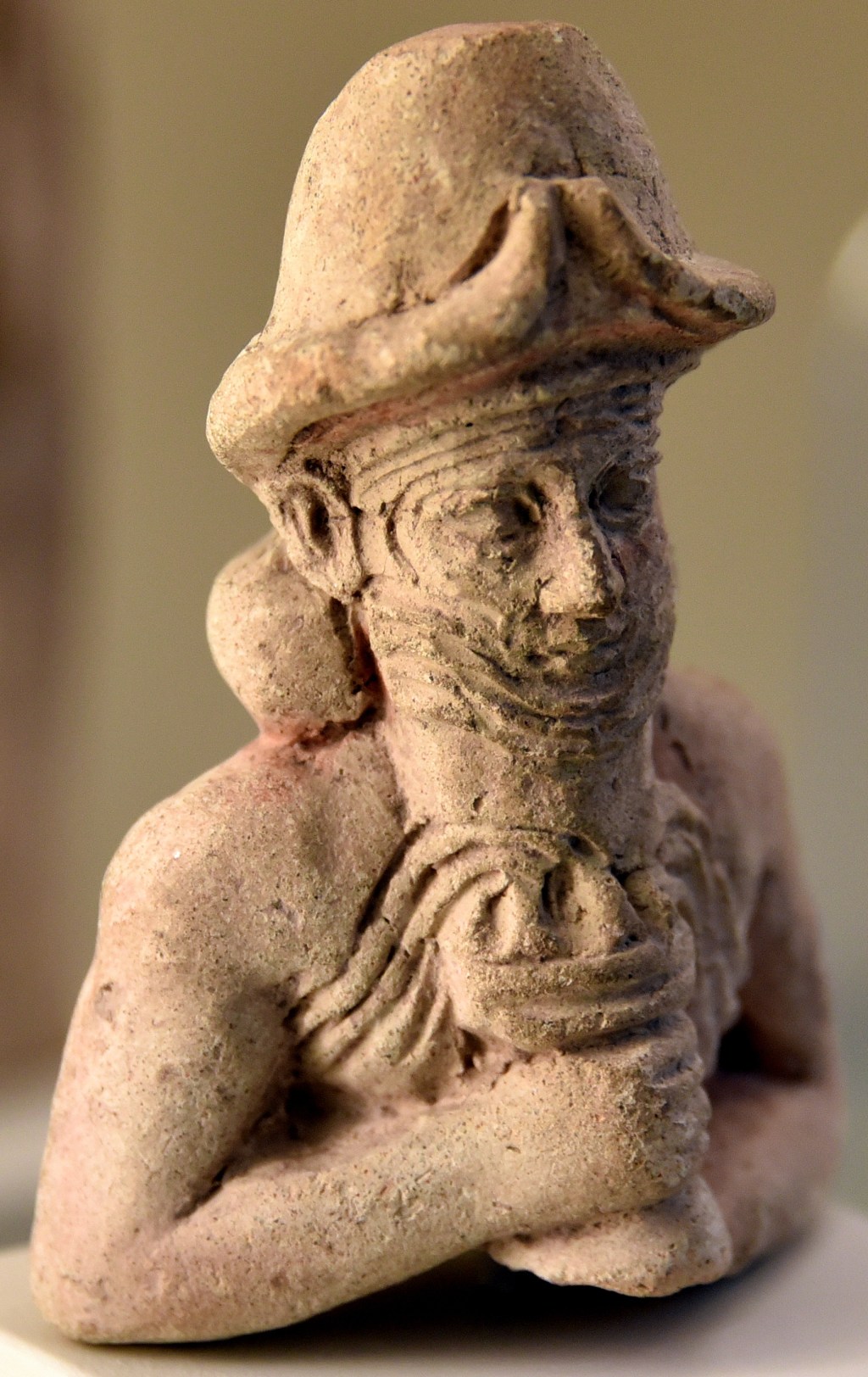
Aryan Enki (Ea) showing the classic Nordic Nose (explained in Nordic features). This Old Babylonian (19th–17th century BCE) statue showing Ea holding a vessel with flowing waters is in Pergamon Museum. Image credit: Wikipedia1
Post outline
- Definition of Anunnaki
- Major Anunnaki deities
- Anunnaki attributes
3.1 Human-shaped
3.2 High hats
3.3 Aryan
3.4 Amphibious
3.5 Celestial origins
3.6 Language - Creation and civilization of humans
- References
1. Definition of Anunnaki
Anunnaki is a collective term in ancient Mesopotamian religion for a variable group of deities — originally the highest-ranking gods of the pantheon who decreed fates as descendants of the sky god Anu, later reimagined as underworld judges after the Old Babylonian period.
The Sumerian form of the term Anunnaki is Anunna (also transcribed da-nun-na, anunna-ke) and the Akkadian form is Anunnaku or Anunnaki.2 The literal translation of Anunnaki is “Offspring (seed) of An(u)” or “princely offspring.” The name is derived from An/Anu (sky god) + unna (offspring/progeny). Some scholars suggest “those who from heaven to earth came,” but this is debated. The name means ‘princely seed’ because the Anunnaki were considered the offspring of Anu (heaven) and Ki (earth) — a divine coupling.2,3,4,5
2. Major Anunnaki deities
Major Anunnaki deities identified are: Enlil (prominent member), Enki/Ea (prominent member), Ninhursag, Sin/Nanna (moon), Shamash/Utu (sun), Ishtar/Inanna, Marduk (later inclusion; in Enuma Elish), and Nergal (Underworld Anunnaki; Post-Babylonian texts). Their roles were tied both to natural phenomena and to the political fortunes of the cities that worshipped them.
Overview of the Anunnaki roles
- Enlil. Lord of the air and wind, and effectively the chief executive of the pantheon in the early periods. He held the Tablet of Destinies and presided over the assembly of the gods, granting kingship and deciding fates. He was a source of authority and order.
- Enki (Ea in Akkadian). God of fresh water, wisdom, crafts, and magic. Where Enlil represented raw authority, Enki was the clever problem-solver who championed humanity. He ruled the subterranean freshwater ocean, the Abzu.
- Ninhursag. Mother goddess associated with mountains, fertility, and the birth of living things. She was called the “Lady of the Mountain” and functioned as a divine midwife and mother-figure to both gods and kings.
- Sin (Nanna). Moon god, patron of Ur, and father of Shamash and Ishtar. He measured time through the lunar cycle, which made him central to the calendar. His cult at Ur enjoyed enormous prestige.
- Shamash (Utu). Sun god and, crucially, god of justice. Because the sun sees everything, he witnessed all human deeds and became the guarantor of law. He also protected travelers and, as a light that penetrates darkness, oversaw truth and oaths.
- Ishtar (Inanna). Goddess of love, sexuality, and war. Her role reflects a force of overwhelming passion in all its forms. Politically, she grew in importance from the Sumerian period onward.
- Marduk. City god of Babylon, who rose from relative obscurity to supreme kingship of the pantheon, reflected politically in Babylon’s rise to dominance. He absorbed many attributes of Ea, his supposed father.
- Nergal. Underworld god associated with death, plague, and destruction, sometimes linked to war and pestilence. He ruled the netherworld. Nergal overlapped with Shamash in that both were associated with the sun’s destructive heat.
As Mesopotamian religion evolved continuously over three millennia, these roles shifted.
Enki and Ea are essentially the same deity. Enki is his Sumerian name (original name, from c. 2600 BCE onward) and Ea is his Akkadian name (c. 2400 BCE onward).1,2,3,4,5,6,7,8,9
3. Anunnaki attributes
3.1 Human-shaped
Ancient texts describe the Anunnaki as almost exclusively anthropomorphic (human-shaped) beings who wore melam, an ambiguous substance which covered them in a shimmering veil of terrifying splendor.10
3.2 High hats
The Anunnaki were routinely sculpted and painted wearing tall caps adorned with multiple pairs of bull or ox horns (often up to seven stacked pairs).10 Horns were a universal sign of strength, authority, and divine status in the ancient Near East, worn to show that a figure was a god rather than a human king or mortal. According to mainstream archaeology, the high caps do not necessarily indicate that the Anunnaki had exceptionally tall or long heads.10
However, as many modern writers have suggested, the tall hats would be consistent with Anunnaki heads being exceptionally long, as seen in the long skulls of the Paracas humanoids for example (images in Long-heads of America).
3.3 Aryan
A scholarly analysis of historical reliefs and statues of Anunnaki by Bonatz11 shows facial features associated with Northern Europeans. These Aryan features are explained as the result of deliberate cultural and artistic conventions of the Ancient Near East.12 The standard stylistic conventions used by Mesopotamian sculptors to project royal authority are based on the appearance of Aryans because the Anunnaki are Aryan, and more specifically Northern European / Nordic in appearance.
3.4 Amphibious
In the post Anunnaki are amphibious it is shown that the Anunnaki are amphibious.
3.5 Celestial origins
In the post Anunnaki are from The Winter Sky it is shown that the Anunnaki have a local base on Mars and that they originate from “The Winter Sky.”
3.6 Language
In the post Aspects of Aryans evidence is cited to suggest that the language referred to in the Oera Linda Book as “the language of the gods” is the Anunnaki language.
4. Creation and civilization of humans
Having established basic information about the Anunnaki, evidence of their creation and civilization of humans can be concisely presented in separate posts.
5. References
- Wikipedia: Enki
- Falkenstein, A. (1965). Die Anunna in sumerischen texten, Assyriologische Studien 16
- Edzard, D.O. (1965). Anunna, Reallexikon der Assyriologie 1
- Black, Jeremy & Green, Anthony (1998). Gods, Demons and Symbols of Ancient Mesopotamia, 2nd ed., British Museum Press
- Katz, D. (2003). The image of the netherworld in Sumerian sources, CDL Press
- ORACC AMGG University of Pennsylvania; peer-reviewed
- ETCSL Oxford University; original texts with translations
- CDLI Cuneiform Digital Library Initiative; tablet images
- Britannica Academic: Anunnaki
- Wikipedia: Anunnaki
- Bonatz, Dominik (2002). Was ist ein Bild im Alten Orient? [What is an image in the Ancient Near East?] in M. Heinz & D. Bonatz (eds.), Bild – Macht – Geschichte. Visuelle Kommunikation im Alten Orient: 9–20 [Image – Power – History. Visual Communication in the Ancient Near East]
- Sumerian Art, Digital Maps of the Ancient World

Family from afar

