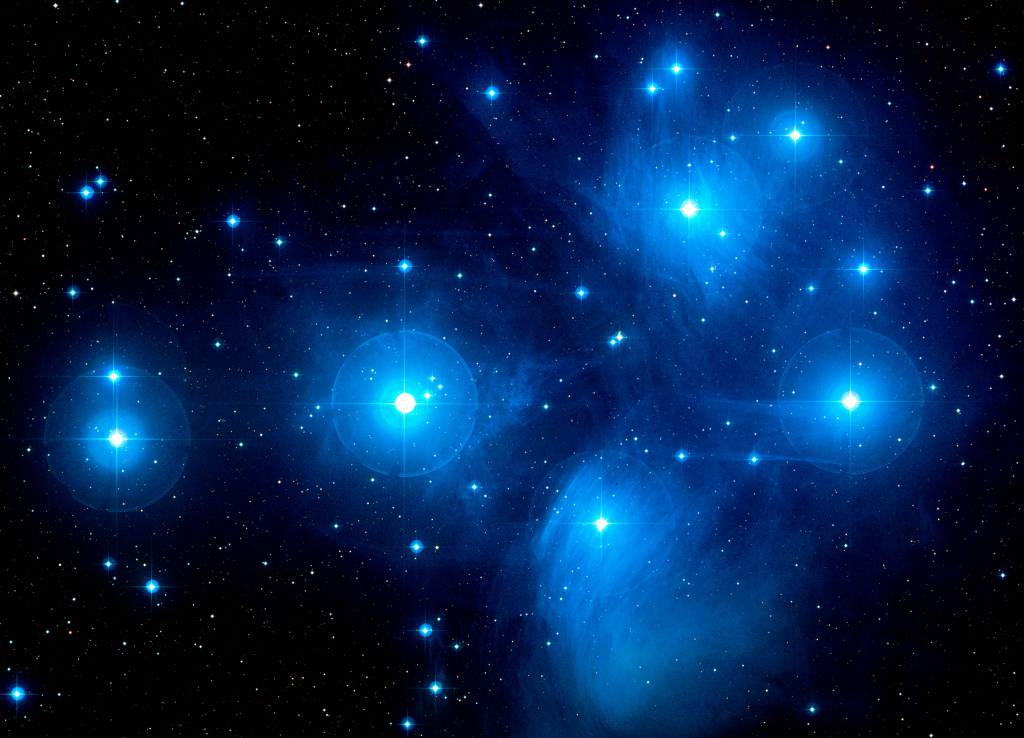
Pleiades — central to our true religion
Previous posts in this series:
Family from afar 1: Long-heads of Europe
Family from afar 2: Long-heads of Asia
Family from afar 3: Long-heads of America
This post concerns ancient religion, art, and symbols of relevance to the next post, Family from afar 5: Long-heads of Egypt.
Post outline
- ET god symbols: an Egyptian sculpture
- ET god symbols: an Egyptian tomb
- ET god symbols: Rapa Nui and Tula sculptures
- ET god symbols elsewhere
4.1 Turkey: Karahan Tepe
4.2 Turkey: Gobekli Tepe
4.3 Turkey: Nevali Cori
4.4 Mexico
4.5 Bolivia
4.6 Mesoamerica: Mayans
4.7 Other - References
- Appendix
1. ET god symbols: an Egyptian sculpture
According to ancient Egyptian religion, the god Set (Seth, Setekh, Sut, Sutekh, Sety) had white skin and red hair, and people with red hair were his followers.1 Set is one of the most ancient Egyptian gods, the son of Nut and Geb, and the brother of Osiris, Horus the elder, Isis, and Nephthys.1 The earliest known representation of Set is on a carved ivory comb from the Amratian period (Naqada I, from c. 4,000 to 3,500 BCE).1,2
Set was most often depicted as a “Set animal” or a man with the head of a Set animal. There is no consensus about what exactly this animal is.1,2

Set and Horus crowning Ramesses III
Notable symbols in this sculpture include Set’s long geometric ears and the Ankh.
Long ears
The shape of Set’s ears comprise the rectangle (shape of the exterior and the interior) and the semicircle (the mound shape along the back of the ear). The square, or where necessary the rectangle, corresponds to the cross formed by the four cardinal points (north, south, east, west). Therefore the rectangular shape (outline and inner depression) of Set’s ears represents the conjunction of opposites (positive – negative, superior – inferior, life – death) and spiritual ascension.3 As this shape occurs in the ear, including the interior of the ear, the transcendence and spiritual ascension is by means of spiritual hearing.
In Egyptian hieroglyphics a semicircle with a base (the shape of Set’s ears if observed from the ends) refers to the sun’s orbit. It symbolizes the Origin counterbalanced by the End, or birth counterbalanced by death.
In combination, the rectangular and semicircular shapes of Set’s ears symbolize transcendence and spiritual ascension by spiritual hearing in worldly life and upon departure from this realm.
The Ankh
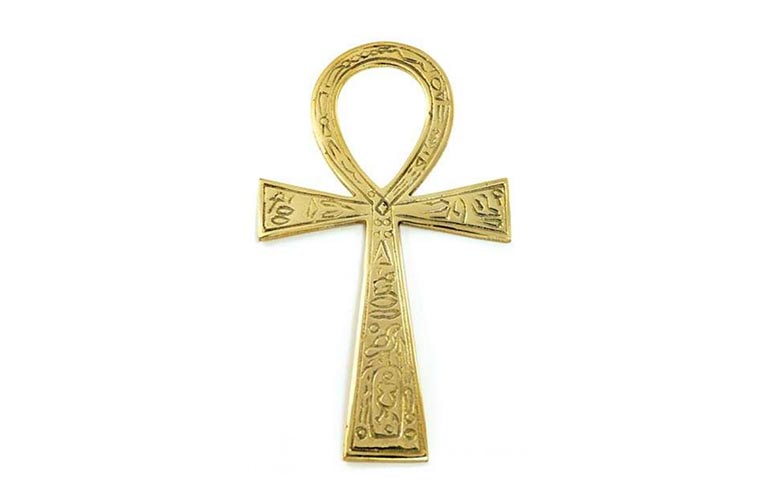
The Ankh
The Ankh represents eternal life. It was often used in Egyptian tomb paintings and other art, and it was associated with the cult of Isis.4 As a form of cross, the Ankh represents conjunction of opposites (positive – negative, superior – inferior, life – death) and spiritual ascension.3
2. ET god symbols: an Egyptian tomb
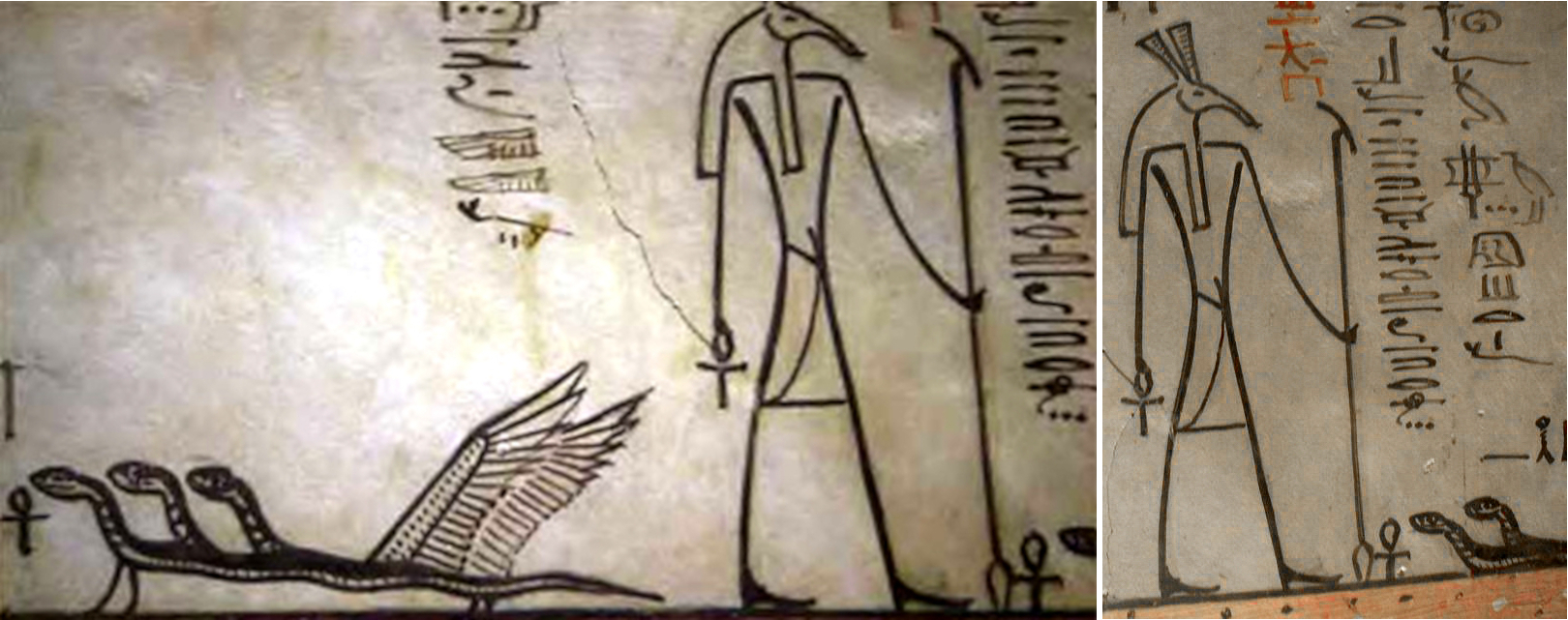
Mural 1. A mural from the tomb of Thutmose III
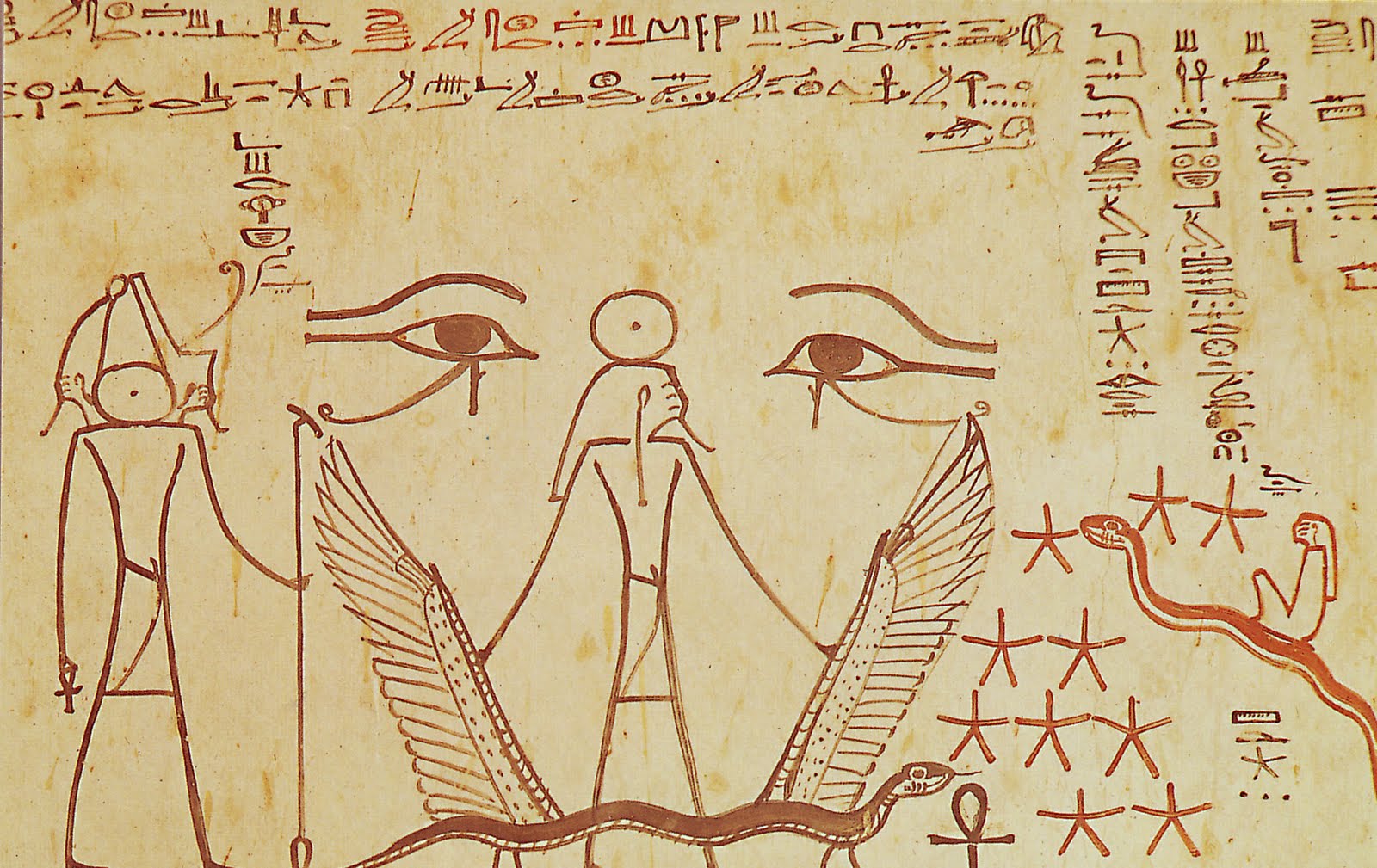
Mural 2. Another mural from the tomb of Thutmose III
Mural 1
Notable features in this image include (a) the representation of Set (identifiable by his head), (b) the Ankh in Set’s right hand (also near his left foot and elsewhere), (c) the ‘Was’ symbol (the staff in Set’s left hand), (d) serpents (snakes approaching Set on the ground, and three winged snakes taking flight to his rear), and (e) a pair of wings (above the snakes’ wings).
Mural 2
Notable features in this picture include (a) Set (identifiable by his ears), (b) the Ankh in Set’s right hand (and elsewhere in the picture), (c) the ‘Was’ symbol (the staff in Set’s left hand), (d) a winged snake whose wings are held onto by Thutmose III, (e) a snake that seems to be flying upward with Thutmose III sitting on its back, (f) a large circle with a dot centre above the head of Thutmose III in the centre of the picture and another such circle behind the head of Set, (g) a large pair of stylized eyes within the space occupied by the person holding onto the snake’s wings, (h) twelve symbols (eleven ‘stars’ with five points and the Ankh) clustered in the area of the snakes’ heads (direction of travel), and (i) symbols directly below the seated person’s feet (from top to bottom): a horizontal rectangle containing seven vertical marks, the Egyptian hieroglyphics symbol for a hemisphere, a ‘star’, and three horizontal dots.
Set, long ears, and the Ankh are discussed above. The remaining symbols of greatest relevance to this article are discussed below. The other symbols referred to in Mural 2 (large circles with dot centres, the eyes, eleven ‘stars’ and the Ankh, and the symbols directly below the seated person’s feet) are discussed in the Appendix.
The ‘Was’
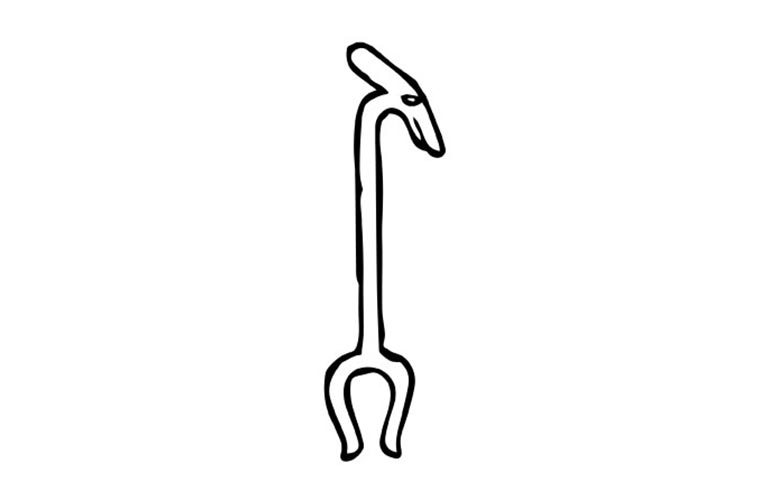
The ‘Was’ symbol
The crooked top of the staff represents the shape of Set’s head. The staff symbolizes power, the dominion of gods, and the continuance of a king’s prosperity.4
3. ET god symbols: Rapa Nui and Tula sculpture
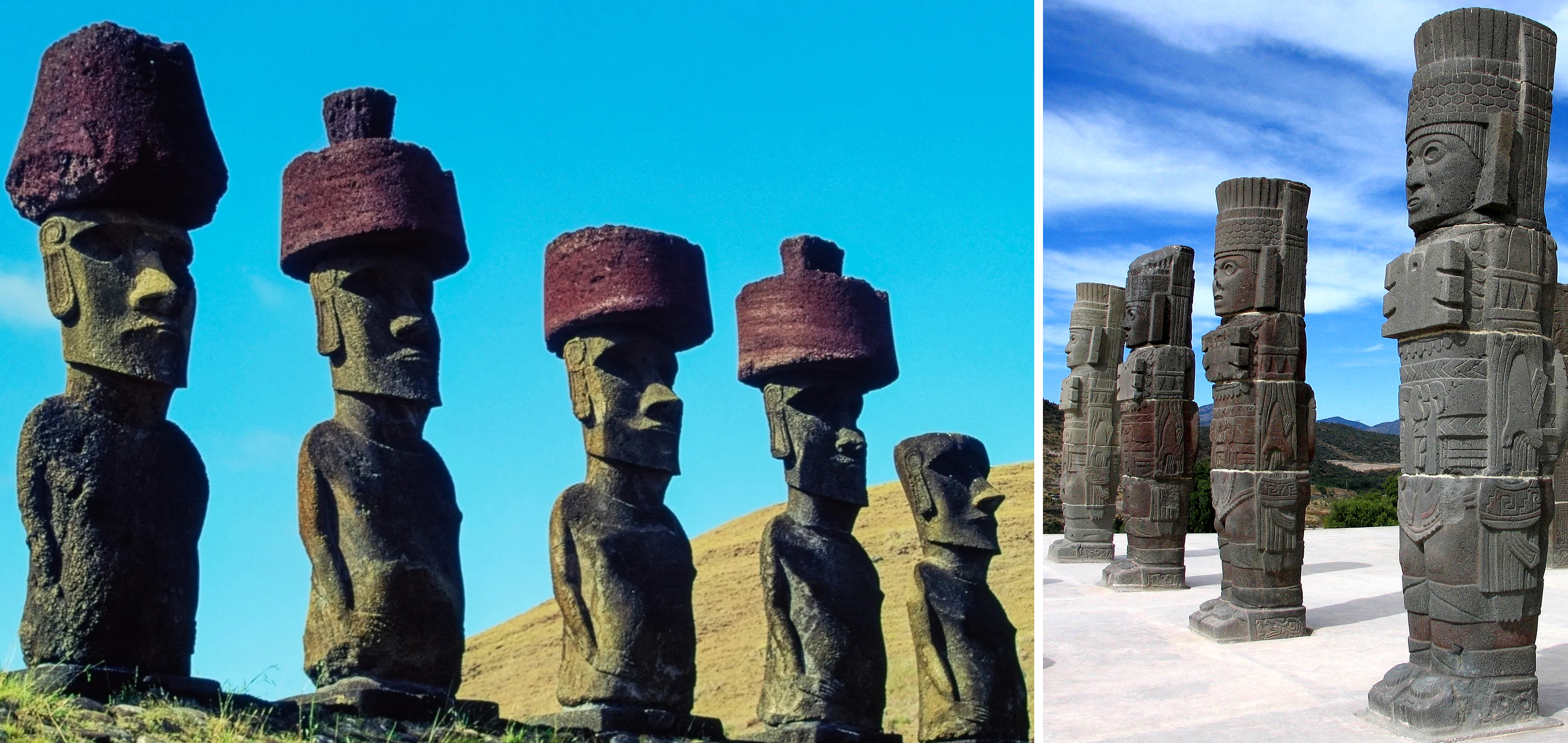
Statues of Rapa Nui and Tula
The monolithic human figures on Rapa Nui (Easter Island) were carved by the Rapa Nui people between the years 1,250 and 1,500 CE.5,6 The massive statues (“Atlantean figures”) in Tula (now the southwest of the Mexican state of Hidalgo) are in what was the ancient capital of the Toltec civilization, which ruled Mexico and flourished from about 850 to 1,150 CE.6
The Rapa Nui and earlier Atlantean figures are similar in that they both show beings with long ears. Further, the rectangular long ears of the Atlantean figures are comparable to the rectangular long ears of Set in the sculpture pictured above.
Alexander Koltypin is eminently qualified to write on this subject. He graduated with honours from the Moscow Geological Prospecting Institute of S. Ordzhonikidze, participated in geological expeditions for fifteen years, published many popular science books, was editor-in-chief for several science magazines, is Director of the Scientific Center of Fundamental Researches in Natural Science at the International Independent University of Environmental and Political Sciences (IIUEPS), is a member of the Academic Council of IIUEPS, a member of the editorial board of the bulletin MNEPU and other scientific works, and for many years Mr Koltypin has collected, analyzed and systematized scientific data on different aspects of the Unknown, with findings that went far beyond the bounds of traditional scientific theories and Internet pseudo-scientific hypotheses.7
Mr Koltypin’s research led him to write as follows in his article Long ears as a sign of divinity (Koltypin, 2010):8
- The only surviving lifetime portraits of Aryan gods are the stone statues of long-eared beings on Rapa Nui. Those statues represent fair-skinned, white-bearded people, with the Aryan straight narrow nose, sharply outlined lips, protruding chins, and red hair (denoted by the red stone pukao — the element placed on top of the statues’ heads).
- The Rapa Nui statues depict Aryan gods who descended to Earth at the end of the Mesozoic Era, i.e. about 66 million years ago. These long-eared white gods were so long-lived that humans saw them as immortal.
- The gods’ lengthened ears represent acute worldly and spiritual hearing.
- Almost all portraits of the white gods and demigods, as well as Buddhist saints, depict them as long-eared, very often with large, weighty earrings.
- Statues, bas-reliefs and images of long-eared white gods (Indra, Varuna, Vishvakarman, Vaishvanara, Virochana and many others, named and unnamed) are found in India, Indochina, China, Polynesia, Melanesia, and South America.
- To humans, the Aryan gods’ long ears were a sign of divinity. The custom of artificially lengthening ears was emulated by humans globally, including the inhabitants of Rapa Nui, the Marquesas Islands, Melanesia, and the ruling caste of the Incas.
- The enormous influence of the Aryan gods on the populations around them can still be seen in humans of today.
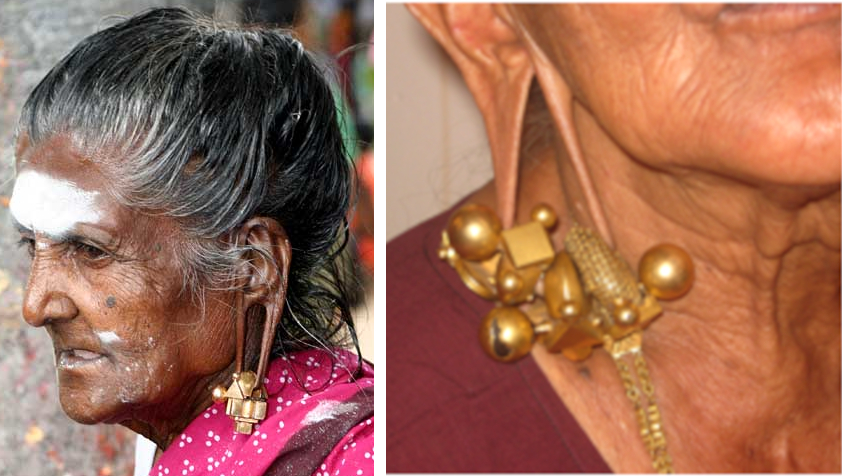
Long ears in India
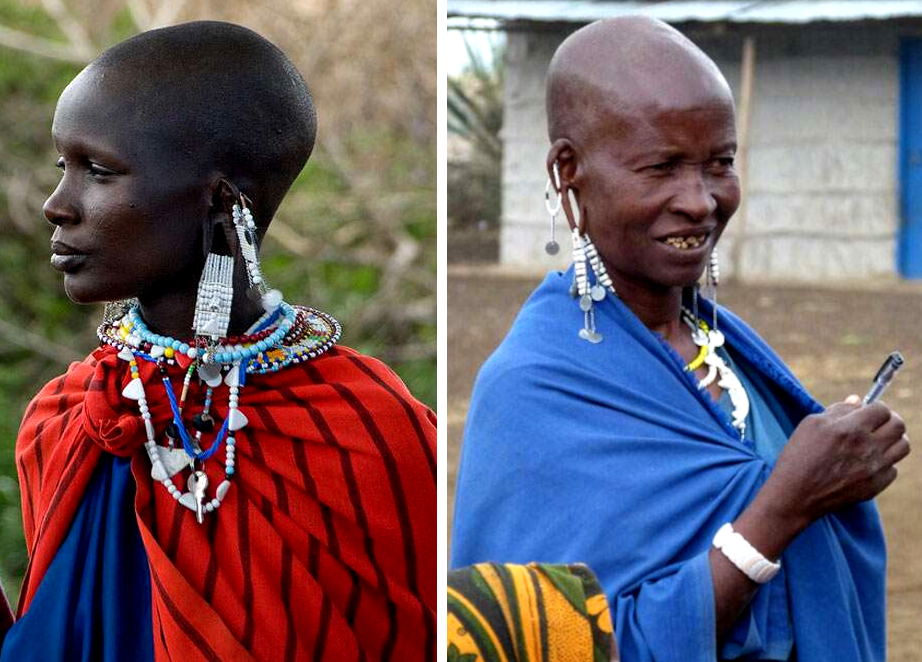
Long ears (and long heads) in Africa
4. ET god symbols elsewhere
Ancient peoples’ sky-god religion is attested to in many aspects of their lives, including their reverence for the snake. As of about 10,000 BCE, various versions of the sky-god religion sprang up around the world and they all associated the snake with gods and ultimately the Anunnaki, although these Aryan ET beings were often known by other names. The Sumerians associated the snake with the Anunnaki gods and the snake is found in legends and religious art in the Ancient Middle East, Egypt, Central Asia, North America, South America, West Africa, and East Africa.9,10,11
4.1 Turkey: Karahan Tepe
At Karahan Tepe (an archaeological site close to Göbekli Tepe, Turkey), a site dated to 11,000- 9,000-BCE,12,13 is art featuring snakes. The prominence of Karahan’s snake art indicates that the snake was especially significant to the local population. Further, the lines of zigzagging avenues of stones on the hill could represent the snake’s descent to the valley below. If so, this would symbolize a snake-like craft descending to Earth from the heavens.14

Carvings of snakes at Gobekli Tepe (L) and Nevali Cori (R)
4.2 Turkey: Gobekli Tepe
As at nearby Karahan Tepe, the snake is the creature most commonly depicted at Gobekli Tepe (‘Potbelly Hill’), a settlement in modern-day Turkey that was inhabited from c. 9,500 to at least 8,000 BCE.14,15 The following symbols are visible in the Gobekli Tepe carving shown above: (a) a relatively large upward-facing top part of a snake (viewed from underneath) that curves forward toward the front of its nose (the hooded snake shape and left eye are clearly visible), (b) an I-shape symbol (below the snake’s jaw-line) that is embodied by the snake, and (c) four smaller snakes below the I-shape. These symbols are discussed below.
- Large snake
The relatively large size and skyward orientation of this snake suggest a supreme god, namely the sky god or sky father known as An (Sumerian) and Anu (Akkadian) of the Anunnaki16 and which is likely represented by the huge face sculpture in the Cydonia region of Mars (image and explanation in the post Family from afar 1: Long-heads of Europe). However, perhaps more likely considering that the smaller snakes seem to be leaving from and returning to the large snake, the large snake represents a mother-ship from which the smaller craft operate. - Symbol I
The symbols H and I are the same basic shape (one is the other turned 90 degrees), H is a double T, and T indicates the connection of below with above and then the Cosmos. To clarify, the T forms half of a cross, with the other half in the spirit world. Many of the Mayan temples have T-shape windows and doorways to represent portals into the spirit world.17 - Four snakes
The four snakes have dome-like heads, similar in shape to that reported in some anti-gravity craft sightings. However, the heads most likely represent disc-shape ET craft with a trail from the sides and rear. Three of the snakes / craft are descending, and one (bottom right) is ascending. As was noted above in relation to the large snake, it seems most likely that these craft are shown leaving from and returning to a mother-ship, represented by the large snake.
This carving represents snake-like ET craft, most likely a mother-ship and smaller craft, that arrived in the vicinity of Earth from the cosmos.
4.3 Turkey: Nevali Cori
Another early example of the culturally important snake was found at the now flooded Nevali Cori, an early Turkish site in Hilvan Province that is dated to 8,400-8,000 BCE. Among the statues and artefacts discovered at Nevali Cori is a life-size stone sculpture of a humanoid head with a snake against the back of the head and the snake’s head against the top of the humanoid head.14 The humanoid head and snake are shown in the image above.
As with the snake symbols discussed above in relation to Gobekli Tepe, it is notable that the shape of the snake’s head is dome-like (as reported in some anti-gravity craft sightings), but the shape most likely represents a disc-shape ET craft with the rear obscured by a comet-like trail. It is also apparent that there are four circles around the perimeter of the snake’s head. Concerning the meaning of these circles, the circle denotes oneness, wholeness, cosmos, the sun, and it can also be associated with the number twelve, e.g. the twelve signs of the zodiac and the twelve major gods of many natural religions.3 In the present context, it seems most likely that the circles refer to the craft’s origin in the cosmos.
Concerning the humanoid head shape, it is notable that the head is narrow with a pronounced ‘occipital bun’. This suggests that the sculpture is of someone with a long head, i.e. the head is dolichocephalic (this subject is discussed in the post Family from afar 1: Long-heads of Europe). This head shape of an apparent god is interesting in view of other evidence (the long skulls of people who were apparently close descendants of the Aryan gods) indicating that the gods had long heads and bigger brains than humans of today.
Due to its close association with a snake (especially a snake with an ET craft-shape head with circles suggesting a cosmic origin, and what looks like a long-head humanoid), this sculpture represents an ET god, specifically an Aryan god of the ET race known as the Anunnaki.
4.4 Mexico
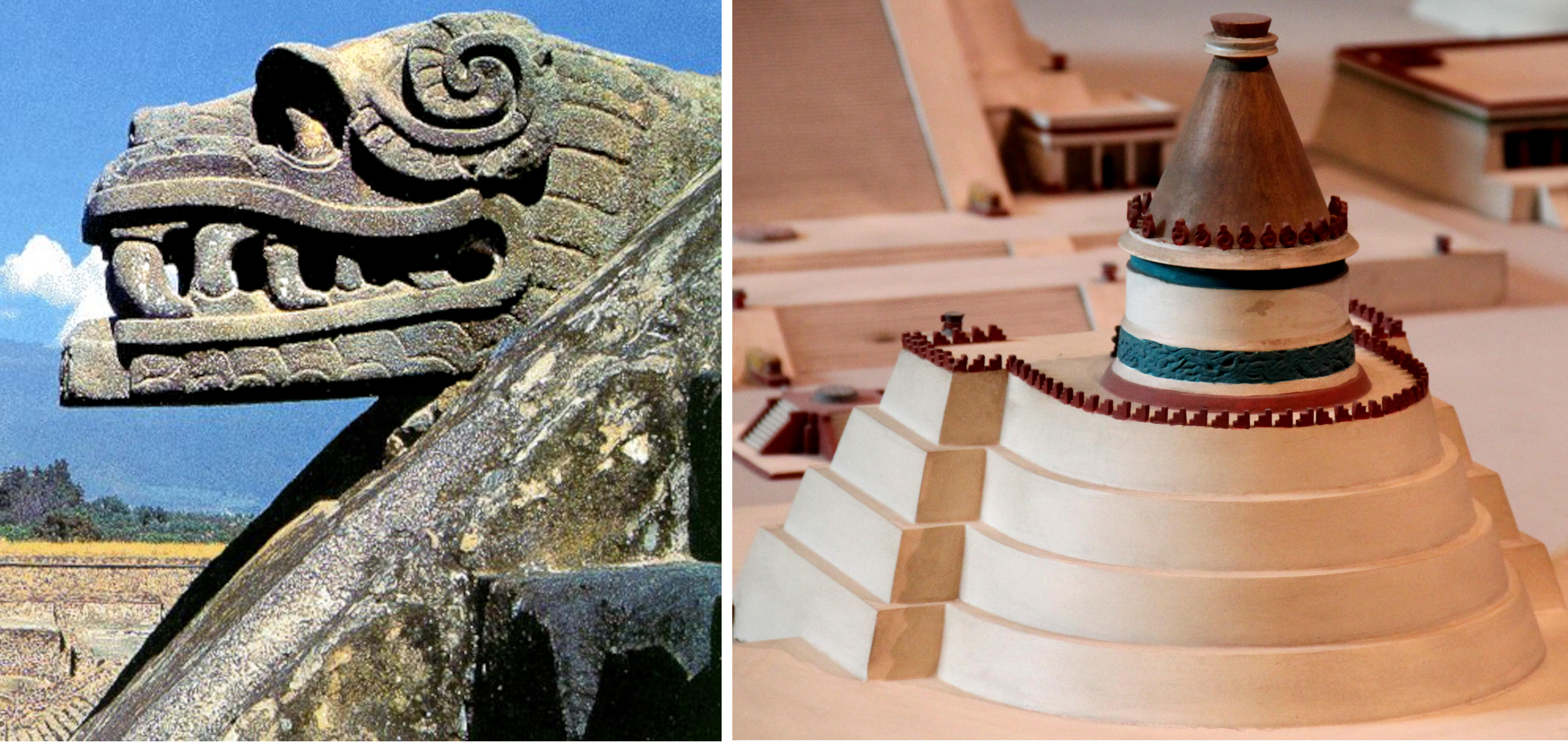
L Temple of the Feathered Serpent in Teotihuacan, R Model of Quetzalcoatl’s temple in Tenochtitlan
The Temple of the Feathered Serpent is in Teotihuacan, Mexico, and the model is of Quetzalcoatl’s temple in Tenochtitlan, Mexico.
The name Quetzalcoatl means “the feathered serpent” and according to the Aztecs (a civilization that flourished in central Mexico from 1,300 to 1,521 CE) Quetzalcoatl is a white, white-robed, bearded man who carries a sceptre, and he will return when a comet is seen in the heavens.11
Quetzalcoatl’s ‘sky/serpent temple’ in Tenochtitlan (shown as a model above) was an Aztec representation of a space craft. It was in the form of a cylinder on a pyramid base with its entrance in the shape of a snake’s open jaws. When the Aztecs celebrated the god Quetzalcoatl, the priest or person representing him emerged before the congregation of worshippers from a ‘flying, circular object’ which had long ago been seen as a snake flashing across the sky.11
This flying object-snake association is consistent with the name for comets in Mexico: in Mexico comets were called ‘flaming serpents’.11 This flying object-snake association is also evident in the Bible (Isaiah 14:29): “Rejoice not thou, whole Palestina, because the rod of him that smote thee is broken: for out of the serpent’s root shall come forth a cockatrice [a serpent hatched from a cock’s egg and having the power to kill by its glance], and his fruit shall be a fiery flying serpent.” (King James Bible)
4.5 Bolivia

The Gate of the Sun in Tiwanaku
The Gate of the Sun is a monolithic gateway at the site of Tiwanaku in Bolivia where an Andean civilization of Bolivia thrived around Lake Titicaca from about 500-950 CE.18 However, the Gate of the Sun has been dated to 300 or 200 BCE or possibly about 110 CE.19,20,21,22 The above images show a full front view of the gate, a section of the gate with the god and some surrounding features, and an artist’s illustration that shows details of that section more clearly.
The Gate of the Sun is the best-known surviving example of a solar structure. It features carvings of deities and astronomical symbols of the Tiwanaku pantheon. The gate is part of a greater astronomical complex with massive stone pillars and ruined buildings, all aligned to the June and December solstice sun rise and set.23
The central figure is most likely the Inca god Viracocha or a deity who evolved into him.23 Viracocha was the supreme god of the Incas, the father of all other gods, and he created the earth, sun, moon, planets, heavens, stars and all living beings. Viracocha was typically described as a tall, white, bearded man who wore a long white robe and and carried a staff.23,24 Like the Aztecs, it seems that the Incans linked this god to the snake. In the Serpent Temple at Cassamarca (in the northern highlands of Peru) there was a stone snake, there were effigies of snakes on many Incan buildings, Viracocha was depicted holding twin snake staffs, and in the gardens of Cuzco’s (a city in southeastern Peru) sacred Coricancha temple, there are carved effigies of a snake, a condor, and a puma.11
On the gate this man is radiating 24 linear sun-rays and holding two downward-pointing twin snake ‘staffs’. To the sides of the man are 48 carved squares, each containing a winged character, 32 with human faces and 16 with condor heads.23
The rectangular area
The vertical sides of this large rectangular area are indicated by the twin snake ‘staffs’. Within this area we can see:
- From above all the other visible symbols, the god is descending by means of the downward-pointing (the snake heads are pointing toward the earth) snakes (associated with ET craft and gods, as explained earlier) onto which he is holding.
- The man’s head is enveloped by headgear such as might be worn by an astronaut.
- Like the sacred number 12 featured in the number (12 x 2 = 24) of rays from his head, the number 12 is also featured in the temple-like structure onto which he is descending. Within that structure (an implied square as lines drawn vertically downward from the edges of the top line form a square) are 12 creatures: 6 snakes (3 on each side), 4 human-like figures (2 on each side on the highest level), and 2 creatures within the inner square.
The meaning of the number twelve, which occurs three times within the rectangle (and another four times in the 48 carved squares and winged characters outside the rectangle), is practically identical to that of a circle, which denotes oneness, wholeness, cosmos, and the sun.3 In the present context, the number 12 (associated with the circle and sun) is consistent with the purpose of the gate as a solar structure and the sun-rays from the god’s head.
Rectangles and squares. There are many rectangles and squares featured on the gate. This includes the large rectangular area referred to above and the two squares comprising the temple-like structure below the god. As was noted above, the square, or where necessary the rectangle, corresponds to the cross formed by the four cardinal points (north, south, east, west) and represents the conjunction of opposites (positive – negative, superior – inferior, life – death) and spiritual ascension.3 The cardinal points represented by the square / rectangle is consistent with the astronomical alignment of the gate and the spiritual significance of the cross is consistent with the spiritual importance of this god.
Outside the rectangular area
The god is shown descending into the midst of 32 winged characters with human faces and 16 winged characters with condor heads. The beings are kneeling toward the god in postures of reverence.
Since antiquity, birds and wings have been used to denote flight and also beings from another world. Winged gods are featured in Assyrian religious art and in Christianity angels are always depicted with wings. In particular, across the Northern Hemisphere and North America, the eagle was associated with gods; in South America, the condor was a companion of the Aryan god Viracocha; there is a huge image of a condor among the mystical drawings in Peru’s Nazca Desert;25 and in Sumerian and ancient Egyptian religion, wings represent gods’ ability to fly.16,26 In the case of funerary art, in ancient Egypt wings symbolize the journey of the soul, the afterlife, and protection by the goddess Isis, who was often shown with wings spread out to indicate her ability to fly and protect souls of the dead.26
In the context of the Gate of the Sun, the meaning of wings is consistent with the arrival of a being from another world and the condor in particular is a companion of the Aryan god Viracocha.
In essence, although this information-rich solar structure offers the opportunity for more detailed interpretation, the Gate of the Sun shows an extraterrestrial Aryan god arriving on Earth.
4.6 Mesoamerica: Mayans
Kukulcan is a prominent Aryan god in Mayan religion (the Maya civilization arose in antiquity and ended in 1697 CE). As with the name Quetzalcoatl (the Aztecs’ Aryan god), Kukulcan means “the feathered serpent.” Kukulcan is a snake in his natural form but he can transform into an Aryan man with long white hair standing about 6 feet tall. Mayan writing and sculptures portray Kukulcan as a thoroughly European-looking man. Kukulcan civilized the Mayans by teaching them subjects including agriculture and medicine.27
4.7 Other
In Africa snake worship is as old as the hills. For example, among the West African Ashanti there are sky-god snake legends that are very similar to those of Central America25 and the Lebe or Lewe (fr. Lébé), a primordial ancestor of the Dogon tribe, arose from a serpent.28,29
Leonard Farra (2014, The mystery of serpent worship)11 provides more information about the association of snakes and gods in various cultures.
5. References
- Hill, J. (2008). Set (Seth), Ancient Egypt Online.
- te Velde, Herman (1967). Seth, God Of Confusion: A study of his role In Egyptian mythology and religion, Brill academic pub, translation by Mrs. G.E. van Baaren-Pape.
- Cirlot, Juan E. (1962, extensively revised in 1971). A dictionary of symbols.
- Cleopatra Egypt Tours (2021). Important ancient Egyptian symbols and their meanings.
- Fischer, Steven R. (2005). The island at the end of the world, London: Reaktion.
- Sutherland, A. (2020). Obscure history of Atlantean statues in ancient Toltecs’ city of Tula, Ancient Pages.
- Koltypin, A. His Books and Website on the “Unknown” – Earth before the Flood: Disappeared Continents and Civilizations.
- Koltypin, A. (2010). Long ears as a sign of divinity.
- Farra, Leonard (2012). The Ancient astronauts and a new history of man.
- Farra, Leonard (2012). Extraterrestials, the Flood and the Giants.
- Farra, Leonard (2014). The Mystery of Serpent Worship.
- Demirören news agency (2020). New Karahan tepe settlement may be older than Göbekli tepe, Daily Sabah, 27 Nov 2020.
- Thomas, Sean (2022). Is an unknown, extraordinarily ancient civilisation buried under eastern Turkey?, Spectator Magazine, 8 May 2022.
- Farra, Leonard (2015). My thoughts about Gobekli Tepe.
- Breuers, J., & Kinzel, M. (2022). Tracking the Neolithic in the Near East. Lithic Perspectives on Its Origins, Development and Dispersals, In Nishiaki, Y., & Maeda, O. (2022), The Proceedings of the 9th International Conference on the PPN Chipped and Ground Stone Industries of the Near East, Tokyo, 12th–16th November 2019.
- Wilkin, Stanley (2019). Jesus and Bel Christianity and the Continuation of Paganism.
- Tartaria tablets (2021). Symbols T, H, I close meanings in Gobekli Tepe and Mesoamerica /South-West North-America.
- Stone-Miller, Rebecca (1996). Art Of The Andes, New York: Thames & Hudson
- Marsh, Erik (2012). A Bayesian re-assessment of the earliest radiocarbon dates from Tiwanaku, Bolivia, Radiocarbon, 54 (2), 203–218.
- Browman, David (1980). Tiwanaku expansion and economic patterns, Estudios Arqueológicos, 5, 107–120.
- Janusek, John (2003). Vessels, time, and society: Toward a ceramic chronology in the Tiwanaku heartland, In Kolata, Alan (ed.). Tiwanaku and its hinterland: Archaeological and paleoecological investigations of an Andean civilization, 2, 30–89.
- Stanish, Charles (2003). Ancient Titicaca, Los Angeles: U of California Press.
- Cowie, Ashley (2016). Unearthing the Inca’s lost sun path, 22 Dec 2016.
- Farra, Leonard (2014). Machu Picchu’s E.T Connection.
- Farra, Leonard (2014). ETs and a new history of early civilised man.
- Seti (2023). Unlocking The Symbolic Meaning Of Wings: Exploring Their Spiritual And Cultural Significance.
- Farra, Leonard (2012). Alien Contact – Fact or Fiction?
- Heusch, Luc de (1985). Sacrifice in Africa: A Structuralist Approach, (trans. Linda O’Brien, Alice Morton), Manchester U Press.
- Imperato, Pascal James (1978). Dogon Cliff Dwellers: The Art of Mali’s Mountain People, Kahan Gallery.
6. Appendix
The Mural 2 symbols referred to that were not discussed above are explained below.
Large circle with dot centre
This symbol is above the head of of the person (Thutmose III) in the centre of the picture and also behind the head of Set.
The circle denotes Heaven, oneness, wholeness, cosmos, the All, eternal order, eternity, continuity, cyclic processes, stability, the sun. The point within the circle represents the mystic Centre — the starting-point and finishing-point of all things.1
The eyes

The eye of Ra and the eye of Horus
This symbol is within the space occupied by the person (Thutmose III) holding onto the serpent’s wings.
The right eye is known as the Eye of Ra (sun god), it symbolizes the sun, and it represents divine perception, divine providence, and the eternal cycle of life. The left eye is known as the Eye of Horus (sky god who has the head of a falcon), it symbolizes the moon, and it represents divine perception, protection, healing, and wisdom. The eyes are often depicted in the curved shape of a falcon’s eye, with the eyeliner extending beyond the eye socket.2,3
The eye symbol was used in rituals and ceremonies to invoke the protective power of the gods. In particular, the Eye of Horus was used in funerary art to guide the soul of the deceased to the afterlife. As a symbol of healing, the Eye of Horus was associated with the goddess Sekhmet (goddess of healing and medicine) and used in medical practices and rituals.2,4
Eleven ‘stars’ and the Ankh
These twelve symbols are clustered in the area of the snakes’ heads (direction of travel) and the eleven ‘stars’ have five points.
Odd numbers and their geometric forms (e.g. triangle, pentagon) indicate dynamism; the number five in particular corresponds to the five Elements (four material Elements + spirit or quintessence) and it denotes love, health and humanity. Further, the number five is analogous with the human figure (four extremities + head).1
In the present context, this symbol most likely represents a 5-point star. The 5-point star was used in Mesopotamia since at least 2,500 BCE. The five points represent the five elements: earth, air, water, fire, and spirit. This star was associated with the Sumerian goddess Inanna in her role as the queen of heaven and it symbolized her divine authority and power.3
Concerning the number twelve (twelve symbols), it is suggested that after the numbers three (triangle) and four (square), the next most important numbers are seven (their sum) and twelve (their multiplication).1 The number twelve is associated with the circle (cosmic order). The importance of this number is indicated by examples such as the twelve signs of the zodiac, hours on the clock-face, months of the year, and major gods of many natural religions.1
Symbols below the seated person’s feet
These symbols are directly below the seated Thutmose III’s feet (from top to bottom):
A horizontal rectangle containing seven vertical marks
The Egyptian hieroglyphics symbol for a hemisphere
A 5-point ‘star’
Three horizontal dots
Rectangle containing seven marks
The square, or where necessary the rectangle, corresponds to the number four and a cross formed by the four cardinal points (north, south, east, west) and it represents the conjunction of opposites (positive – negative, superior – inferior, life – death) and spiritual ascension.1
The number seven is the sum of the square (4) + triangle (3), with the number three represented by the three dots at the base of these symbols. The significance of the number seven is shown by examples such as the seven colours of a rainbow, days of the week, notes of the diatonic musical scale, and directions of space.
Symbol for a hemisphere
In Egyptian hieroglyphics the symbol for a hemisphere (a semicircle with the diameter as the base) refers to the sun’s orbit. It symbolizes the Origin counterbalanced by the End, or birth counterbalanced by death. In the present context, the symbol most likely refers to the end of Thutmose III’s life in this world.
A 5-point ‘star’
As was noted above in relation to the eleven ‘stars’, this symbol most likely represents a 5-point star. The 5-point star was used in Mesopotamia since at least 2,500 BCE. The five points represent the five elements: earth, air, water, fire, and spirit. This star was associated with the Sumerian goddess Inanna in her role as the queen of heaven and it symbolized her divine authority and power.3
Three horizontal dots
The triangle and the corresponding number three represents spirit, spiritual synthesis, and communication between the material world and heaven.1 The position of the three horizontal dots at the base of the symbol formation below the seated Thutmose III’s feet is consistent with what is now known as the primacy of consciousness (the primacy of spirit).
In essence, the combined meanings of the symbols discussed in the body of this article and in this appendix can be summarized as follows in relation to the murals: The two murals in the tomb of Thutmose III record the departure of his soul to eternal life with Divine guidance and support.
Appendix references
- Cirlot, Juan E. (1962, extensively revised in 1971). A dictionary of symbols.
- Seti, (2023). The fascinating history and symbolism behind the Egyptian eye symbol, Shunspirit, 26 Jul 2023.
- Seti (2023). The intriguing meaning behind the eye of Ra symbol, Shunspirit, 23 Jul 2023.
- Cleopatra Egypt Tours (2021). Important ancient Egyptian symbols and its meanings.


 Toward the Light