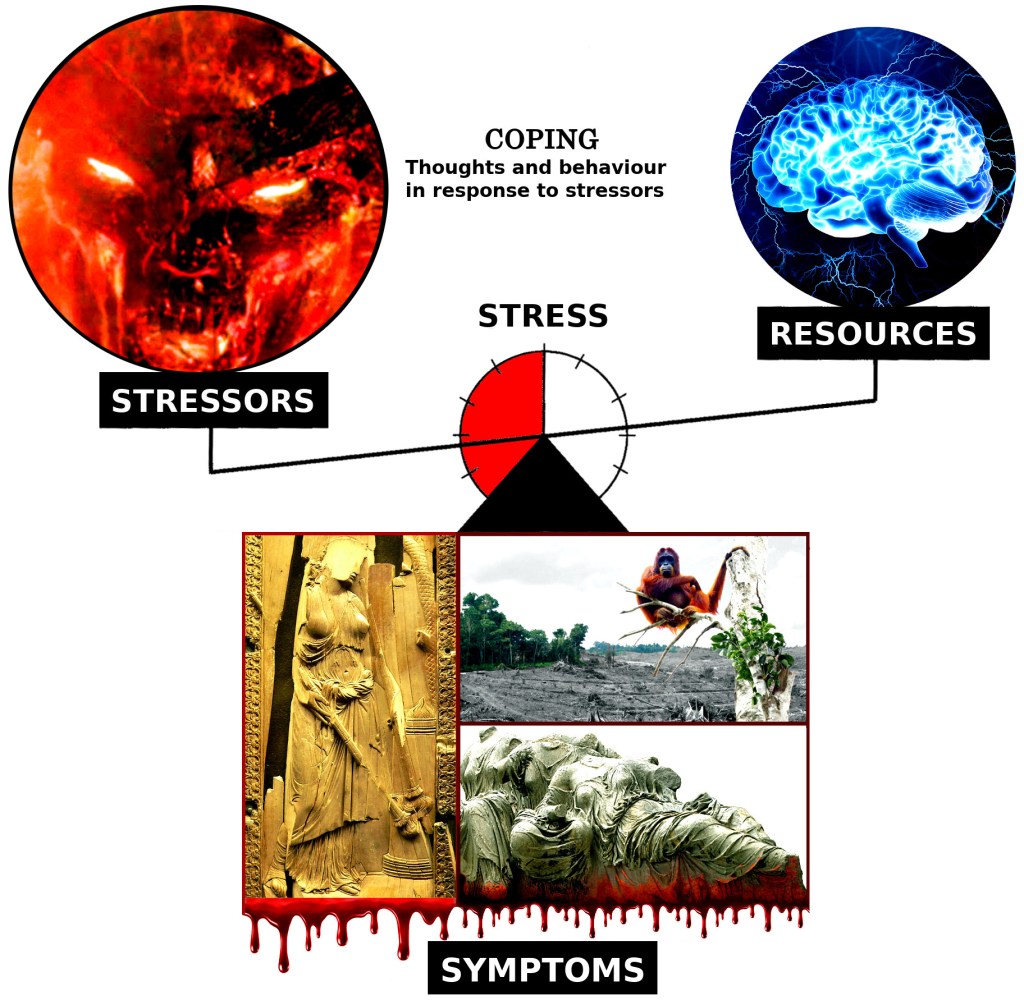
A simplified version of the predominant model of stress and coping in psychology
The subjects addressed on this site can be helpfully conceptualized within the predominant model of stress and coping in psychology.
Stress and Coping
The predominant model of stress and coping in psychology acknowledges four categories:
- Stressors (situations, problems), e.g. global cooling, resource scarcity, excessive human population and per capita consumption, accelerating mass extinction of species (Holocene extinction), societal decay and collapse, Jew persecution of non-Jews.
- Coping (thoughts and behaviour in response to stressors), e.g. denial, blaming, acceptance, efforts to try survive.
- Outcomes, e.g. stress, stress-related symptoms, illness / death, mass human die-off, including from the Jew attacks. Stress occurs when the demands of stressors tax or exceed coping resources.
- Coping resources, e.g. health; social support (including racial cohesiveness, and potentially the support of benevolent ETs); knowledge / skill; personality factors (e.g. intelligence, creativity, hardiness); spirituality; and material resources (including the natural environment).
Coping resources are also referred to as moderator variables (they moderate the relationship between stressors and outcomes), vulnerability factors, or resilience factors.
Naturally these four categories are interrelated, e.g. illness can be an outcome, stressor, and it can mean reduced coping resources. Same for the loss of a supportive interpersonal relationship and many other factors that can occur in several categories.
Effective coping
Effective coping reduces stress by principles articulated in the Serenity Prayer, including this Mother Goose rhyme version:
For every ailment under the sun
There is a remedy, or there is none;
If there be one, try to find it;
If there be none, never mind it.
For situations that are changeable effective coping involves efforts to change the situation (problem-focused coping), e.g. financial stress can be reduced by leading a simpler lifestyle, work stress can be reduced by changing jobs, societal stress can be reduced by serving justice on the gangsters controlling our societal levers, ecological collapse can be mitigated by nature conservation efforts.
For situations that are not changeable (e.g. permanent disability, loss of a loved one, terminal illness) effective coping involves efforts to reduce the severity of stress (emotion-focused coping), e.g. catharsis (releasing emotions through talk, crying, laughter, music, writing, art), spiritual activities (meditation, being in nature), social support (being with friends who understand, accept and love us). Concerning social support, even just one close confiding relationship can substantially improve coping during times of stress.
Changeable or not changeable?
The first step in effective coping is accurate assessment of the situation and the extent to which it is changeable. Processes that are beyond human control include those of the solar system, the cycle of ages in Hindu cosmology, glacial / inter-glacial periods including our current descent into a glacial period (discussed in posts on the Nature page), geological ages, and the spiritual principle of cause and effect (aka Karma, Örlög, Wyrd, God’s immune system) to which we are all subject. For example, God is reacting to humans’ destruction of His creations (the ecological catastrophe known as the Holocene extinction, a subject also discussed in the post Revenge in realms of Death).
In contrast, among the many ways in which we can influence our future to some extent are our choice of religion (e.g. anti-life Abrahamic religion vs pro-life natural religion), lifestyle (e.g. destructive consumerism vs Nature/God-conscious living) and politics (e.g. submitting to our attackers vs removing them from power by means that include support for leaders who stand for truth, life and justice).
Our dire societal situation is changeable, it is changing for the better, and it’s changing fast.
The positive change
Consistent with information online, within the peak of Solar Cycle 25, among my relatives, friends and acquaintances, I’ve seen a dramatic awakening to the psychopathic conduct of organized Jewry and their stooges. This includes the psychopathic nature of Judaism as stated in their holiest book (Talmud) and by rabbis, the Christ-Con, Climate-Con, Covid-Con, Conflict-Con, Central Banking-Con, and other cons including the “Holocaust” lie that has been exposed as Jew fiction, including by court-accepted expert evidence in the German trial of Ernst Zündel. This awakening includes understanding of why Jews have been expelled from civilized societies on more than 1,030 occasions across their history.
The Nine Noble Virtues
In many ways, effective coping involves living in the truth of The Nine Noble Virtues. Following are extracts from The Nine Noble Virtues, formulated from texts of ancient European paganism. This is powerful stuff, especially when we consider that European paganism can be traced to Anunnaki teachings in ancient Sumer that are also represented in the universal symbolism of the D&M Pyramid on Mars (a picture of the D&M Pyramid is in the post The Oera Linda Book: Explosive power for Aryans). People such as Adolf Hitler (privately he was essentially pagan and intensely opposed to Judaism and Christianity) who represent our highest ideals, live in the truth of The Nine Noble Virtues.
Truth
- Truth is the principle of holy realization.
- It steels us in our courage.
From the Hávamál:
I counsel you second; swear no oath
But what you mean to abide by.
A halter awaits the word breaker,
Villainous is the wolf-of-vows.
Courage
- Courage is the bravery to do what is right.
- Courage sustains our Being.
From the Hávamál:
The coward believes he will live forever
if he holds back in the battle.
But in old age he shall have no peace
though spears have spared his limbs.
Honour
- Honour is of noble being, our worth in the community.
- Our deeds attest to our honour.
From the Eddic poem Sayings of the High One:
Cattle die, kinsmen die
one day you yourself shall die
but the reputation of the dead never dies.
Fidelity
- Fidelity is loyalty to our gods, folk, self and friends.
- Vengeance for harming a kinsmen is not just a virtue, but an obligation.
From the Hávamál:
If you find a friend you fully trust
And wish for his good-will,
exchange thoughts,
exchange gifts,
Go often to his house.
Self-discipline
- Self-discipline favours fidelity.
- It helps us to achieve our purposes.
From the Hávamál:
Early shall he rise who rules few servants,
And set to work at once.
Much is lost by the late sleeper,
Wealth is won by the swift.
Hospitality
- This is sharing with our folk when they are guests in our home.
- It establishes and reaffirms bonds of friendship and kinship.
From the Hávamál:
Fire is needed by the newcomer
Whose knees are frozen numb.
Meat and clean linen a man needs
Who has fared across the fells.
Industriousness
- This is working hard and efficiently.
- It favours achievement of our goals.
From the Hávamál:
Cattle die, kindred die,
Every man is mortal:
But the good name never dies
Of one who has done well.
Self-reliance
- This is the spirit of independence of the individual, family, clan, tribe and nation.
- It ensures that we can take care of ourselves first, then family and loved ones, then the extended family, the tribe and the nation (all true folk).
From the Hávamál:
One’s home is best, though small it be
To each home is hall.
The heart bleeds in the beggar who must
Ask at each meal for meat.
Perseverance
- Perseverance is standing up and returning from defeat.
- If our purpose is true, we continue until successful.
From the Hávamál:
May the halt [one who is lame] ride a horse
and the handless be herdsman,
the deaf man may doughtily fight,
a blind man is better than a burn one [on fire] ay;
of what gain is a good man dead?
Dedication
All posts on this site are dedicated to men and women of noble virtues.

The Anunnaki are commonly depicted with wings, and the concept of winged angels can be traced to the Anunnaki (Stanley Wilkin, 2019, University of London, Jesus and Bel Christianity and the Continuation of Paganism)
 Toward the Light
Leave a comment